Roadmeow takes a different approach from a technical roadmap. It serves more as a community content calendar, organizing the flow of storytelling and dissemination activities. By first understanding Cash Cat (CASHCAT) and its project positioning, then examining Roadmeow, you can more clearly see its growth logic. As a culturally driven meme token, CASHCAT does not emphasize functional utility, making its communication framework a key entry point for understanding how the project collaborates.
What Role Does Roadmeow Play Within the CASHCAT Ecosystem?
Roadmeow is not a list of functional milestones; it is a framework for advancing the narrative. It organizes the project’s main themes, social media activities, and community engagement methods by stage, helping participants quickly identify what to say, do, and share at each point. This design is perfectly suited to meme assets: when a project does not rely on complex product features, staged storytelling becomes the foundation for collaboration.
The name Roadmeow itself carries a meme-like tone, signaling that it should not be interpreted as a traditional software delivery checklist. It is more akin to a “communication rhythm chart”: each stage aligns with specific topic templates, visual assets, and interaction models. For creators, it lowers the cost of topic selection; for observers, it serves as a reference point for whether discussions remain focused on the same narrative. Understanding this helps avoid mistaking stage slogans for actual feature launch promises.
How Is Roadmeow Different From a Technical Roadmap?
A technical roadmap answers, “When will the product be delivered, and how will features iterate?” Roadmeow, on the other hand, answers, “How should the community tell its story and coordinate dissemination at each stage?” Both are called roadmaps, but they serve entirely different purposes: the technical roadmap targets engineering and product, while Roadmeow targets content and community.
| Dimension |
Roadmeow (Communication Roadmap) |
Technical Roadmap |
| Core Objective |
Organize narrative and content pacing |
Organize feature delivery and version iteration |
| Main Output |
Topic templates, meme assets, social media actions |
Feature modules, protocol upgrades, product milestones |
| Success Signals |
Consistent retelling, cross-platform reach, symbolic memory |
Feature availability, performance benchmarks, version releases |
| Failure Modes |
Narrative drift, content fatigue, unfocused discussion |
Delays, defects, compatibility issues |
This comparison makes it clear: treating Roadmeow as a technical delivery commitment leads to misaligned expectations. For meme-centric projects like CASHCAT, it is more appropriate to see Roadmeow as a communication guide, not an engineering schedule. You can further explore these differences in the CASHCAT vs Typical Meme Coin article, especially regarding community strategies.
How Does CASHCAT’s Staged Communication Unfold?
On the official site, the stages are summarized as: Wake up, Meme, Rebrand Narrative, and Valhalla. Each stage features clear language templates and visual focal points. While not strictly linear, this sequence helps sustain ongoing discussion.
| Stage |
Objective |
Typical Content Actions |
| Wake up |
Activate core meme |
Explain Cash Cat’s origin and naming story |
| Meme |
Amplify visibility |
High-frequency short posts, remixes, cross-platform sharing |
| Rebrand Narrative |
Strengthen identity conflict |
Character-driven copy, interactive memes, expressions of belonging |
| Valhalla |
Cement symbolic memory |
Community identity tags and commemorative expressions |
The core value of this staged approach is repeatability: each stage can be executed independently by community members. Wake up clarifies the origin story; Meme amplifies the visibility of short phrases and images; Rebrand Narrative turns character conflict into identity play; Valhalla cements symbols as lasting community tags.
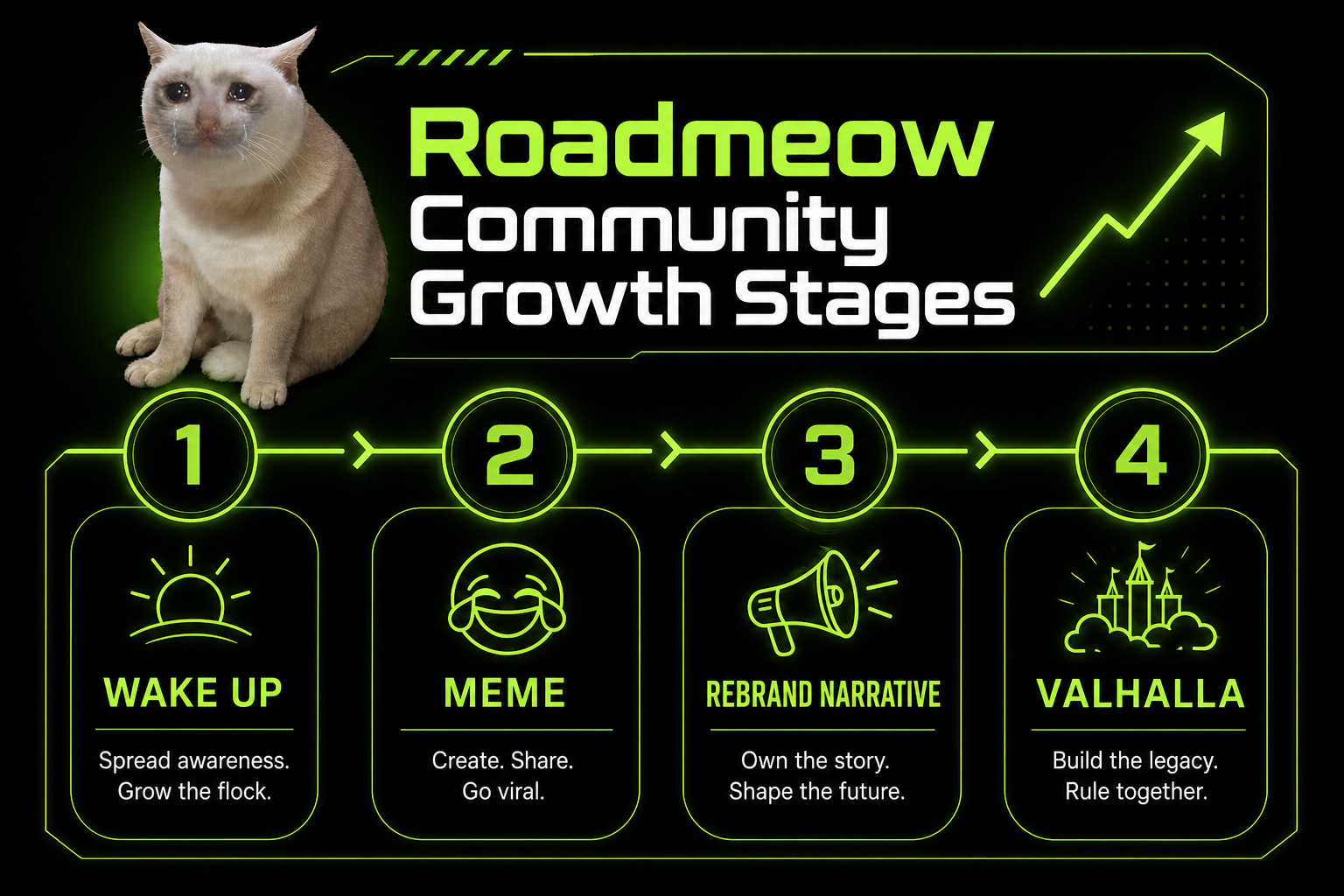 Figure 1. CASHCAT Roadmeow four-stage community growth model: from meme origin to cemented symbolic memory.
Stage names are part of the communication language, not on-chain state machines. Different platforms may be in different “perceived stages” at the same time, but as long as the core narrative remains stable, Roadmeow continues to coordinate content direction. If discussions stray far from Cash Cat’s origin or the Robinhood Chain context, it signals that template constraints are weakening.
Content templates drive community collaboration efficiency. CASHCAT’s templates typically revolve around “origin meme + cat imagery + Robinhood Chain affiliation”—simple and easy to replicate. The clearer the template, the easier it is for members to create quickly and maintain a consistent tone. For meme projects, templates serve as the shared grammar that reduces friction in collaboration.
Templates can be broken down into three layers: factual core (origin story, contract entry, consistent public parameters), expressive core (reusable short phrases, visual symbols, character tone), and interactive core (questions, meme responses, tag-driven participation). Excessive repetition may cause narrative fatigue, so it’s important to keep the core narrative stable while continuously updating expression formats. On-chain operations are not part of Roadmeow’s functional delivery, but can be understood alongside the CASHCAT Participation Process: storytelling clarifies the narrative, while process reduces operational errors.
What Practical Value Does Roadmeow Offer Participants?
For everyday participants, Roadmeow provides a minimal framework for understanding the stage context. Origin explanations align with Wake up; frequent remixes and short posts with Meme; more character-driven identity expression with Rebrand Narrative; and commemorative tags with Valhalla. This framework isn’t for price prediction, but for assessing whether information remains focused on the main narrative.
For creators, Roadmeow offers topic prompts and boundaries; for researchers, it serves as a barometer for community activity, measuring coverage, consistency, and stage transitions. For risk-conscious participants, it’s a reminder: public narratives focus on cultural dissemination, not protocol revenue. When evaluating, keep communication efficiency and information verification separate. For parameter analysis, refer to CASHCAT Tokenomics; for risk assessment, see CASHCAT Risks and Limitations.
How Do You Know If Roadmeow Is Still Effective?
To judge Roadmeow’s effectiveness, focus not on slogan updates, but whether community content is still organized around the same narrative. Use these three qualitative indicators: discussion coverage, content consistency, and continuity of stage transitions.
| Observation Indicator |
Meaning |
Healthy Signal |
Red Flag |
| Discussion Coverage |
Are multiple platforms producing content around the same narrative? |
All platforms echo the core meme |
Fragmented discussions, narrative lost |
| Content Consistency |
Are the origin story and key facts stable? |
Key statements can be cross-verified |
Key facts distorted by remixes |
| Continuity of Stage Transitions |
Does content progress from awakening to cementing? |
Forms evolve but narrative remains stable |
Only spamming, no symbolic consolidation |
These are communication system indicators, not performance metrics. They help distinguish “active but unfocused” from “well-coordinated community collaboration.” If coverage is broad but retelling drifts, templates have lost their grip; if retelling is consistent but forms never change, narrative fatigue may set in.
What Are the Advantages, Risks, and Limitations of the Roadmeow Model?
Advantages: rapid communication launch, unified templates, low barriers to collaboration. Staged storytelling lowers the learning curve for new members and helps cross-platform content build strong brand memory. For meme-centric projects, this structure is a better fit than a complex product roadmap.
Risks: heavy reliance on social media sentiment—if sentiment turns, communication efficiency can drop quickly. Fake accounts, staged update forgeries, and packaging slogans as feature promises all increase information noise. Limitation: without functional milestones, sustainability depends on community self-organization and content output; too rigid templates stifle innovation, too loose templates cause narrative drift.
In summary, Roadmeow is best used as a communication guide, not as a feature delivery commitment. Participants should still verify information sources, contracts, and minimize authorizations—don’t treat stage slogans as proof of security.
Summary
Roadmeow illustrates how CASHCAT, as a narrative-driven meme project, fuels growth: it organizes community content production through staged storytelling and boosts cross-platform dissemination with unified templates. The key is to view it as a communication—not product—system. For participants, recognizing stage context, maintaining narrative verification, and separating communication from on-chain checks are all equally important.
FAQ
Is Roadmeow a Technical Roadmap?
No. Roadmeow is a community communication roadmap, designed to organize storytelling and content pacing. It is not a feature development checklist and should not be judged by engineering milestone standards.
Why Does CASHCAT Use Staged Storytelling?
Staged storytelling lowers collaboration costs, helping members produce content in the same direction at the same time. For meme projects, this consistency is vital for efficient dissemination and for building lasting symbolic memory.
Do Content Templates Limit Innovation?
Templates do restrict some creative freedom, but they also ensure greater consistency. The best approach is a stable core narrative with diverse forms of expression—preserving both recognizability and freshness.
How Should Roadmeow’s Effectiveness Be Judged?
Look at discussion coverage, content consistency, and continuity of stage transitions. If all platforms can consistently produce narrative around the same theme, the framework is working; if content drifts away from the core, template constraints are weakening.
What’s the Relationship Between Roadmeow and On-Chain Participation?
Roadmeow organizes communication and community collaboration. It does not replace contract verification, bridging, or swap processes. Understanding the stage context helps interpret community discussions, but actual participation still requires independent verification and authorization.
Is CASHCAT an Official Robinhood Project?
No. CASHCAT is positioned as a community-driven cultural narrative and meme project, not an official Robinhood initiative. Any claims equating communication stages with official endorsement should be verified against reliable sources.