Private companies often complete their most important phase of value growth before going public. For a long time, these investment opportunities have mainly been held by venture capital firms, high-net-worth investors, and company insiders, making it difficult for ordinary market participants to access these assets. As real-world asset, or RWA, tokenization develops, more projects are beginning to bring private market assets into the blockchain ecosystem.
Through mapping the economic interests of Pre-IPO companies into on-chain assets, PreStocks is attempting to build a more open private equity trading market.
What Is an SPV Ownership Structure?
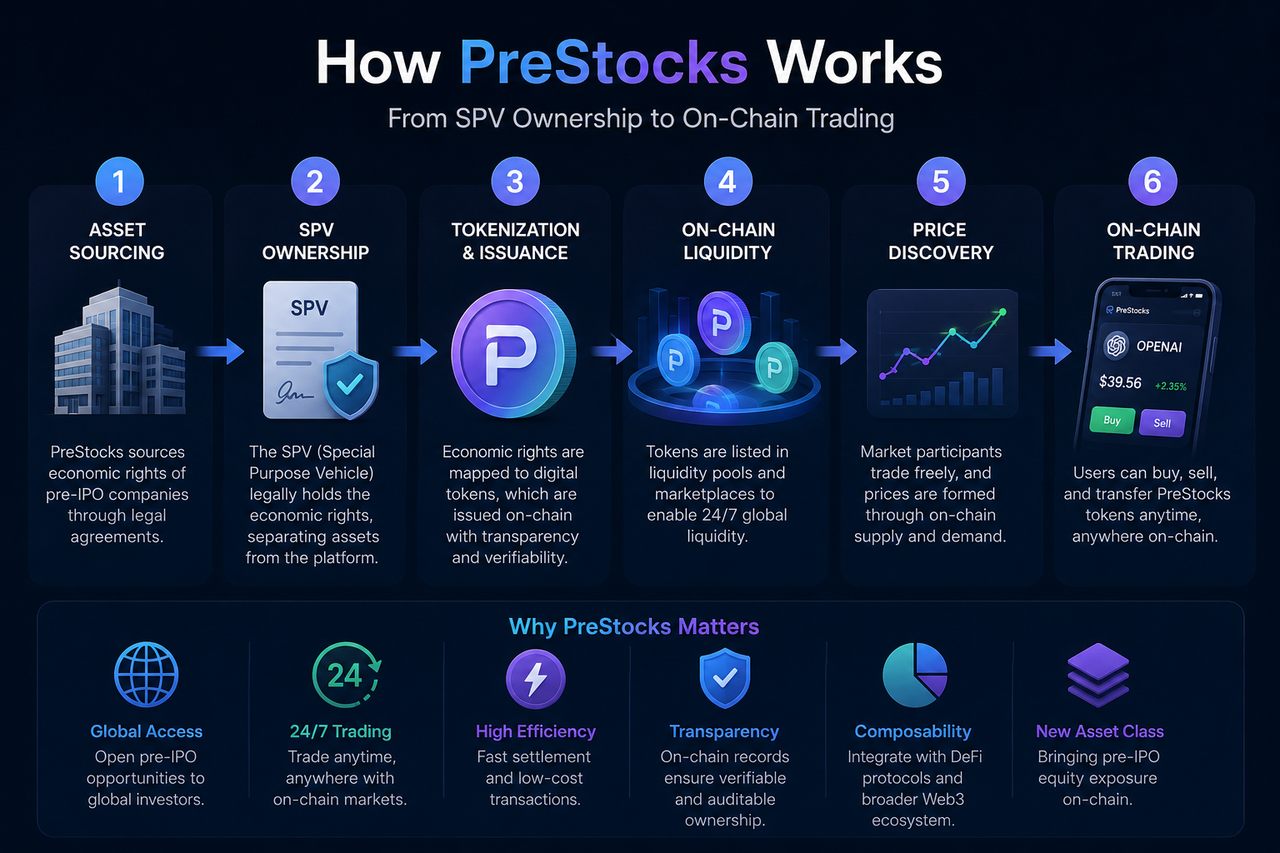
An SPV, or Special Purpose Vehicle, is the core legal structure in the PreStocks operating process.
Equity ownership in traditional private markets often involves complex legal agreements and investor qualification restrictions. If these interests were mapped directly onto the blockchain, both management costs and compliance challenges would rise significantly.
For this reason, platforms usually use an independent legal entity to hold the relevant assets in a centralized way. The SPV manages the underlying interests, while the on-chain tokens correspond to the economic value performance of those interests.
This model has already been widely used in areas such as real estate tokenization, bond tokenization, and the digitization of fund shares.
How Does PreStocks Acquire Underlying Assets?
The first step for PreStocks is to establish asset exposure related to the target company.
In traditional private markets, company employees, early-stage investment institutions, or existing shareholders may hold relevant interests. Through lawful transaction arrangements, the SPV obtains these interests or the related economic benefits.
After the assets are acquired, the SPV becomes the foundational source of support for the value of the on-chain tokens.
This stage determines the value connection between the tokens and the target company. It is also an important foundation for the credibility of the entire system.
How Are PreStocks Tokens Issued?
After asset allocation is completed, the platform issues a corresponding number of on-chain tokens based on the scale of the underlying interests.
The tokens themselves do not directly represent the company’s registered share records. Instead, they map the economic value corresponding to the underlying interests.
During issuance, the platform needs to determine the asset valuation, token supply, and initial market structure.
Because private companies do not have public market prices, valuations are usually formed with reference to financing rounds, secondary equity markets, market consensus, and other factors.
What Happens After Users Buy PreStocks?
When users buy PreStocks tokens, they are effectively gaining market exposure to changes in the target company’s economic value.
For example, when market expectations around the valuation of OpenAI or SpaceX change, the price of the related tokens may fluctuate accordingly.
Holders can trade, transfer, or hold these assets in supported on-chain markets.
It is important to note that token holders usually do not directly hold shareholder status in the company. As a result, they do not enjoy voting rights or corporate governance rights in the traditional sense.
The price discovery mechanism of PreStocks is clearly different from that of public stock markets.
Listed companies have continuously updated public trading prices, while private companies lack a unified market quotation. As a result, PreStocks pricing mainly depends on the combined influence of multiple sources.
Common reference factors include:
-
The company’s latest financing valuation
-
Private market transaction prices
-
Industry growth expectations
-
Market supply and demand
-
On-chain trading activity
As buyers and sellers continue to trade, the market gradually forms a dynamic pricing system.
This process is similar to price discovery in traditional securities markets, but there are major differences in transparency and data sources.
How Does PreStocks Achieve On-Chain Liquidity?
One of the biggest challenges in traditional Pre-IPO investing is the lack of liquidity.
Private equity transactions usually take weeks or even months to complete and are subject to strict transfer restrictions.
PreStocks uses blockchain networks to build an around-the-clock trading environment, allowing assets to be transferred and settled on-chain in real time.
Based on Solana’s high throughput and low transaction costs, the platform can support more frequent market trading activity.
This mechanism significantly improves asset circulation efficiency and also allows the value of Pre-IPO companies to be reflected in market prices more quickly.
How Is PreStocks Different from the Traditional Pre-IPO Investment Process?
Although both focus on private companies, their operating methods are significantly different.
| Comparison Dimension |
PreStocks |
Traditional Pre-IPO Investment |
| Asset Form |
On-chain tokens |
Equity agreements |
| Trading Environment |
Blockchain network |
Private market |
| Market Hours |
24 hours |
Limited hours |
| Settlement Speed |
Real time |
Several days to several weeks |
| Liquidity |
Relatively higher |
Relatively lower |
| Technical Foundation |
Blockchain |
Traditional financial systems |
PreStocks does not fundamentally change the nature of the underlying assets. Instead, it uses blockchain to reconstruct the way assets circulate and are traded.
How Is PreStocks Different from Traditional Tokenized Stocks?
PreStocks is often compared with tokenized stocks, but the two are backed by different sources of assets.
Tokenized stocks usually map shares of publicly listed companies, such as Apple, Microsoft, or Tesla.
PreStocks mainly targets private companies. Therefore, its pricing basis, liquidity sources, and risk structure are all different.
This distinction gives the two types of assets different characteristics in terms of market behavior and price discovery.
Conclusion
PreStocks uses an SPV ownership structure, token issuance mechanism, and on-chain trading infrastructure to map the economic interests of Pre-IPO companies in traditional private markets into transferable digital assets. The full process includes underlying asset acquisition, SPV management, token issuance, market pricing, and on-chain liquidity building.
This model lowers the participation threshold of traditional private markets, improves the efficiency of asset circulation, and demonstrates the future potential of RWA and on-chain capital markets. However, PreStocks’ price discovery mechanism is still affected by factors such as valuation transparency, market liquidity, and the regulatory environment. For that reason, understanding its complete operating logic is essential to understanding the tokenized equity market.
FAQs
Do PreStocks Holders Own Real Stocks?
PreStocks holders usually hold economic value exposure related to the target company, rather than official shareholder status in the company. The specific scope of rights depends on the product structure and legal arrangements.
Why Does PreStocks Need to Use Blockchain?
Blockchain can provide around-the-clock trading, fast settlement, and asset transferability. Compared with traditional private markets, on-chain systems can improve trading efficiency and asset liquidity.
How Is the Price of PreStocks Determined?
PreStocks prices are usually formed through a combination of factors, including company financing valuations, private market transaction prices, market supply and demand, and investor expectations.
How Is PreStocks Different from Tokenized Stocks?
Tokenized stocks usually correspond to shares of publicly listed companies, while PreStocks corresponds to interests related to private companies. Therefore, the two differ clearly in valuation sources, risk structure, and market behavior.
Is PreStocks an RWA?
Yes. PreStocks is an important use case for real-world asset, or RWA, tokenization. Its underlying assets come from real-world private equity and company interests.