The key distinction between Metaplex and other Solana asset issuance frameworks is that Metaplex delivers an integrated infrastructure focused on “asset standards, metadata, permissions, and lifecycle management.” In contrast, alternative frameworks are typically lighter and more specialized, designed for “rapid issuance of specific asset types” or tailored integration with particular product scenarios. Both approaches allow asset deployment on Solana, but they differ in abstraction level, engineering requirements, and long-term governance strategies.
A frequent pitfall for project teams is to consider “the ability to issue assets” as the only standard, neglecting the costs of upgrades, operations, and interoperability. The Metaplex asset project implementation process details the execution workflow, while the differences between Metaplex Core and traditional NFT issuance highlight the impact of standard migration.
Metaplex serves as the foundational infrastructure for asset issuance and management in the Solana ecosystem, supporting both fungible and non-fungible assets across critical processes like creation, minting, metadata binding, permission control, and extensibility. When using Metaplex, teams typically adopt a unified asset model with standardized rules, rather than interacting with a single contract, ensuring consistency in issuance workflows, content indexing, and application-side data retrieval.
In practice, Metaplex’s value lies in standardized interfaces and long-term maintainability. Teams can separate “asset definition” from “product logic,” improving compatibility across wallets and applications and reducing friction during future upgrades.
What Are Other Solana Asset Issuance Frameworks?
“Other frameworks” refers to a suite of tools rather than a single product. This includes lightweight token issuance scripts, custom templates built on Token Program/Token-2022, vertical tools for launch scenarios, and custom contract solutions developed with Anchor. These options are highly flexible, allowing teams to rapidly tailor features for specific business needs.
Such frameworks are ideal for projects requiring deep customization of issuance mechanisms or those with experienced on-chain development teams. Teams can retain only essential modules—such as streamlined metadata structures, customized permission logic, or unique distribution flows—to minimize constraints. However, this flexibility often results in less standardization, making cross-platform adaptation, auditing, and ongoing maintenance more dependent on the team’s engineering governance.
Core Differences at a Glance
| Dimension |
Metaplex Path |
Other Solana Issuance Frameworks |
| Abstraction Level |
Asset infrastructure layer, emphasizes standards |
Tool or scenario layer, emphasizes customization |
| Time to Launch |
Moderate, requires full model understanding |
Fast, plug-and-play for specific needs |
| Consistency |
High, unified metadata and permissions |
Medium to low, varies by team implementation |
| Composability |
Strong, easily integrates with ecosystem standards |
Highly variable, requires individual adaptation |
| Maintenance Difficulty |
Moderate, reduces long-term burden via framework constraints |
Low initially, may increase over time |
| Team Requirements |
Suitable for cross-functional teams (product + engineering) |
Relies on experienced on-chain developers and auditors |
For most long-term projects, the real consideration is not “which is more advanced” but “which best fits organizational capabilities and the roadmap.” Lightweight frameworks are more efficient for short-term, single-use cases, while standardized approaches yield greater benefits for long-term growth.
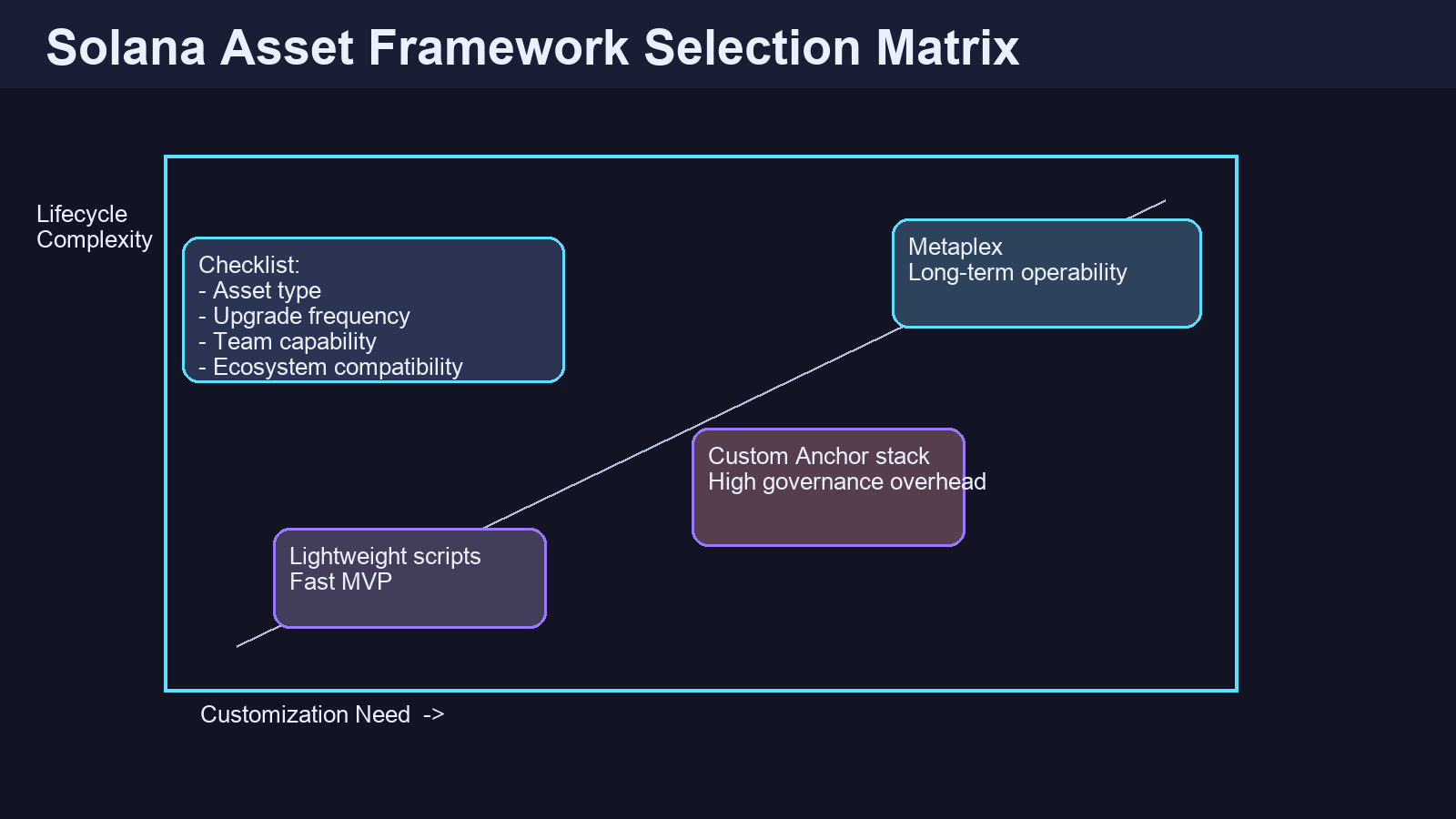
Figure 1. Solana asset issuance framework selection matrix: Comparing Metaplex and other approaches across customization needs and lifecycle complexity.
How Do the Tech Stack and Composability Compare?
Metaplex’s technical strength lies in its reusable paradigm that integrates asset semantics, metadata indexing, and permission logic. With a unified model, frontends, indexers, and wallets can share field definitions, reducing redundant mapping and integration effort.
Other frameworks focus on “rapid delivery of current functionality.” While the MVP stage is easier, adding asset types or integrating third-party markets later requires additional standardization. It’s important to consider future iteration requirements, not just initial development time.
How Do Cost, Performance, and Maintenance Complexity Differ?
Framework costs encompass more than on-chain fees—they include development time, audit expenses, index maintenance, operational tooling, and version upgrade costs. Metaplex typically requires more comprehensive architecture and standards learning upfront, but reduces redundant development later. Other frameworks may offer lower initial launch costs, but as asset lifecycles extend, maintenance costs can rise exponentially.
| Cost Item |
Metaplex Tendency |
Other Framework Tendency |
| Initial Development |
Heavier requirements analysis, moderate speed |
Fast, direct customization |
| Security Audit |
Clear module boundaries, stable audit scope |
More custom logic, variable audit scope |
| Data Indexing |
Standardized fields, manageable maintenance |
More custom fields, increased adaptation |
| Version Upgrades |
Clearer migration paths |
Requires custom migration and compatibility |
| Operational Collaboration |
Better for multi-team workflows |
Strong reliance on core developers |
Performance should be measured against business metrics: issuance throughput during peak periods, indexing latency, and retry mechanisms for failures. If rapid campaign launches are the priority, lightweight frameworks are more direct. For long-term maintainability, structured frameworks are more robust.
How to Evaluate Governance, Upgrades, and Compliance Visibility?
Asset issuance is an ongoing governance process, not a one-time event. Teams must address three questions: how are permissions layered, how are upgrades rolled back, and how is data verified? The Metaplex approach typically offers clearer boundaries for these issues.
Other frameworks are not inherently non-compliant or ungovernable, but require teams to establish their own documentation, change management, and permission audit systems. Without stable on-chain governance, custom solutions may result in “functionality without reusable governance” in future expansions. For projects requiring external collaboration (issuers, marketplaces, service providers), governance visibility is often more important than initial launch speed.
How Should Teams Select a Framework at Each Stage?
The most effective strategy is phased decision-making, not a one-time commitment. During proof-of-concept, prioritize solutions that deliver and iterate quickly. As you scale, evaluate migration to more standardized infrastructure. If your project requires parallel assets, long-term content operations, and cross-application flows, adopting Metaplex from the start typically minimizes total cost.
Teams can also use a “layered combination”: standardize the core asset layer with Metaplex, and deploy lightweight custom modules for specific campaigns or experimental features. This preserves ecosystem compatibility and supports rapid business experimentation. Decision meetings should focus on four evaluation criteria: asset complexity, team engineering capabilities, go-live timeline, and expansion goals for the next three to four iteration cycles. Clear consensus on these factors leads to framework choices that align with business needs.
Summary
Metaplex and other Solana asset issuance frameworks represent engineering choices at different levels of abstraction, not direct substitutes. Metaplex is best for teams building long-term asset infrastructure, while other frameworks are well-suited for single-use scenarios and rapid validation. The key is not to compare conceptual trends, but to match asset complexity, organizational capabilities, and iteration pace. When possible, a “standardized foundation with a lightweight experimental layer” strategy best balances delivery speed and long-term maintainability.
FAQ
Which Is More Suitable for Startups: Metaplex or Other Solana Issuance Frameworks?
If your goal is rapid validation of a single asset scenario, lightweight frameworks are typically easier to start with. If you plan for multi-asset expansion, long-term operations, and multi-party collaboration from the outset, Metaplex’s standardization is more advantageous for future iterations. Base your decision on future roadmap, not just initial development speed.
Does Choosing Metaplex Necessarily Increase Development Costs?
Metaplex often raises upfront modeling and standards understanding costs, but can lower maintenance and migration expenses later. The overall cost depends on asset lifecycle length and iteration count. Projects requiring ongoing operations after issuance are more likely to recoup early investments.
Can Other Frameworks Be Combined with Metaplex?
Yes. A common practice is to use Metaplex for core asset layers and deploy custom modules for campaigns or experimental features. The key to hybrid solutions is clear interface boundaries, consistent permission models, and unified field indexing.
What Should Teams Prioritize When Selecting a Framework?
First, clarify asset types and lifecycle objectives: Will you need parallel assets? Frequent upgrades? Integration with third-party marketplaces and wallets? Define these constraints first, then discuss technical direction—this reduces disputes. Starting with tools before clarifying requirements often leads to repeated migrations.
How Can You Avoid “Short-Term Speed, Long-Term Maintenance Challenges” When Comparing Frameworks?
Incorporate operational considerations from the outset—evaluate permission governance, upgrade rollback, data indexing, and audit reusability. If a framework excels only in “initial launch speed” but lacks stable paths for these four areas, long-term risks will grow. Extending your evaluation across three or more iterations yields a more accurate picture of total cost.