The 1:1 real stock reserve and corporate action mechanism underpinning the QQQB stock token ensure each on-chain unit consistently reflects the economic exposure of the Invesco QQQ Trust (QQQ ETF). To validate the reliability of tokenized securities mapping, it is crucial to understand custody, disclosure, the mint/burn process, and how the Multiplier manages stock splits and dividends.
The QQQB stock token offers a comprehensive view of how reserves and corporate actions fit within the overall product structure. By analyzing Proof of Collateral, minting and burning, and Multiplier rebasing separately, one can distinguish between "verifiable mapping" and "market risk-free" concepts.
What is QQQB's 1:1 real stock reserve?
A 1:1 real stock reserve means each QQQB token in circulation is fully backed by an equivalent amount of underlying equity, held with a US-regulated broker. bStocks are issued by BTech Holdings Limited; reserves are typically managed through a ring-fenced special purpose vehicle (SPV) that purchases and holds the corresponding securities, with share segregation and daily reconciliation to ensure on-chain supply never exceeds actual stock held.
The 1:1 ratio refers to quantity matching, not price pegging. Fluctuations in the underlying QQQ basket will directly impact QQQB's market value. The reserve mechanism clarifies "what asset the token represents" but does not eliminate volatility from Nasdaq 100 constituents. When verifying the underlying, reference the QQQB and QQQ ETF underlying structure to understand the boundaries of the Trust basket and token mapping.
| Element |
Function |
User Perspective |
| 1:1 Correspondence |
Aligns circulating supply with underlying reserves |
Positions map directly to stock economic exposure |
| Regulated Custody |
Real stocks are held by a US-regulated broker |
Reserves are in custodial accounts, not in user wallets |
| Ring-fenced SPV |
Segregates issuer from custodial asset structure |
Clarifies bankruptcy remoteness and position boundaries |
| BEP-20 Contract |
Standard for on-chain unit circulation |
Contract address: 0x205812cdbed920aff76c6580abd681a46d11efc7 |
The table summarizes the four core verification points of the reserve framework. Holding QQQB does not mean you are directly registered as an Invesco QQQ Trust shareholder; economic exposure, legal status, and governance rights must be verified separately.
How does Proof of Collateral verify transparency?
Proof of Collateral is bStocks' mechanism for reconciling custodied holdings with total on-chain supply, disclosing this information publicly. Typically updated daily, it matches custodial holdings with the circulating supply of bStocks (including QQQB), allowing users to verify full backing.
Verification involves three steps: review the public Proof of Collateral page; check the total supply and transfer records for contract 0x205812cdbed920aff76c6580abd681a46d11efc7 on BscScan; and compare your personal holdings with the product page disclosures. Cross-referencing these sources enhances mapping transparency, but public reconciliation does not grant direct access to custodial accounts for physical audits.
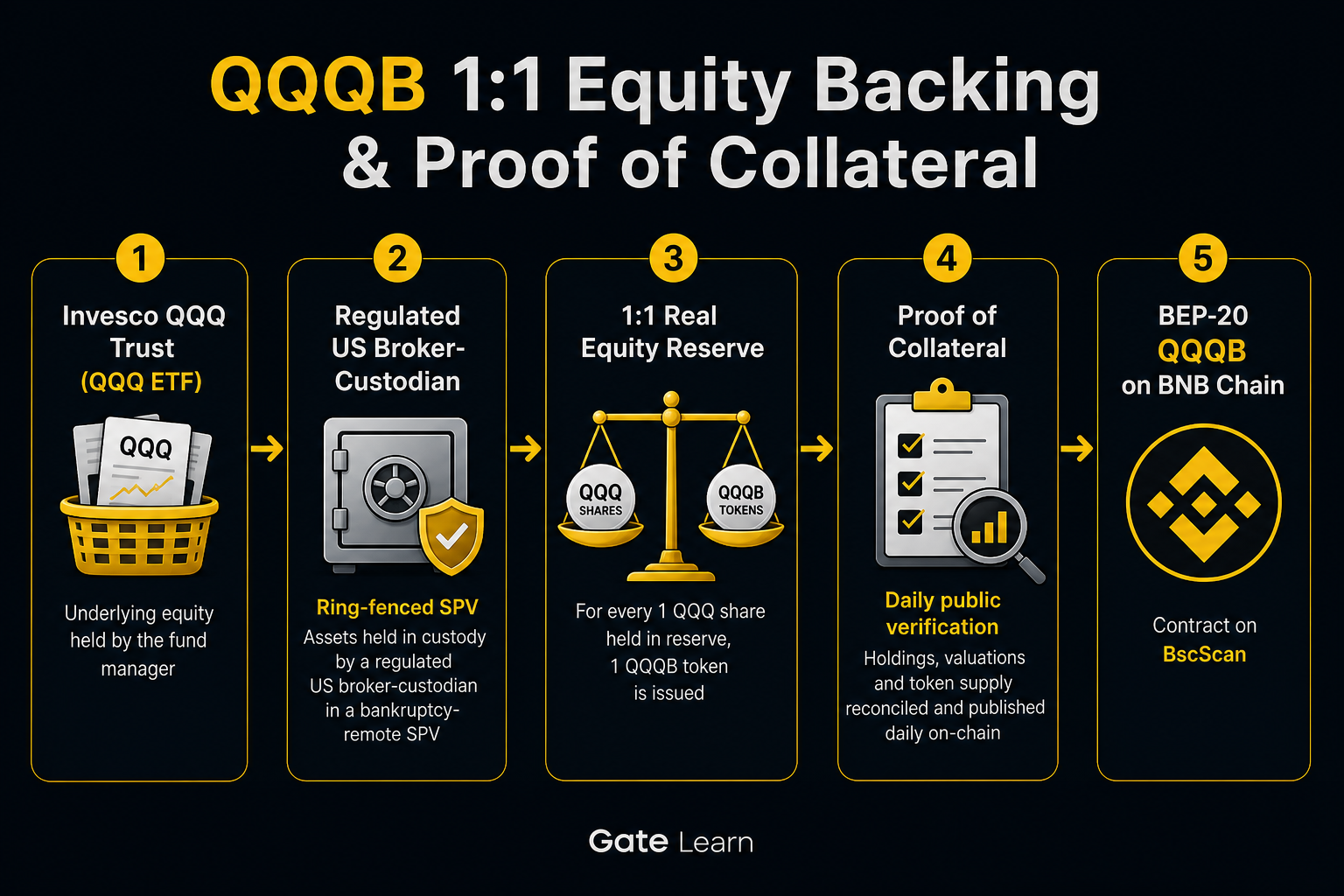 Figure 1. QQQB: From Invesco QQQ Trust and regulated custody, through 1:1 reserves, to Proof of Collateral and BEP-20 issuance.
Proof of Collateral enhances reserve transparency but does not eliminate market risk. It addresses the question of "is there an underlying asset," while QQQB vs QQQ ETF vs other tokenized stocks offers further comparison between real-stock anchoring and other synthetic exposure models.
How do minting and burning align with reserves?
Minting and burning are supply-side mechanisms that maintain the 1:1 correspondence. Once underlying equity is deposited into custody and recorded, the smart contract mints QQQB at a 1:1 ratio. When users redeem or convert to the underlying security, tokens are burned and the corresponding reserve is released or transferred. When Nest Trading Limited facilitates Token Conversion, securities and tokens are exchanged 1:1 with zero conversion fee (subject to product terms), ensuring reserves and supply adjust in tandem.
Minting requires incremental real stock in custody; burning reduces supply as reserves are released or transferred. If on-chain circulation does not match custody, the 1:1 ratio is broken. Users typically do not interact directly with minting functions, but supply changes occur through spot trading, conversion, or withdrawal.
| Action |
Reserve Side |
On-Chain Side |
Typical Trigger |
| Minting |
Underlying equity deposited or transferred to custody |
QQQB supply increases |
Security-to-token conversion, issuance to reserve |
| Burning |
Underlying equity released or transferred out |
QQQB supply decreases |
Token-to-security conversion, redemption |
| Reconciliation |
Custody balance updated |
Total supply can be publicly checked |
Daily Proof of Collateral |
The table shows these actions must be understood in pairs. Minting and burning are protocol mechanisms, not investment income events; the key is matching quantities and synchronizing timing.
How does Multiplier rebasing handle stock splits and other corporate actions?
Multiplier rebasing is QQQB's on-chain mechanism for handling corporate actions. When the underlying Invesco QQQ Trust undergoes stock splits or reverse splits, changing the per-share equity ratio, the contract's Multiplier updates accordingly. QQQB balances in wallets are automatically adjusted to the new ratio—no manual airdrops or conversions are needed.
Rebasing ensures continuous economic exposure: before and after the event, your relative exposure to the Trust remains consistent with traditional holdings. Forward splits increase balances with unit value adjusted proportionally; reverse splits do the opposite. No user action is required, but balances and Multiplier details in announcements should be checked post-adjustment.
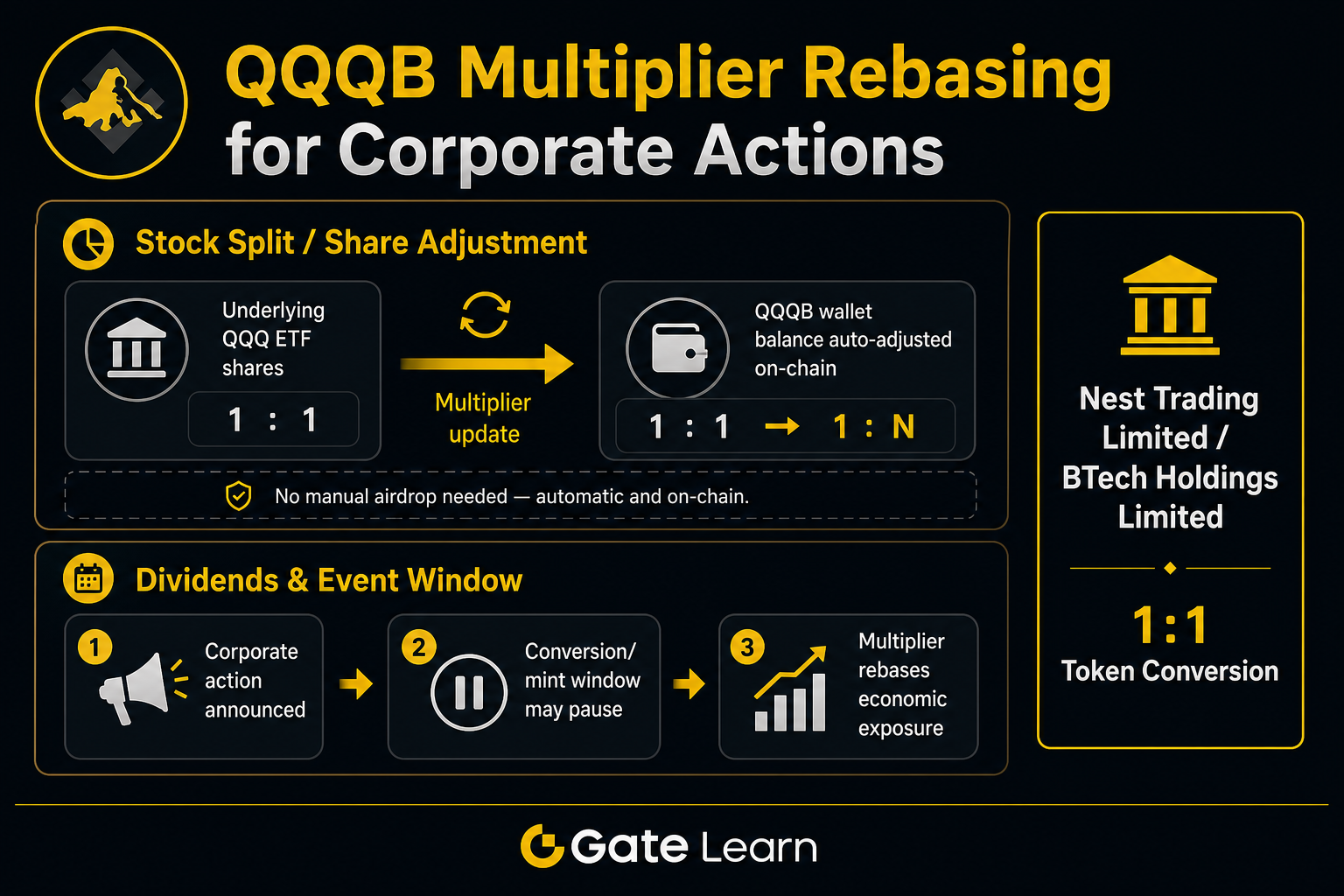 Figure 2. QQQB Multiplier rebasing: automatic adjustment for splits, and minting/conversion pauses during dividend and corporate action windows.
Corporate action changes are announced in advance via Binance and other channels. The Multiplier manages per-share equity ratio changes; when 1:1 conversions led by Nest Trading Limited or BTech Holdings Limited occur in parallel, confirm whether conversions are permitted during event windows to avoid mistaking a pause for reserve failure.
What are the pause rules for dividends and corporate action windows?
For dividends, when the underlying Trust pays out, QQQB holders generally retain corresponding economic rights (after applicable US withholding tax). Public disclosures typically state dividends are automatically reinvested into economic exposure, and fractional shares receive proportional rights. Distribution method, timing, and tax treatment are governed by account records and product terms.
Pause rules for corporate action windows mean minting, burning, or Token Conversion may be temporarily paused around key dates such as splits, reverse splits, or dividend record dates, to allow for share registration, reconciliation, and Multiplier updates. These pauses prevent mismatched quantities during settlement and do not alter the 1:1 standard. Advance notices specify adjustment times and scope; after the pause, supply and reserves should realign and can be verified via Proof of Collateral.
Distinguish "temporarily non-convertible" (an operational constraint during events) from "insufficient reserve" (an indicator of mapping failure). Whether spot trading remains open during events depends on product rules and announcements.
What are the limitations of reserve verification?
While reserve verification enhances transparency, structural limitations remain. Proof of Collateral depends on the disclosing party's reconciliation and publication schedule; users see aggregate data, not real-time transaction-level details of custodial accounts. Total on-chain supply can be independently checked on BscScan, but custodial account details are generally not available for direct audit.
Legally, QQQB is a certificate structure representing specific financial instruments; holders are not directly registered as shareholders of the underlying company or ETF, and voting rights are subject to product terms. Regulatory approvals (such as ADGM FSRA prospectus frameworks) describe issuance and disclosure arrangements but do not guarantee conversion or trading rights across all jurisdictions.
Liquidity, smart contract, and private key management risks are distinct from the reserve mechanism. 1:1 anchoring describes asset correspondence, but does not eliminate order book depth issues, protocol liquidations, or operational errors. For comprehensive risk boundaries, see QQQB risks and compliance boundaries.
Summary
The QQQB reserve system comprises regulated custody, 1:1 correspondence, public Proof of Collateral reconciliation, and mint/burn linkage. Corporate actions are automatically adjusted via Multiplier rebasing, while dividends and event windows may involve temporary minting or conversion pauses. The core verification focus is "is custody fully backed, is disclosure accessible, is supply synchronized," with mapping transparency evaluated separately from market, compliance, and operational risks.
FAQ
Is QQQB 1:1 backed by real stock reserves? How can this be verified?
QQQB operates under a 1:1 real stock reserve standard, with each circulating token backed by corresponding underlying equity held with a US-regulated broker. To verify, check the public Proof of Collateral reconciliation, review the total supply for contract 0x205812cdbed920aff76c6580abd681a46d11efc7 on BscScan, and cross-reference your holdings with product disclosures. Reserve verification addresses mapping transparency but does not eliminate underlying asset volatility.
How does bStocks operate?
bStocks are issued by BTech Holdings Limited, selecting US-listed stocks or ETFs as the underlying, maintaining 1:1 real stock reserves with a regulated broker, and minting the corresponding BEP-20 tokens on BNB Smart Chain. Users can gain exposure through spot trading, Token Conversion facilitated by Nest Trading Limited, and on-chain withdrawals, with reserves and supply verifiable via Proof of Collateral.
Does QQQB pay dividends? How are dividends settled?
When the underlying Invesco QQQ Trust pays dividends, QQQB holders generally retain corresponding economic rights (after applicable withholding tax). Public disclosures often state dividends are automatically reinvested in the economic exposure; splits and similar events are handled via Multiplier rebasing to adjust balances. Distribution method and timing are determined by account records and product terms.
What are the risks of trading QQQB?
Primary risks include volatility in Nasdaq 100 constituents, differences in spot or DEX liquidity, smart contract and private key operational risks, and compliance restrictions on conversion and trading rights across jurisdictions. 1:1 reserves and Proof of Collateral improve mapping transparency but do not guarantee risk-free returns.
What does Proof of Collateral prove—and what doesn't it prove?
Proof of Collateral demonstrates that, at the time of disclosure, custodied holdings and total on-chain supply can be reconciled, verifying public claims of 1:1 backing. It does not guarantee price stability, nor does it substitute for a physical audit of custodial accounts, and it does not eliminate market, liquidity, or smart contract risks.