When holding QQQB stock tokens, it is crucial to clearly distinguish between "underlying ETF economic exposure" and "1:1 real stock reserve mapping," as well as "on-chain circulation, platform rules, and jurisdictional availability." The QQQB stock token has been thoroughly explained in terms of issuance mechanisms, trading pathways, and DeFi composability. The following sections focus on risk sources and compliance boundaries, specifically addressing mechanism constraints rather than time-sensitive market judgments.
QQQB is issued by BTech Holdings Limited, mapping the economic interests of the Invesco QQQ Trust to a BEP-20 token on BNB Smart Chain. Reserve anchoring, Proof of Collateral, and Token Conversion address asset correspondence and conversion, but do not automatically eliminate structural impacts from volatility, liquidity contraction, contract interaction, or regional restrictions.
How to Understand QQQB's Compliance Availability
The compliance framework for QQQB consists of three layers: issuance structure, product functionality availability, and the applicable laws of the user's jurisdiction.
For issuance structure, BTech Holdings Limited, as the issuer of bStocks, disclosed relevant arrangements under a prospectus framework approved by the Financial Services Regulatory Authority (FSRA) of the Abu Dhabi Global Market (ADGM) for "Certificate over select U.S. stocks and ETFs" products. ADGM approval defines issuance and disclosure obligations, but does not automatically grant all global users equal spot trading, Token Conversion, or on-chain withdrawal rights.
Product functionality availability is determined by the Binance User Agreement, KYC status, and product page. Token Conversion is facilitated by Nest Trading Limited, supporting two-way 1:1 conversion between QQQ and QQQB; eligibility, limits, and processing rules vary by account type and applicable regulations. Binance may restrict some or all services in certain regions.
Tax reporting, AML, and KYC compliance are the user's responsibility, and users should consult professional advisors. Any changes in issuance structure disclosure, platform rules, or local laws may impact executable pathways.
| Compliance Dimension |
Key Mechanism Points |
Verification Reference |
| Issuance Structure |
BTech Holdings · ADGM Disclosure Framework |
Prospectus & Product Terms |
| Conversion Rights |
Nest Trading · Token Conversion |
Account Eligibility & Limits |
| Regional Availability |
Binance Service Scope |
User Agreement & KYC Status |
| Local Laws |
Securities/Digital Asset Regulation |
Independent Legal Consultation |
The table above summarizes the main layers of compliance availability. Approval or disclosure does not guarantee unlimited access to all features for individual accounts.
Liquidity and Counterparty Risks
QQQB's liquidity varies by trading pathway: Binance spot order book, on-chain DEXs (like PancakeSwap), and Token Conversion channels each have different depths and counterparty structures.
Binance spot relies on order book depth; during periods of market sentiment shifts, the order book may thin, making large market orders subject to slippage or partial fills. On-chain DEX liquidity depends on pool size and may not be fully synchronized with centralized spot depth.
Counterparties include BTech Holdings Limited, U.S. regulated brokers, Nest Trading Limited, and Binance. Changes in operating rules or processing times at any point can impact redemption, withdrawal, or balance display. While 1:1 reserve descriptions guarantee quantity, they do not ensure large transactions are always executed at ideal prices.
The QQQB vs QQQ ETF vs other tokenized stocks article can help compare differences in liquidity sources and conversion mechanisms across tokenized products, and avoid assuming QQQB has the same exchange depth as a traditional ETF.
| Pathway |
Liquidity Source |
Typical Risk Manifestation |
| Binance Spot |
Platform Order Book |
Slippage, Partial Fills |
| Token Conversion |
Issuer Conversion Channel |
Eligibility Restrictions, Processing Delays |
| On-chain DEX |
Liquidity Pool |
Insufficient Pool Depth, Impermanent Loss (if providing LP) |
| On-chain Self-Custody |
User Wallet + DEX |
Private Key, Protocol Liquidation |
Liquidity risk and 1:1 reserves are separate dimensions: even with full reserves, specific pathways may still encounter transaction challenges.
Underlying Asset Volatility and ETF Structure Risks
QQQB provides holders with economic exposure to the Invesco QQQ Trust, which tracks the NASDAQ-100 Index. Component stock performance, interest rate expectations, and macroeconomic factors all affect the QQQ net asset value and are reflected in QQQB's market value.
The QQQB and QQQ ETF underlying structure article details the basket composition and mapping logic. ETF structure risks include component changes, weight rebalancing, tracking errors, and accumulating fees. Tokenization does not alter the volatility of the underlying basket; BEP-20 only changes the holding and trading vehicle.
A common misconception is that 1:1 reserves mean price stability. Reserve anchoring ensures circulating supply corresponds to the underlying rights but does not lock in price. Dividends and corporate actions are synchronized through Multiplier rebasing, with distribution timing based on Binance records.
Smart Contract and On-Chain Custody Risks
QQQB is deployed on BNB Smart Chain at contract address 0x205812cdbed920aff76c6580abd681a46d11efc7. On-chain interactions require verifying the contract address and token symbol to avoid counterfeit assets: tokens with the same or similar names that are not publicly confirmed are not equivalent to QQQB issued by BTech.
With self-custody, loss or compromise of the private key results in unrecoverable assets; authorizing malicious contracts may result in token theft. Using protocols like Venus, Lista DAO, or PancakeSwap as collateral or LP introduces risks such as contract vulnerabilities, liquidation, and oracle dependencies, which must be evaluated separately from ETF volatility.
BscScan allows users to view contract and transfer records; Proof of Collateral verifies reserves and circulation. On-chain transparency does not replace the responsibility for protocol selection and parameter management.
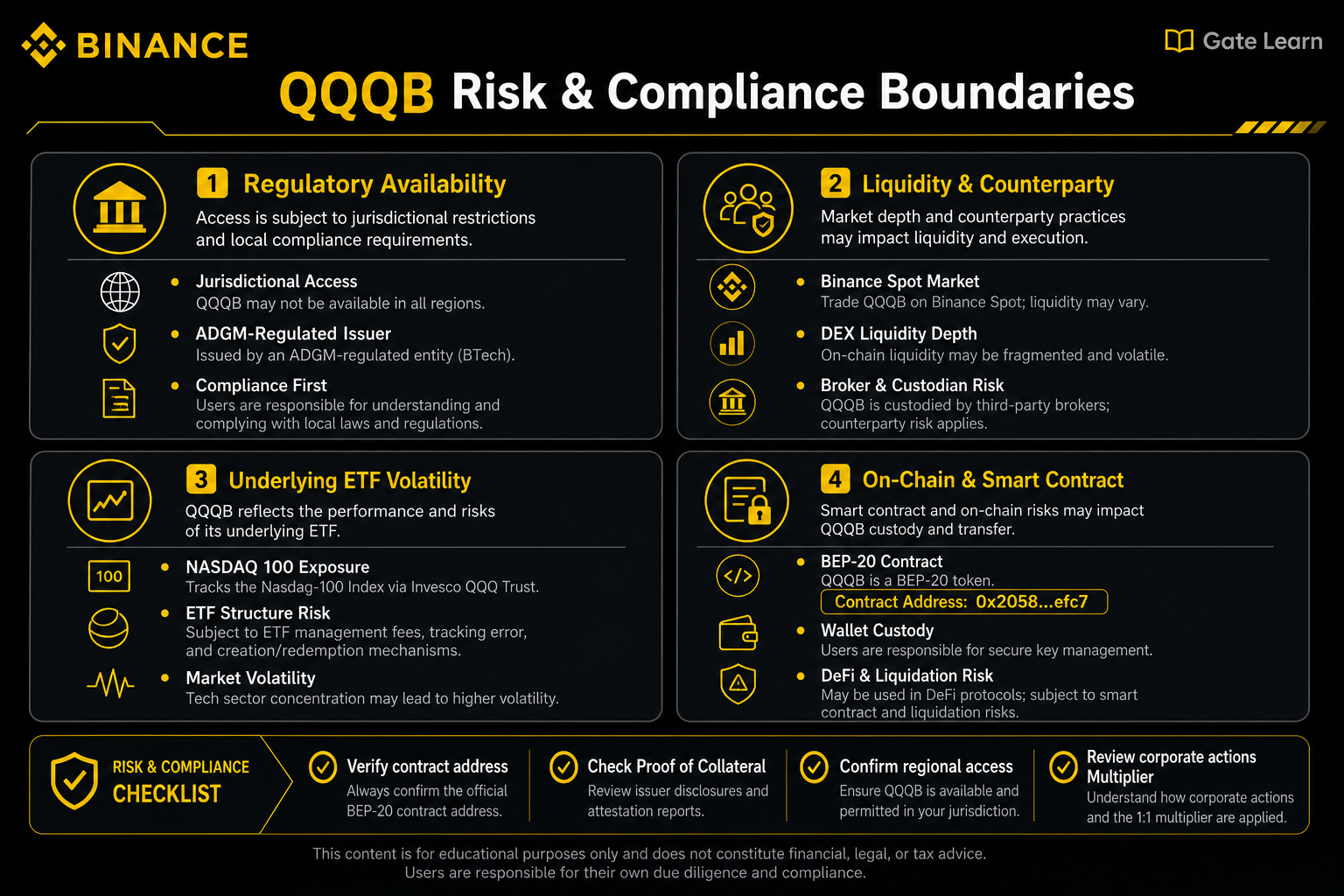 Figure 1. QQQB risk and compliance boundaries: regulatory availability, liquidity counterparties, underlying volatility, and on-chain custody.
Corporate Action Handling Boundaries
QQQB corporate actions (dividends, splits, reverse splits, etc.) are handled through Multiplier rebasing: when the underlying Trust undergoes events affecting per-share rights, the Multiplier is adjusted to keep QQQB's economic exposure aligned with the underlying securities. Users typically do not need to claim manually, but should verify after balance changes that adjustments are as expected.
The QQQB 1:1 reserve and corporate action mechanism article explains Multiplier triggers. Tokenization does not automatically grant full shareholder rights as with traditional brokers; governance rights like voting must be verified in the product terms. Dividend settlement timing is based on Binance account records.
Pre-Operation Checklist
Before operating QQQB, it is recommended to check each of the four layers: mechanism, liquidity, on-chain custody, and compliance, to avoid mistaking product features for risk-free guarantees.
Mechanism Check: Do you understand that QQQB maps to the Invesco QQQ Trust, not a direct ETF share? Do you distinguish between 1:1 reserves and price locking? Are you aware of how Multiplier handles corporate actions?
Liquidity Check: Are you planning to use Binance spot, Token Conversion, or on-chain DEX? Have you confirmed order types and expected slippage? For large transactions, have you considered splitting and timing?
On-Chain Custody Check: If withdrawing to a self-custody wallet, is the contract address 0x205812cdbed920aff76c6580abd681a46d11efc7 correct? Are you familiar with DeFi protocol audits and collateralization ratios? Are your private key and 2FA securely managed?
Compliance Check: Does your account meet KYC and regional requirements? Is Token Conversion eligibility confirmed? Have you consulted a professional advisor about local tax and reporting obligations?
| Checklist Layer |
Key Issues |
Reference |
| Mechanism |
Underlying Mapping, Reserves, Multiplier |
Pillar, Reserve Mechanism Cluster |
| Liquidity |
Pathway, Depth, Slippage |
Order Book, Product Page |
| On-Chain |
Contract Address, DeFi Parameters |
BscScan, Protocol Docs |
| Compliance |
Region, Conversion Rights, Tax |
User Agreement, Prospectus Disclosure |
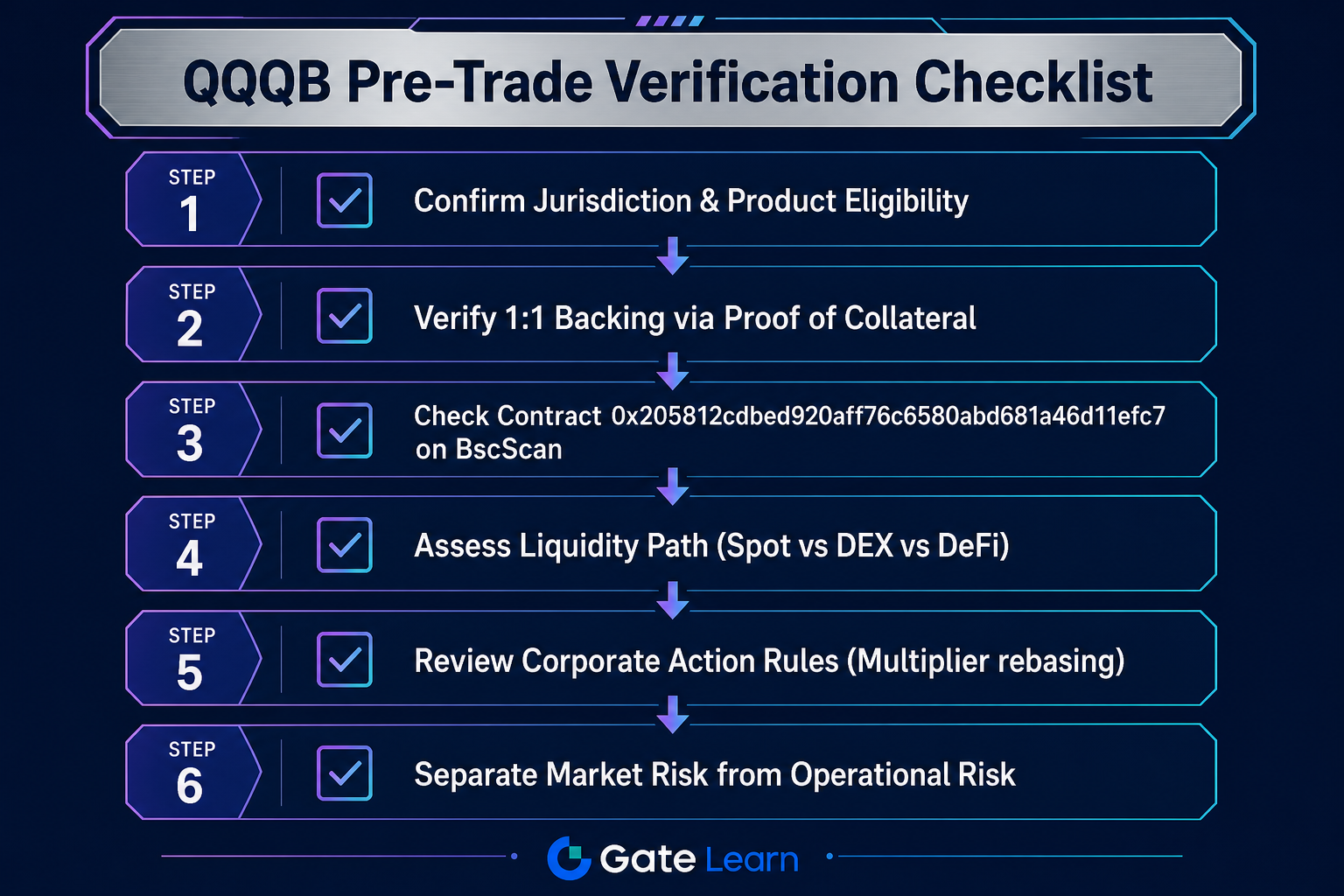 Figure 2. Six-step QQQB pre-operation risk checklist: issuer, regional access, reserve verification, liquidity, corporate actions, and custody pathway.
Repeat this checklist each time you switch trading pathways or attempt DeFi combinations. Mechanism and compliance boundaries should be assessed separately from operational steps.
Summary
The risk and compliance boundaries for QQQB stock tokens include: jurisdiction and product functionality availability, differences in liquidity between Binance spot and DEX, NASDAQ-100 underlying volatility, BSC smart contracts and self-custody, Multiplier handling of corporate actions, and counterparty structure across the issuance—custody—conversion chain. 1:1 real stock reserves and Proof of Collateral ensure mapping transparency but do not automatically eliminate these risks. Completing four-layer checks for mechanism, liquidity, on-chain custody, and compliance before operating helps clarify QQQB's capabilities and responsibilities within the regulatory framework.
FAQ
What are the risks of trading QQQB?
Key risks include: NASDAQ-100 component volatility, liquidity differences between Binance spot and DEX, DeFi smart contract and liquidation risks, private key self-custody risks, Token Conversion eligibility and processing time limits, and compliance restrictions on trading and conversion rights in different jurisdictions. 1:1 reserves describe asset correspondence but do not eliminate these risks.
Is QQQB 1:1 backed by real stock reserves? How can this be verified?
QQQB follows a 1:1 real stock reserve standard, with each circulating token fully backed by corresponding underlying rights maintained by BTech Holdings Limited at a U.S. regulated broker. Users can verify circulating supply and underlying holdings through publicly disclosed Proof of Collateral and view on-chain records at BscScan (contract 0x205812cdbed920aff76c6580abd681a46d11efc7). Verification ensures mapping transparency, but does not eliminate price volatility.
Can QQQB be held in an on-chain wallet?
Yes. QQQB is a BEP-20 token, and users can withdraw QQQB from Binance to any BSC-compatible self-custody wallet. After withdrawal, ownership is controlled by your private key, and QQQB can be traded on DEXs like PancakeSwap or used in protocols like Venus and Lista DAO. Self-custody requires you to manage your private keys, verify contract addresses, and assess DeFi protocol risks.
How does QQQB differ from traditional stock trading?
QQQB uses the BEP-20 token standard to provide economic exposure to the Invesco QQQ Trust, enabling 24/7 Binance spot trading, Token Conversion, and on-chain self-custody. Traditional QQQ ETFs are traded in share form during exchange hours, with settlement and rights exercised according to securities account rules. There are differences in account structure, conversion pathways, DeFi composability, and compliance availability.
What factors constrain QQQB's compliance availability?
Compliance boundaries are determined by BTech Holdings Limited's issuance and ADGM disclosure framework, the Binance User Agreement and KYC status, Token Conversion eligibility, and applicable local laws in the user's jurisdiction. Issuance structure approval does not automatically grant all users the same functional rights.
What should be checked first before holding QQQB?
Priority checks include: understanding underlying mapping and 1:1 reserves, assessing liquidity of your intended trading pathway, verifying contract address and DeFi parameters for on-chain withdrawals, confirming account regional availability and Token Conversion eligibility, reviewing Multiplier handling of corporate actions, and consulting on local tax obligations. These five items form the basic checklist framework.