Gate stock trading offers crypto users a direct path to participate in traditional stock assets using USDT. According to the official Gate website, users can trade global stocks and ETFs with USDT, including stocks, ETFs, and select traditional financial market instruments.
What Should You Know Before Trading Daewon Electric Wire Stock on Gate?
Before trading Daewon Electric Wire stock on Gate, users must recognize that the asset being traded is a traditional stock, not a crypto token or on-chain project. The price of Daewon Electric Wire stock is primarily influenced by the Korean stock market, the company’s fundamentals, trading hours, market liquidity, and order execution.
Daewon Electric Wire stock is categorized as a Korean equity, with the underlying company being Daewon Cable Co., Ltd., a Korean wire and cable manufacturer. Daewon Cable has a corporate history spanning over 50 years, and public records indicate its business covers electricity, communications, automotive, and infrastructure supply chains.
On Gate, USDT serves as the entry currency, pricing, and settlement unit for stock trades. USDT settlement lowers the barrier for crypto users to access traditional stock trading directly from digital asset accounts, but it does not alter the core principle that stock prices are determined by supply and demand in the underlying market.
How to Search for Daewon Electric Wire Stock on Gate?
To search for Daewon Electric Wire stock on Gate, users typically need to identify it using the stock’s platform-supported name, English name, or ticker symbol. The corresponding listed company is Daewon Cable Co., Ltd., with the Korean stock code 006340.KS or KRX:006340.
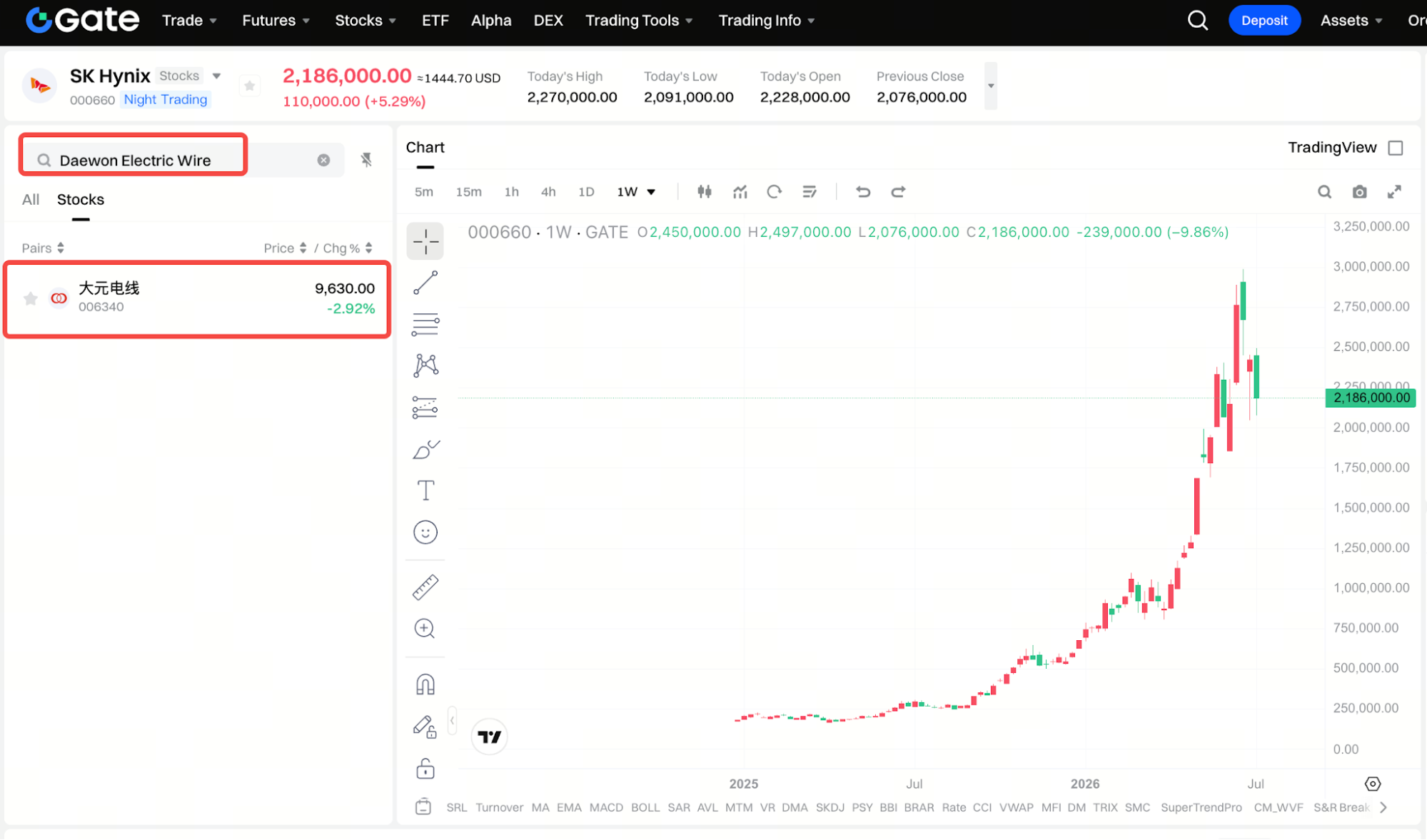
The displayed name for Daewon Electric Wire stock may vary across platforms, so users shouldn’t rely solely on Chinese translations. Always confirm the company’s English name, Korean ticker, and market category to avoid confusing similarly named, abbreviated, or sector-related stocks.
Whether a particular Korean stock is available on Gate should be determined by the platform’s current tradable list. Since available stocks, trading hours, and market support may change, always refer to the platform’s displayed information for the actual tradable status of Daewon Electric Wire.
How to Place an Order for Daewon Electric Wire Stock Using USDT?
The core logic of trading Daewon Electric Wire stock with USDT is that users participate using USDT as their account currency. Gate’s stock trading service integrates traditional equities into its platform, enabling USDT holders to access the stock market within the same system.
Placing an order with USDT does not convert Daewon Electric Wire stock into a crypto asset. The stock’s trading price is still determined by the underlying market, order book liquidity, trading hours, and execution price. USDT simply facilitates pricing and settlement.
When using USDT to place an order, users must distinguish between the “funding unit” and the “asset type.” Daewon Electric Wire stock remains a traditional equity; USDT is merely the currency for trading and settlement. As such, the stock’s volatility is still tied to company fundamentals and the Korean market environment.
What Is the USDT Settlement Mechanism in Gate Stock Trading?
The USDT settlement mechanism in Gate stock trading allows users to use USDT as their funding unit, with the platform recording transaction amounts, Cantidad en tenencia, and asset changes. Gate’s interface shows that Gate Stocks supports trading global stocks and ETFs with USDT.
The main benefit of USDT settlement is reduced currency conversion complexity. Traditional brokers require fiat accounts for stock trading, while Gate’s stock trading is tailored for users who already hold USDT and want to manage both crypto and stock portfolios on a single platform.
| Dimension |
Gate USDT Stock Trading |
Traditional Broker Stock Trading |
| Fund Entry |
USDT as trading currency |
Fiat account as funding source |
| Settlement Method |
Platform records in USDT or equivalent |
Local or exchange currency records |
| User Scenario |
Ideal for crypto users accessing equities |
Geared toward traditional brokerage clients |
| Asset Attribute |
Stocks remain traditional assets |
Stocks are traditional securities |
| Price Impact |
Driven by market price and liquidity |
Driven by exchange price and liquidity |
| Risk Source |
Stock risk, FX/pricing, platform rules |
Stock risk, FX risk, broker rules |
How Do Market Orders and Limit Orders Affect Trading Outcomes?
Market and limit orders influence the execution price, speed, and certainty of Daewon Electric Wire stock trades. Market orders prioritize execution speed, but the final price may be affected by order book depth, liquidity, and market volatility.
Limit orders focus on price control, allowing users to set acceptable price ranges. However, limit orders may not execute immediately—especially in low-liquidity, fast-moving markets, or during special trading hours—resulting in partial or unfilled orders.
For Korean equities like Daewon Electric Wire traded on Gate, order type selection directly impacts the trading experience. Users should focus on the difference between actual and expected execution prices, not just the speed of order fulfillment.
How to View Cantidad en tenencia and Asset Changes for Daewon Electric Wire Stock?
Cantidad en tenencia and asset changes for Daewon Electric Wire stock are reflected in platform account records, including Cantidad en tenencia, market value, trade history, and asset changes. The value of Cantidad en tenencia fluctuates with the underlying market price, USDT valuation, and platform pricing.
Cantidad en tenencia records are not the same as fixed income. The price of Daewon Electric Wire stock may rise or fall, and Cantidad en tenencia value is affected by Korean market volatility, company performance, industry outlook, and trading liquidity.
Asset changes must also be analyzed alongside trading fees, execution price, and settlement currency. When using USDT to trade stocks, account changes typically reflect both price movement and settlement unit changes, so it’s important to distinguish between stock volatility and account reporting differences.
What Risks Should You Consider When Trading Korean Stocks with USDT?
Risks to consider include stock price risk, market liquidity risk, trading hour risk, FX and pricing risk, and platform rule changes. As a Korean traditional stock, Daewon Electric Wire’s price is still driven by the Korean market and company fundamentals.
Korean stock trading may be affected by local market rules, holidays, liquidity, and disclosure schedules. Even with Gate’s USDT entry, users must understand that the underlying stock is a Korean market asset, and its price movements may not align with crypto market cycles.
When trading stocks with USDT, do not mistake equities for stable assets. USDT as a settlement currency does not guarantee price stability—Daewon Electric Wire’s price can fluctuate due to order flow, copper price changes, industry outlook, and market sentiment.
Summary
Trading Daewon Electric Wire stock on Gate with USDT is fundamentally about using USDT as a funding entry to access Korean traditional equities. Daewon Electric Wire stock still represents equity in Daewon Cable Co., Ltd., with its price determined by the stock market and company fundamentals.
To trade Daewon Electric Wire stock effectively, users need to understand the underlying equity, USDT settlement mechanism, order types, Cantidad en tenencia records, and the risk structure of Korean stocks. USDT lowers the barrier for fund conversion, but does not alter the volatility, risk, or fundamental pricing logic of the equity itself.
FAQ
Can I Trade Daewon Electric Wire Stock on Gate Using USDT?
Whether Daewon Electric Wire stock can be traded on Gate with USDT depends on the platform’s current stock list. Gate Stocks supports USDT trading for global stocks and ETFs, but the available assets may change as the platform updates its offerings.
What Is the Stock Code for Daewon Electric Wire?
Daewon Electric Wire’s listed company is Daewon Cable Co., Ltd., with the Korean stock code 006340.KS or KRX:006340. Always confirm both the English company name and ticker for accurate identification.
What Does It Mean to Trade Daewon Electric Wire Stock with USDT?
Trading Daewon Electric Wire stock with USDT means you use USDT as your funding unit for the transaction. USDT is used for pricing or settlement, but the stock itself remains a traditional Korean equity.
Is a Market Order Suitable for Trading Daewon Electric Wire Stock?
Market orders prioritize execution speed but do not guarantee the final price will match your expectations. Daewon Electric Wire stock trading may be affected by liquidity and volatility, so be mindful of slippage risk when using market orders.
What Are the Features of Trading Daewon Electric Wire Stock with Limit Orders?
Limit orders let you set your preferred price, making them ideal for price control. However, they may not execute immediately, especially in fast-moving or illiquid markets, resulting in partial or unfilled orders.
What Are the Differences Between Trading Korean Stocks with USDT and with Traditional Brokers?
The main difference lies in the funding entry and settlement currency. Traditional brokers use fiat accounts for stock trades, while Gate’s offering is designed for users who already hold USDT and want access to equities.