As generative AI models grow in complexity and scale, data centers are transitioning from traditional computing architectures to expansive AI clusters. Massive volumes of data must be exchanged rapidly between GPUs, making network bandwidth, transmission efficiency, and power consumption critical factors for unleashing AI hashrate. High-speed optical communication, with its high bandwidth, low latency, and energy efficiency, is emerging as a pivotal direction for upgrading AI infrastructure.
Lumentum occupies a key position within the AI optical interconnect supply chain, advancing high-speed optical communication technologies like 800G and 1.6T through its lasers and advanced optical components. As AI data centers expand, the importance of optical modules, chips, and interconnect technologies grows, driving increased market attention toward Lumentum and other optical communication leaders.
Why AI Is Accelerating Optical Communication Demand
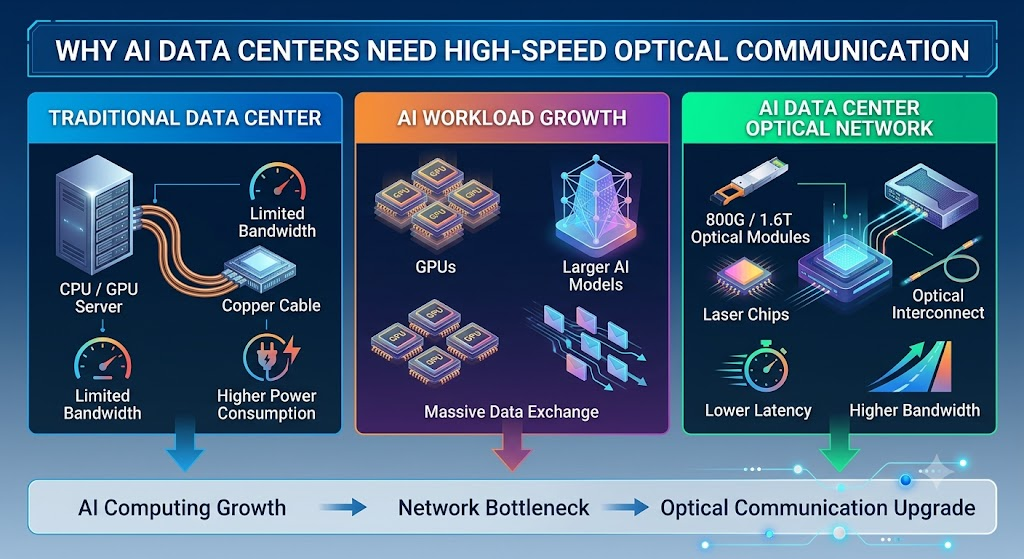
AI data centers form the backbone of model training and inference, and high-speed optical communication is essential for connecting these compute resources. As AI model parameters increase, internal data exchange requirements in data centers rise sharply, exposing the limitations of traditional network connections in bandwidth, distance, and power consumption.
Historically, data centers served web, cloud storage, and enterprise applications, with moderate data transmission between servers. AI workloads, however, require large-scale model training across thousands or tens of thousands of GPUs, demanding continuous, high-volume data exchange between nodes.
For instance, training large language models requires GPUs to not only perform their own computations but also constantly synchronize model parameters. Insufficient server data transmission speeds force GPUs to wait for data, diminishing overall computational efficiency.
Consequently, AI infrastructure development is not merely about increasing GPU counts—it also necessitates upgrading network connectivity. High-speed optical communication has thus become a focal point for the industry.
Compared to copper cable connections, optical communication leverages light signals for data transmission, enabling longer distances, higher bandwidth, and reduced signal loss. For AI data centers requiring large-scale expansion, optical interconnects significantly enhance cluster efficiency.
Global cloud computing companies are ramping up investment in AI infrastructure, building new data centers, sourcing AI chips, and upgrading network equipment. These trends are fueling demand for high-speed optical modules, devices, and laser technologies.
From a supply chain perspective, the AI boom is driving growth not only for computing chip companies like NVIDIA but also for servers, storage, network switches, and the optical communication sector. Lumentum is positioned as a key player in this evolving landscape.
Why Optical Modules Are Integral to AI Data Centers
Optical modules are fundamental components in AI data center networks, responsible for converting electrical signals to optical signals and vice versa.
In practice, server-generated data starts as electrical signals, which optical modules convert to optical signals for high-speed transmission over fiber. Upon arrival, another optical module converts the data back to electrical signals for processing.
Optical modules are already widely deployed among servers, switches, and network devices in conventional data centers. As AI data centers scale, their role becomes even more critical.
AI clusters typically consist of numerous GPU servers working collaboratively. As server counts rise, data exchange between nodes grows exponentially, requiring network devices to support faster transmission speeds.
Recent upgrades have seen data center optical modules evolve from 100G and 200G to 400G, with AI-driven demand propelling the market toward 800G and 1.6T modules.
These speed upgrades demand more advanced optical chips, lasers, and packaging technologies. Optical modules are no longer simple conversion devices—they are foundational infrastructure impacting AI cluster performance.
Energy efficiency is also increasingly important for AI data centers. With GPU power consumption rising, reducing network connection energy usage is a key priority. Optical communication maintains lower power consumption during high-speed transmission compared to traditional electrical connections, offering a clear long-term advantage.
Lumentum’s Strategy for High-Speed Optical Devices
Lumentum (LITE) is a global leader in optical communication and laser technology, focusing not on AI chip manufacturing but on supplying essential optical communication components for AI infrastructure.
The company specializes in high-speed optical devices, lasers, and photonic technologies, providing products for data centers, telecom networks, and industrial applications.
Within the AI optical communication supply chain, Lumentum is positioned as an upstream supplier of core devices. High-speed optical modules require stable, high-performance light sources, with lasers serving as a crucial determinant of module performance.
As data centers move to higher speeds, market demands for optical devices include:
- Increased data transmission rates
- Lower power consumption
- Longer transmission distances
- Enhanced stability
Lumentum’s deep expertise in photonic technologies enables it to drive high-speed communication upgrades.
AI data centers are accelerating the evolution of optical communication standards. 800G optical modules are becoming the choice for large-scale deployments, and as AI cluster sizes grow, 1.6T optical communication is poised to become the next frontier.
Lumentum’s growth opportunities lie in AI infrastructure expansion, cloud network upgrades, and next-generation optical communication applications.
The Role of Lasers in High-Speed Optical Communication
Lasers are core components in optical communication systems, generating stable, high-speed modulated optical signals. During high-speed data transmission, lasers must meet technical requirements for rapid response, energy efficiency, and long-term stability. In the analogy of an information highway, lasers are the engine powering high-speed signals—without high-performance lasers, optical modules cannot achieve elevated data transmission speeds.
AI data centers place heightened demands on lasers:
- AI networks require faster transmission rates, as optical modules advance from 400G to 800G and 1.6T, requiring lasers to support higher-frequency modulation.
- Large AI clusters must reduce energy consumption. As data center size grows, network device power usage becomes increasingly important, making low-power laser technology a strategic priority.
- Emerging architectures like silicon photonics and Co-Packaged Optics (CPO) have the potential to further reshape the optical communication industry.
Lumentum’s long-term investment in laser technology positions it to lead high-speed optical communication advancements and remain a crucial supplier within the AI infrastructure supply chain.
Why AI Clusters Require Low-Latency Optical Interconnects
AI clusters are characterized by extensive collaboration among compute nodes, making data exchange efficiency a direct driver of overall performance.
In traditional computing, a single server can handle many tasks, but AI model training requires multiple GPUs to process different segments of data simultaneously.
With more GPUs, communication pressure between servers intensifies. Excessive network latency forces GPUs to wait for data synchronization, leading to underutilized compute resources.
Optical interconnects address this challenge effectively.
Compared to legacy connections, optical communication offers:
- Higher bandwidth
- Lower latency
- Reduced signal loss
- Superior performance over long distances
In large AI data centers, optical interconnects are evolving from supporting roles to core infrastructure.
As AI inference demand grows, data centers must support not only model training but also real-time AI service calls for vast numbers of users, further raising requirements for network speed and stability.
The AI data center optical communication supply chain is attracting industry leaders like Lumentum, Coherent, and Broadcom, each with distinct strategic positioning. Lumentum’s strengths lie in photonic devices and laser technology, supplying lasers, optical components, and solutions for high-speed communication. The company is a key component supplier, leveraging its technical expertise in AI data center network upgrades.
Coherent Corp. is also a major player in optical and laser technologies, with a broader portfolio spanning communications, industrial lasers, and semiconductor manufacturing. Coherent is competitive in optical communication and relies on industrial laser business for diversified revenue streams.
Broadcom Inc., by contrast, is positioned as a data center infrastructure platform, developing network switching chips, custom ASICs, network solutions, and high-speed connectivity technologies for AI data centers. Broadcom’s strength is its comprehensive capabilities at the chip and system level.
Lumentum and Broadcom are not direct competitors—they operate in different segments of AI infrastructure. Broadcom focuses on data processing and network control, while Lumentum addresses optical connectivity for high-speed data transmission.
AI data center development requires collaboration among computing chips, network chips, optical modules, and optical devices. Future industry competition will revolve around the entire infrastructure ecosystem, not just individual technologies.
Challenges Facing the Optical Communication Industry
Despite new growth opportunities from AI data centers, the optical communication industry faces several key challenges:
- Cyclical market dynamics. Changes in capital expenditures by telecom and cloud computing companies have impacted demand for optical modules. When network infrastructure investment slows, optical communication suppliers may face declining orders and inventory pressures. The AI boom is reshaping demand, but sustained investment in AI infrastructure remains uncertain. Slowdowns in data center expansion could affect growth for optical communication companies.
- Rapid technological advancement. As AI clusters scale, the market is shifting from 400G to 800G, 1.6T, and beyond. Continuous R&D investment is essential to maintain competitiveness. High-speed optical communication requires not only higher transmission speeds but also solutions for power, cooling, cost, and manufacturing scale. Shifts in technology roadmaps may alter long-term competitive dynamics.
- Intensifying industry competition. In addition to established optical communication companies like Lumentum and Coherent, semiconductor companies such as Broadcom and Marvell are strengthening their presence in high-speed interconnects through chip and system solutions.
Asian supply chain companies are also enhancing their manufacturing capabilities for optical modules and devices, intensifying global competition.
The Future of AI Optical Networks
As AI computing demand rises, optical communication technology is entering a new era.
The first trend is toward higher-speed optical modules. 800G modules are becoming standard for AI data center upgrades, and 1.6T modules may soon address the needs of ultra-large AI clusters. Faster speeds will drive ongoing innovation in lasers, optical chips, and packaging.
The second trend is silicon photonics and Co-Packaged Optics (CPO). Traditionally, optical modules are installed between servers and switches, but CPO technology seeks to position optical components closer to the chip, reducing data transmission distance and improving efficiency. As AI chip power consumption increases, CPO may become a key solution for high-speed connectivity and energy challenges.
The third trend is AI-specific network architectures. Future AI data centers may move beyond traditional general-purpose networks, designing dedicated networks for AI workloads with lower latency, higher bandwidth, and more intelligent data scheduling.
Optical communication will play an increasingly central role in these developments.
For Lumentum, growth opportunities stem from both current AI data center expansion and the broader shift toward high-speed interconnects in computing architectures. Sustaining technological leadership in lasers and optical devices will enable participation in next-generation AI infrastructure.
Summary
AI data center development is propelling high-speed optical communication into a critical infrastructure role. As AI models scale, large GPU clusters require rapid, low-latency data exchange, and traditional connections are increasingly insufficient. Optical interconnects, with their high bandwidth and energy efficiency, are becoming the preferred solution.
Optical modules, lasers, and optical components form the foundation of AI networks, with lasers as the core for generating optical signals and driving high-speed communication performance. Lumentum (LITE), leveraging years of photonic technology expertise, holds a leading position in high-speed optical devices and is benefiting from the 800G and 1.6T upgrade cycle.
Compared to Coherent, Lumentum is more focused on communications optics; compared to Broadcom, Lumentum specializes in optical communication devices, while Broadcom emphasizes chip and system-level infrastructure. Together, these companies form a comprehensive supply chain for AI data center development.
Looking ahead, growth in AI hashrate, cloud computing expansion, and next-generation network technology will continue to drive the optical communication industry. However, industry cycles, technological competition, and capital expenditure trends remain critical factors.
Over the long term, AI competition will center not only on chips but also on data transmission capabilities. High-speed optical communication is becoming the essential infrastructure connecting AI hashrate, and Lumentum’s expertise in optical devices will remain vital in building next-generation AI infrastructure.