Understanding the risks associated with WULF stock requires integrating company fundamentals and trading execution into a unified framework. The company profile established around the Comprehensive Overview of TeraWulf (WULF) Stock serves as a foundation for identifying risk sources. Stock-level risk assessment isn't about predicting price movements; it's about explaining volatility, how it propagates, and how execution factors influence outcomes.
A robust risk framework distinguishes between "industry-wide pressures" and "individual stock signals." As a listed Bitcoin mining stock, WULF is influenced by external cyclical factors that the market often prices ahead of company-specific metrics. Trading-level differences in spreads, depth, and order matching can lead to varied execution outcomes, even when directional judgment is the same.
Why Is Industry Cycle Analysis Essential for WULF Stock Risk Assessment?
WULF operates within the Bitcoin mining sector, where industry cycles directly impact revenue quality and valuation. Key cycle variables include Bitcoin price, global hashrate difficulty, block reward frequency, and energy costs. When these factors move together, stock volatility may intensify; when they diverge, the market reassesses the company’s operational flexibility.
Industry cycle risk is highly external, making it challenging for a single company to fully hedge. Even with stable operations, cyclical shifts can influence trading sentiment through profit margin expectations. Prioritizing cycle analysis helps isolate company-specific issues from broader industry pressures.
Cycle risks affect revenue, costs, and capital simultaneously: output value, energy and equipment efficiency, and financing environment collectively impact profit expectations. Comparing peer mining stocks often highlights differences in cost control and capital structure flexibility—core dimensions analyzed in WULF vs MARA, RIOT Comparison. The goal isn't to pinpoint a "single root cause" but to identify multi-variable resonance and assess whether the company can partially buffer external shocks.
Which Critical Areas Are Impacted by Policy and Compliance Risk?
Policy and compliance risks stem from energy regulation, environmental disclosure, accounting standards, information transparency requirements, and trading rule constraints. Mining companies operate in sectors sensitive to both energy consumption and digital assets, so regulatory shifts can directly alter operating costs and disclosure standards.
Compliance risk is characterized by "rules change first, market reacts later." When regulations shift, companies must adjust operations and reporting, and the market reassesses risk premiums based on updated disclosures. Policy risk isn't just about event shocks; it also accumulates through licensing, environmental monitoring, grid connection, and reporting obligations.
When evaluating policy risk, focus on two signals: whether regulatory boundaries are changing, and whether the company promptly integrates those changes into operations and disclosures. If rule changes alter disclosure standards, historical data comparability may decline.
Why Are Liquidity and Execution Risks Often Underestimated?
Liquidity and execution risk centers on whether trades can be completed as intended—not simply on directional accuracy. For WULF stock, bid-ask spreads, order book depth, order type matching, and execution continuity all affect trade quality. Research conclusions clarify asset logic but don't guarantee execution within a set price range.
Heightened volatility increases slippage and partial fills, amplifying execution deviations. Even with accurate directional analysis, differing execution conditions expose varying risks. Highly volatile stocks are prone to "correct direction, poor execution," so execution risk deserves dedicated scrutiny.
The USDT Trading Workflow for WULF Stock outlines liquidity risk checks in three stages: pre-order review, execution, and post-order verification. Before placing an order, review codes, available funds, and order types; during execution, monitor depth and price range; after execution, verify average fill price, partial fill status, and fee structure.
What Company Operating Signals Require Continuous Monitoring?
Operating signals help distinguish short-term noise from medium-term trends. For WULF, key metrics include hashrate deployment pace, unit energy efficiency, power procurement structure, capital expenditure plans, debt maturity profile, and cash flow resilience. Together, these indicators define the company's stress boundaries under cyclical pressure.
These metrics don't single-handedly determine market performance, but they shape the company’s resilience during cycle shifts. If operating metrics deteriorate alongside industry cycles, risks concentrate; improved efficiency can partially offset external pressures and slow risk transmission.
Analysis should emphasize continuity and consistency: are metrics improving, are disclosure standards stable, and do key variables cross-verify? If hashrate expansion isn’t matched by improvements in energy consumption or financing, apparent growth may elevate financial risk and warrants further review.
WULF Stock Risk Checklist Framework
| Risk Dimension |
Typical Triggers |
Transmission Path |
Key Points |
| Industry Cycle |
Mismatched coin price and global difficulty, reward pace changes |
Reassessment of revenue and profit margins |
Are cycle variables resonating together? |
| Policy Compliance |
Energy rules, disclosure standards, accounting shifts |
Changes in compliance costs and valuation discounts |
Is disclosure timely after rule changes? |
| Liquidity Execution |
Shallow order book, wider spreads, increased slippage |
Price deviation and position errors |
Are order types matched to market conditions? |
| Operating Signals |
Reduced efficiency, imbalanced capital spending, debt pressure |
Lower cash flow resilience, higher risk premium |
Are metric trends continuous and verifiable? |
This checklist standardizes risk terminology, preventing different risks from being conflated. Industry cycles explain the "external environment," policy compliance defines "regulatory boundaries," liquidity execution clarifies "trading outcomes," and operating signals highlight "corporate resilience." Together, these four dimensions offer a more comprehensive risk assessment than isolated analysis.
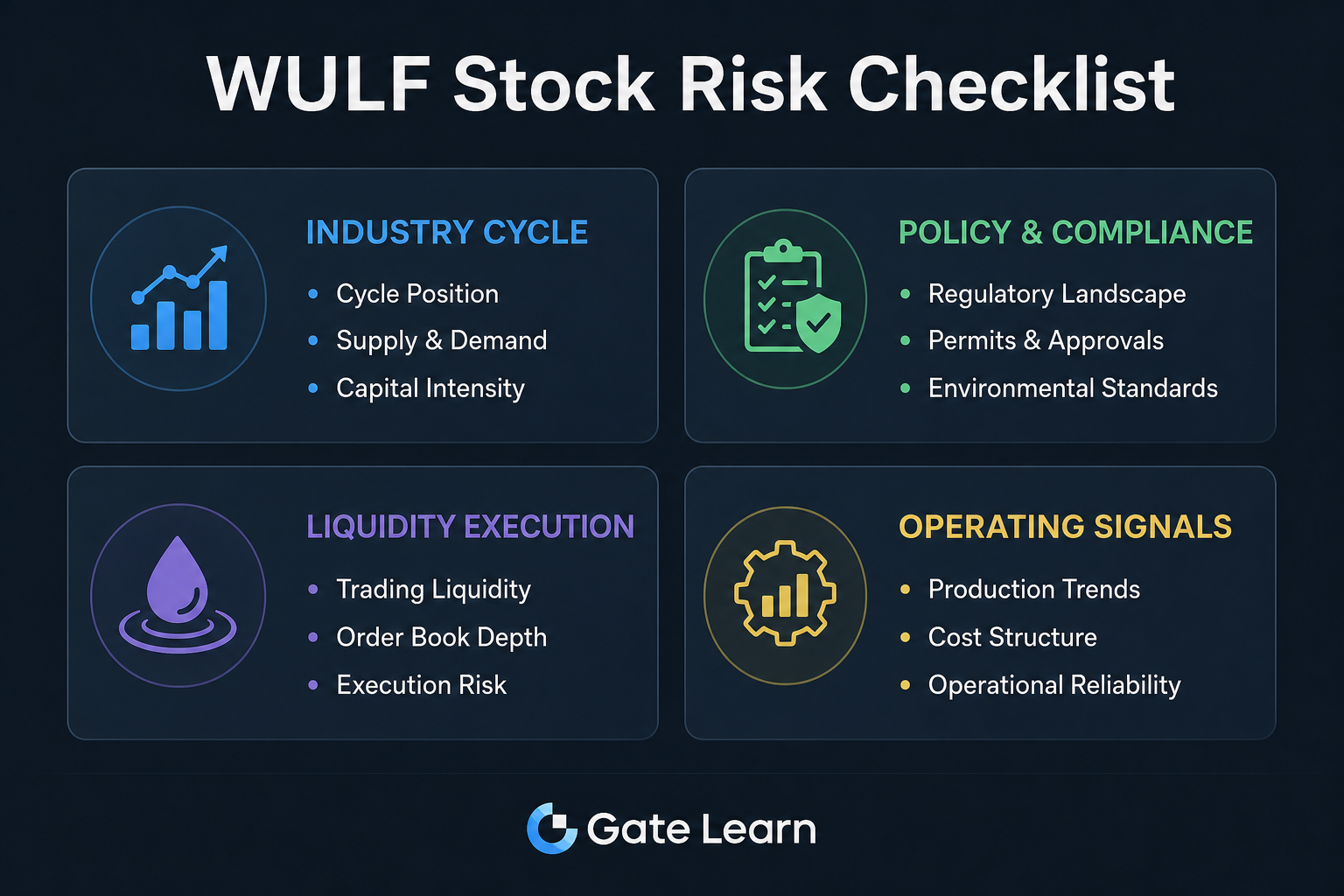
Figure 1. WULF Stock Risk Checklist: Four main themes—industry cycle, policy compliance, liquidity execution, and operating signals.
How Do Common Misconceptions Undermine WULF Stock Risk Identification?
One misconception is treating Bitcoin price volatility as the sole risk factor. While price is critical, global difficulty, power costs, financing, and execution conditions independently affect profit and trade outcomes. Relying on a single variable systematically underestimates multi-path risk resonance.
A second misconception is substituting a single operating metric for trend analysis. One-off hashrate, efficiency, or debt figures may be skewed by disclosure changes; without multi-period comparisons, structural shifts may be misjudged.
A third misconception is ignoring execution risk and focusing solely on research conclusions. For volatile stocks, spreads, depth, and order matching directly impact outcomes. Omitting Gate’s WULF stock page fields and order rules from the checklist leaves gaps in risk management.
Summary
WULF stock risk analysis centers on four themes: industry cycles set the backdrop for volatility, policy compliance shapes regulatory costs, liquidity execution determines trading deviations, and operating signals define resilience. Risk identification should follow the sequence "external first, internal later; structural first, execution later," then return to trading checks. Avoiding oversimplification—such as focusing solely on coin price, single-period data, or pure research—enables a more robust, reusable risk assessment.
FAQ
Is Bitcoin Price Volatility the Only Core Risk for WULF Stock?
No. While Bitcoin price is a key factor, risks also include global difficulty, power costs, financing conditions, regulatory rules, and liquidity execution. WULF’s volatility is typically driven by multiple variables, not just price.
Why Is Industry Cycle Risk Especially Significant for WULF Stock?
WULF’s industry is directly tied to hashrate output and energy costs, so cycle shifts affect both revenue and expenses. When industry variables resonate, markets quickly reassess profit resilience. Cycle risk is often priced before company-specific signals.
Where Does Liquidity Execution Risk Manifest in WULF Stock Trading?
Liquidity execution risk appears as wider spreads, increased slippage, partial fills, and order matching errors. Even with consistent analytical frameworks, varying execution conditions yield different results. Trading risk control focuses on field checks and order matching.
How Do Policy and Compliance Changes Impact Stock Risk Assessment?
Policy changes alter operational boundaries and disclosure requirements, affecting cost structure and valuation. Markets reassess risk premiums based on new rules. Compliance strength is reflected in a company’s responsiveness and disclosure quality.
Which Operating Signals Indicate WULF Stock’s Resilience to Risk?
Monitor hashrate deployment efficiency, power procurement structure, unit energy consumption, capital expenditure pace, debt maturity, and cash flow stability. These metrics reveal resilience during cyclical shifts. Multi-period tracking is more informative than single-period data.