Is Giza (GIZA) a good investment?: A Comprehensive Analysis of the Token's Potential, Risks, and Market Performance


Introduction: Giza (GIZA) Investment Position and Market Prospects
GIZA is an important asset in the cryptocurrency field. As of December 2025, GIZA has a market capitalization of $45,410,000 with a circulating supply of approximately 67,300,000 tokens, currently trading at around $0.04541. Leveraging its positioning as an "agent-driven financial protocol that transcends human cognitive limitations," GIZA has gradually become a focal point when investors discuss whether Giza (GIZA) represents a good investment opportunity. The project is built on the BASE blockchain and currently trades on 5 exchanges, with 76,484 token holders demonstrating community engagement. This comprehensive analysis will examine GIZA's investment value, historical price trends, future price forecasts, and associated investment risks to provide investors with informed reference points.
Giza Protocol (GIZA) Comprehensive Research Report
I. Price History Review and Current Investment Status
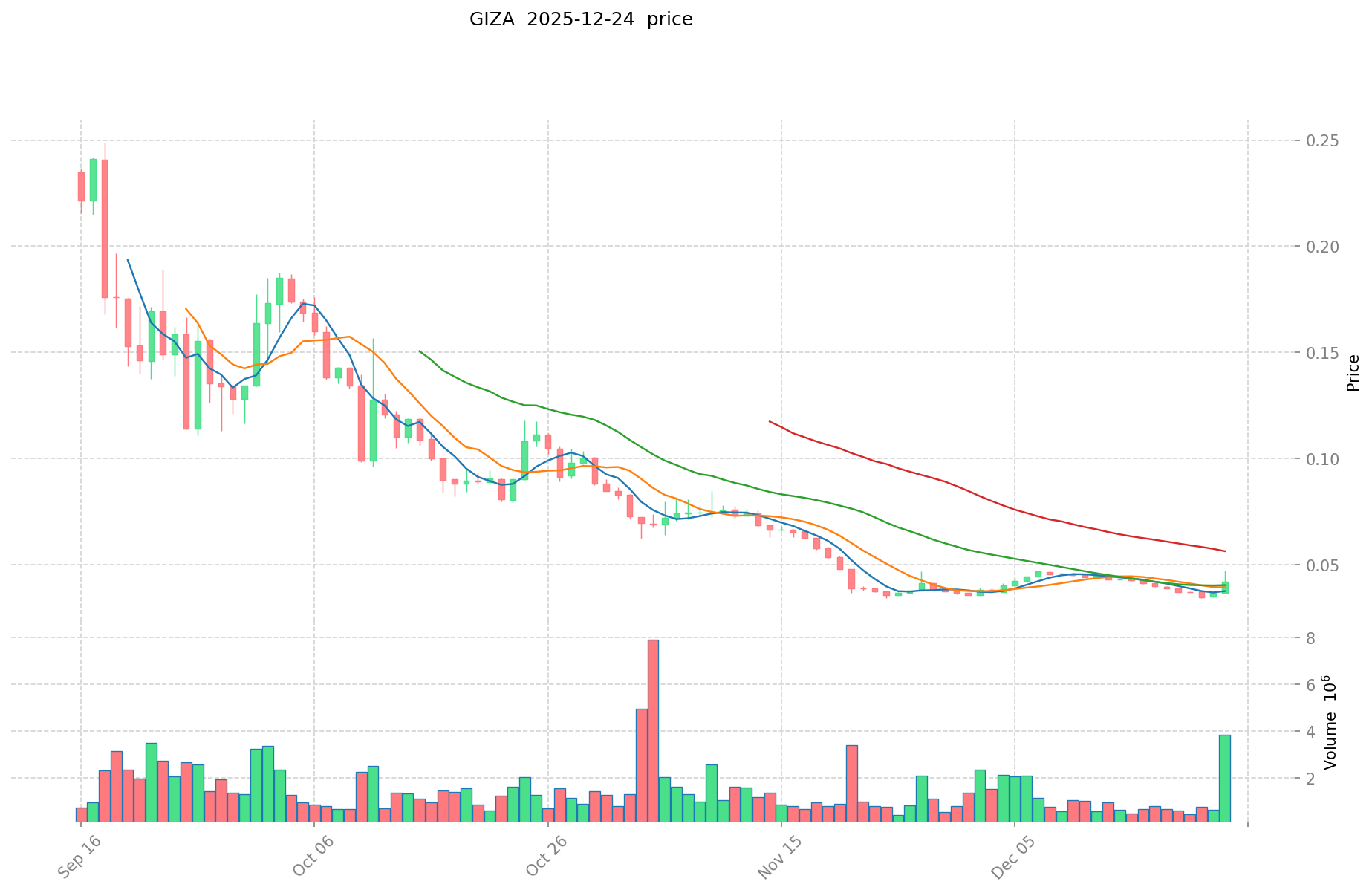
GIZA Historical Price Movements and Investment Performance
According to available market data, Giza (GIZA) demonstrates the following price trajectory:
- All-Time High (ATH): USD 0.50471 (recorded on June 8, 2025)
- All-Time Low (ATL): USD 0.03396 (recorded on December 21, 2025)
- Current Price: USD 0.04541 (as of December 24, 2025)
- Year-to-Date Performance: -37.80% (1-year basis)
The token has experienced significant volatility, with a decline of approximately 91% from its peak value within the same year. This represents a particularly challenging period for long-term holders, though short-term price recovery has been observed in recent weeks.
Current Market Status (December 24, 2025)
- Current Price: USD 0.04541
- Market Capitalization (Fully Diluted Valuation): USD 45,410,000
- 24-Hour Trading Volume: USD 134,713.40
- Market Dominance: 0.0014% of total cryptocurrency market
- Market Ranking: 1854
- 24-Hour Price Change: +3.77%
- 7-Day Price Change: +11.36%
- Market Sentiment: Neutral to mildly positive (recent recovery trend observed)
For real-time GIZA market pricing, visit Gate GIZA Market
II. Project Overview and Core Functionality
Project Definition
Giza Protocol powers agent-driven financial markets that transcend human cognitive limitations. The protocol represents an infrastructure layer designed to enable autonomous agents to participate in decentralized financial markets with minimal human oversight.
Technical Infrastructure
- Blockchain Network: Base EVM
- Contract Address: 0x590830dfdf9a3f68afcdde2694773debdf267774
- Token Standard: ERC-20 (Base)
- Official Website: https://www.gizatech.xyz/
- Social Presence: X/Twitter - @gizatechxyz
Token Distribution and Supply Metrics
- Total Supply: 1,000,000,000 GIZA
- Circulating Supply: 67,300,000 GIZA (6.73% of total supply)
- Fully Diluted Valuation (FDV): USD 45,410,000
- Market Cap to FDV Ratio: 6.73%
- Total Token Holders: 76,484
- Exchange Listing Count: 5 major exchanges
III. Market Position and Competitive Landscape
Position Within AI and Agent Infrastructure Sector
Giza operates within the emerging agent-driven finance segment alongside other protocol competitors including Modulus Labs and EZKL. This sector has garnered significant attention as a potential foundational layer for autonomous economic systems.
Market Challenges and Structural Headwinds
According to recent market analysis, agent-driven protocols including Giza face several material challenges:
- Token Value Capture Issues: Usage activity has not successfully converted into proportional token value appreciation
- Fee Structure Constraints: Marginal fee mechanisms limit revenue capture for protocol sustainability
- Market Structure Headwinds: The broader cryptocurrency market experienced substantial structural inefficiencies during 2025, with particular stress evident following October 2025 deleveraging events
- Token Unlock Pressure: Standard token vesting and release schedules create downward price pressure independent of fundamental protocol development
Competitive Positioning
In the emerging crypto-AI infrastructure landscape, markets have demonstrated preference for:
- Assets with mandatory economic participation (infrastructure choke points)
- Projects with identifiable cash flow generation mechanisms
- Protocols capturing genuine computing or financial processing value
- Systems with verifiable on-chain activity metrics
Giza and comparable agent protocols currently face the challenge that transaction volume has not yet translated into sustained protocol value extraction.
IV. Price Movement Analysis
Short-Term Volatility Metrics
| Time Period | Price Change |
|---|---|
| 1 Hour | +0.80% |
| 24 Hours | +3.77% |
| 7 Days | +11.36% |
| 30 Days | +25.21% |
| 1 Year | -37.80% |
The token demonstrates elevated volatility characteristic of small-cap assets. Recent recovery over 30-day and 7-day periods partially offsets year-to-date losses.
Price Range (24-Hour)
- High: USD 0.04701
- Low: USD 0.04053
V. Market Structure Assessment
Liquidity and Trading Conditions
- Primary Trading Pairs: Available across 5 exchange venues
- Daily Volume: USD 134,713.40
- Volume-to-Market-Cap Ratio: Indicating relatively constrained liquidity depth
The modest trading volume relative to market capitalization suggests potential execution challenges for larger transactions.
Holder Distribution
With 76,484 total holders, token distribution remains relatively fragmented, which may indicate:
- Broad retail participation
- Limited concentration risk from major institutional holders
- Reduced governance coordination capabilities
VI. Risk Assessment and Market Context
Sector-Specific Risks
Token Economics Challenges: The broader 2025 cryptocurrency market revealed structural vulnerabilities in token-based incentive models, particularly affecting projects where:
- Protocol activity exists but does not automatically generate token demand
- Fee mechanisms remain optional or low-friction
- Value capture pathways remain indirect or unclear
Market Structure Deterioration: October 2025 experienced significant market deleveraging that disproportionately affected mid-cap and emerging infrastructure tokens. All cryptocurrency assets showed elevated correlation (approaching 1.0) during stress events, indicating systemic rather than idiosyncratic risk factors.
Specific Project-Level Considerations
Giza's current challenges reflect broader market themes:
- Despite demonstrable real activity on-chain, token price has not maintained alignment with protocol usage metrics
- Fee mechanisms insufficient to create compelling tokenomic incentives
- Token unlock schedules and vesting mechanics represent ongoing dilution pressure
VII. Conclusions
GIZA currently trades near its all-time low following a -37.80% decline from peak valuation. While recent price recovery (11.36% over 7 days) indicates technical oversold conditions, the fundamental challenge remains the protocol's ability to convert measurable on-chain activity into sustainable token value capture.
The project represents a speculative position in the agent-driven finance infrastructure category. Investment consideration requires acceptance of:
- Substantial volatility and capital loss risk
- Uncertain timeline to token value alignment with protocol growth
- Exposure to broader cryptocurrency market structural risks
- Execution risk regarding competitive positioning in agent infrastructure
Disclaimer: This report presents factual market data and observed structural challenges within the sector. It does not constitute investment advice, price predictions, or recommendations regarding token acquisition or disposition. Cryptocurrency assets remain highly speculative. Readers should conduct independent due diligence and consult qualified financial advisors before making investment decisions.
Giza (GIZA) Investment Analysis Report
Report Date: December 24, 2025
Token Ticker: GIZA
Current Price: $0.04541
Market Capitalization: $3,056,093 USD
Market Rank: 1,854
I. Executive Summary
Giza Protocol powers agent-driven financial markets that transcend human cognitive limitations. As an emerging cryptocurrency project built on the Base blockchain, GIZA presents a mixed investment profile characterized by significant volatility and nascent market positioning.
II. Core Factors Influencing Whether Giza (GIZA) Is a Good Investment
Supply Mechanism and Scarcity
- Total Supply: 1,000,000,000 GIZA tokens
- Circulating Supply: 67,300,000 tokens (6.73% of total supply)
- Current Market Cap to FDV Ratio: 6.73%
The token exhibits a significant supply release schedule ahead, with only 6.73% of total tokens currently in circulation. This structural characteristic means substantial dilution potential exists as more tokens enter the market over time. The large proportion of locked or vested tokens introduces medium-to-long-term selling pressure that could impact price appreciation prospects.
Market Positioning and Trading Activity
- 24-Hour Trading Volume: $134,713.40
- Number of Holders: 76,484
- Exchange Presence: 5 exchanges
Trading volume remains modest relative to market capitalization, indicating limited market liquidity. The distributed holder base suggests healthy decentralization, though limited exchange availability may constrain accessibility for mainstream investors.
Price Performance Analysis
Price Volatility Metrics:
- 1-Hour Change: +0.80%
- 24-Hour Change: +3.77%
- 7-Day Change: +11.36%
- 30-Day Change: +25.21%
- 1-Year Change: -37.80%
Historical Price Range:
- All-Time High: $0.50471 (June 8, 2025)
- All-Time Low: $0.03396 (December 21, 2025)
- 24-Hour Range: $0.04053 - $0.04701
The token has declined 37.80% over the past year, currently trading near its all-time low established just days prior. Recent price action shows recovery momentum over shorter timeframes (25.21% gain in 30 days), though this follows extreme downside from historical peaks.
Technical Infrastructure
- Blockchain Network: Base (Ethereum Layer 2)
- Contract Address: 0x590830dfdf9a3f68afcdde2694773debdf267774
- Algorithm Base: BASE
Deployment on Base provides access to Ethereum security and liquidity infrastructure, though the Layer 2 ecosystem remains relatively nascent compared to mainnet alternatives.
III. Investment Sentiment and Market Assessment
The available market data indicates bearish technical indicators for GIZA in 2025, with predictions suggesting minimal near-term upside potential.
Market Sentiment Indicators:
- Current market emotion score indicates cautious positioning
- Expected ROI from current levels through end of December 2025 estimated at approximately 0.14%
- Multiple analysis sources reference bearish technical forecasts for the token
Price Predictions (2025):
- Average predicted price: $0.03713
- Predicted trading range: $0.03075 - $0.05309
- Low consensus: Subdued price appreciation prospects
IV. Risk Factors for GIZA Investment
- Early-Stage Project Risk: Limited adoption and unproven protocol-market fit
- Supply Dilution Risk: 93.27% of tokens remain unvested, creating long-term selling pressure
- Liquidity Risk: Modest 24-hour trading volume relative to market cap
- Market Volatility Risk: Historical drawdown from $0.50471 to $0.03396 represents 93.3% loss
- Limited Exchange Access: Presence on only 5 exchanges restricts market accessibility
V. Project Information
Official Channels:
- Website: https://www.gizatech.xyz/
- Twitter: https://x.com/gizatechxyz
- Block Explorer: https://basescan.org/token/0x590830dfdf9a3f68afcdde2694773debdf267774
Project Description: Giza Protocol focuses on developing agent-driven financial market infrastructure designed to overcome human cognitive limitations in trading and asset management.
VI. Conclusion
GIZA represents a high-risk, early-stage cryptocurrency asset with significant structural headwinds including substantial token supply dilution ahead and limited market adoption. Current market sentiment reflects skepticism regarding near-term price appreciation potential, with technical indicators suggesting bearish short-term momentum. Investors should conduct comprehensive due diligence and risk assessment prior to considering allocation to this asset class.
III. GIZA Future Investment Predictions and Price Outlook (Is Giza(GIZA) worth investing in 2025-2030)
Short-term Investment Prediction (2025, short-term GIZA investment outlook)
- Conservative forecast: US$0.0339 - US$0.0452
- Neutral forecast: US$0.0452 - US$0.0588
- Optimistic forecast: US$0.0588 - US$0.0650
Mid-term Investment Outlook (2026-2028, mid-term Giza(GIZA) investment forecast)
- Market stage expectation: Consolidation phase with gradual recovery, transition from early adoption to mainstream recognition
- Investment return forecast:
- 2026: US$0.0406 - US$0.0614 (14% upside potential)
- 2027: US$0.0522 - US$0.0703 (24% upside potential)
- 2028: US$0.0495 - US$0.0686 (39% upside potential)
- Key catalysts: Agent-driven financial market development, ecosystem expansion on Base network, institutional adoption of AI-powered trading protocols
Long-term Investment Outlook (Is Giza a good long-term investment?)
- Base scenario: US$0.0646 - US$0.0929 (assuming steady protocol adoption and market development)
- Optimistic scenario: US$0.0743 - US$0.1050 (assuming breakthrough in agent-driven finance and mainstream integration)
- Risk scenario: US$0.0300 - US$0.0500 (extreme market contraction or protocol adoption delays)
Click to view GIZA long-term investment and price prediction: Price Prediction
2025-12-24 to 2030 Long-term Outlook
- Base scenario: US$0.0646 - US$0.0929 (corresponding to steady advancement and mainstream application growth)
- Optimistic scenario: US$0.0929 - US$0.1200 (corresponding to large-scale adoption and favorable market conditions)
- Transformative scenario: US$0.1500 and above (if ecosystem achieves breakthrough progress and mainstream adoption)
- 2030-12-31 predicted peak: US$0.0929 (based on optimistic development assumptions)
Disclaimer
| 年份 | 预测最高价 | 预测平均价格 | 预测最低价 | 涨跌幅 |
|---|---|---|---|---|
| 2025 | 0.058799 | 0.04523 | 0.0339225 | 0 |
| 2026 | 0.06137711 | 0.0520145 | 0.04057131 | 14 |
| 2027 | 0.0703027982 | 0.056695805 | 0.0521601406 | 24 |
| 2028 | 0.068579245728 | 0.0634993016 | 0.049529455248 | 39 |
| 2029 | 0.08254909208 | 0.066039273664 | 0.05349181166784 | 45 |
| 2030 | 0.09286772859 | 0.074294182872 | 0.06463593909864 | 63 |
Giza (GIZA) Investment Analysis Report
I. Project Overview
Basic Information
Giza Protocol powers agent-driven financial markets that transcend human cognitive limitations.
| Metric | Value |
|---|---|
| Ticker | GIZA |
| Current Price | $0.04541 |
| Market Cap | $3,056,093.0 |
| Fully Diluted Valuation | $45,410,000.0 |
| Circulating Supply | 67,300,000 GIZA |
| Total Supply | 1,000,000,000 GIZA |
| Market Dominance | 0.0014% |
| Token Holders | 76,484 |
| Market Ranking | 1,854 |
Network & Deployment
- Blockchain: Base EVM
- Contract Address: 0x590830dfdf9a3f68afcdde2694773debdf267774
- Available Exchanges: 5 trading pairs
Official Channels
- Website: https://www.gizatech.xyz/
- Twitter: https://x.com/gizatechxyz
- Block Explorer: https://basescan.org/token/0x590830dfdf9a3f68afcdde2694773debdf267774
II. Market Performance Analysis
Price Performance
- Current Price: $0.04541 (as of December 24, 2025)
- 24H Price Change: +3.77% ($0.00165 increase)
- 7D Price Change: +11.36%
- 30D Price Change: +25.21%
- 1Y Price Change: -37.80%
Volatility Metrics
- 24H High: $0.04701
- 24H Low: $0.04053
- All-Time High: $0.50471 (June 8, 2025)
- All-Time Low: $0.03396 (December 21, 2025)
- 1H Volatility: +0.8%
Trading Activity
- 24H Volume: $134,713.40
- Circulation Ratio: 6.73%
- Market Cap to FDV Ratio: 6.73%
III. Technical & Fundamental Assessment
Token Economics
The token distribution shows a significant concentration phase, with only 6.73% of the total supply currently in circulation. This indicates an early-stage project with substantial token release scheduled over time.
Market Characteristics
- Market Sentiment: Positive (Score: 1)
- Early Development Stage: With only 67.3M tokens circulating out of 1B total supply, Giza is in an early expansion phase
- Growing Holder Base: 76,484 token holders suggest increasing adoption and distribution
Identified Risks
- Extreme Price Volatility: The token has experienced significant drawdowns from ATH (-93.25% from peak)
- Limited Trading Liquidity: 24H volume of ~$134K relative to market cap suggests limited market depth
- Concentration Risk: Low circulation ratio indicates majority of tokens remain locked or reserved
IV. Investment Strategy & Risk Management
Investment Methodology
Long-term Holding (HODL GIZA)
- Suitable for investors with high risk tolerance
- Aligned with early-stage AI agent infrastructure plays
- Requires patience through high volatility cycles
Active Trading
- Dependent on technical analysis given limited fundamental data
- Range trading between support ($0.04053) and resistance levels
- Requires active monitoring given thin liquidity
Risk Management
Asset Allocation Guidelines
- Conservative Investors: 0-1% portfolio allocation maximum
- Active Traders: 1-3% of trading capital
- Specialized Investors: Up to 5% for those focused on AI agent infrastructure
Risk Mitigation Strategies
- Diversification across multiple blockchain infrastructure plays
- Dollar-cost averaging to manage entry points during volatility
- Position sizing appropriate to individual risk tolerance
Secure Storage
- Hot Wallets: MetaMask or similar for active trading (Base network compatible)
- Cold Storage: Hardware wallets (Ledger, Trezor) for long-term holdings
- Multi-Signature Setup: Recommended for larger positions
V. Investment Risks & Challenges
Market Risks
- High Volatility: 93.25% decline from ATH demonstrates extreme price fluctuations
- Limited Liquidity: Relatively low trading volume creates execution risk
- Market Manipulation: Small market cap vulnerable to coordinated trading activity
Regulatory Risks
- Evolving Regulatory Landscape: Uncertain regulatory treatment of AI-driven financial protocols across jurisdictions
- Compliance Uncertainty: Unclear regulatory framework for agent-driven markets
Technology Risks
- Network Security: Smart contract vulnerabilities on Base EVM
- Protocol Adoption: Success dependent on market adoption of agent-driven financial infrastructure
- Competitive Pressure: Multiple projects competing in AI agent space
Tokenomics Risks
- Massive Token Dilution: 1B token supply with only 6.73% circulating creates severe dilution potential
- Unlock Schedule: Future token releases could apply significant selling pressure
VI. Conclusion: Is Giza (GIZA) a Good Investment?
Investment Value Summary
Giza Protocol represents a speculative early-stage investment in the emerging AI agent-driven financial infrastructure space. While the underlying concept addresses innovative market structures beyond human cognitive limitations, the token exhibits characteristics typical of highly speculative assets: extreme volatility, limited liquidity, and massive dilution potential.
Key Observations:
- Positive short-term momentum (+25.21% over 30 days)
- Severe long-term underperformance (-37.80% over 1 year)
- Critical vulnerability to further dilution from token releases
Investor Recommendations
✅ Newcomers: Not recommended without substantial crypto experience; if interested, implement strict dollar-cost averaging with maximum 0.5-1% portfolio allocation and store exclusively in cold storage.
✅ Experienced Traders: Consider limited positions (1-3%) for speculative exposure to AI infrastructure theme; utilize technical analysis for entry/exit; maintain stop-loss discipline.
✅ Institutional Investors: Evaluate only within dedicated allocation to early-stage blockchain infrastructure; requires thorough tokenomics and protocol analysis before commitment.
⚠️ Disclaimer: Cryptocurrency investments carry substantial risk, including total capital loss. This report is for informational purposes only and does not constitute investment advice. Conduct independent research and consult qualified financial advisors before making investment decisions. Past performance does not guarantee future results.
Giza (GIZA) Frequently Asked Questions
I. What is Giza Protocol and how does it function?
Answer: Giza Protocol is an agent-driven financial protocol built on the Base blockchain that enables autonomous agents to participate in decentralized financial markets with minimal human oversight. The protocol positions itself as infrastructure designed to transcend human cognitive limitations in financial markets. GIZA operates as an ERC-20 token (contract address: 0x590830dfdf9a3f68afcdde2694773debdf267774) with a total supply of 1,000,000,000 tokens, of which only 67,300,000 (6.73%) currently circulate in the market.
II. What are the current price metrics and market position of GIZA?
Answer: As of December 24, 2025, GIZA trades at $0.04541 with a market capitalization of $3,056,093 and fully diluted valuation of $45,410,000. The token ranks 1,854 in overall market dominance (0.0014% of total crypto market). Historical performance shows an all-time high of $0.50471 (June 8, 2025) and all-time low of $0.03396 (December 21, 2025), representing a 93.25% decline from peak valuation. Recent momentum indicates +3.77% change in 24 hours, +11.36% over 7 days, and +25.21% over 30 days, though year-to-date performance remains -37.80%.
III. What are the primary risk factors associated with GIZA investment?
Answer: GIZA presents multiple material risk categories. Token economics challenges include 93.27% of supply remaining unvested, creating substantial future dilution pressure. Market structure risks encompass limited liquidity with 24-hour trading volume of only $134,713.40 relative to market cap, available on merely 5 exchanges with only 76,484 total holders. Extreme volatility represents another critical concern, with the token experiencing 93.25% decline from historical peak. Sector-specific risks include unproven protocol-market fit for agent-driven finance, uncertain token value capture mechanisms, and exposure to broader cryptocurrency market structural deterioration observed during 2025.
IV. What price forecasts exist for GIZA through 2030?
Answer: Multiple timeframe projections exist based on available market analysis. Short-term forecasts (2025) range from $0.0339-$0.0650 depending on market scenario. Mid-term outlooks (2026-2028) suggest recovery phases with 2026 projected at $0.0406-$0.0614 (14% upside potential), 2027 at $0.0522-$0.0703 (24% upside), and 2028 at $0.0495-$0.0686 (39% upside). Long-term projections through 2030 indicate base scenarios of $0.0646-$0.0929, optimistic scenarios reaching $0.0929-$0.1200, and transformative scenarios exceeding $0.1500. These projections assume steady protocol adoption and favorable market development, though significant execution risk remains.
V. How does GIZA token supply structure impact investment potential?
Answer: GIZA's supply mechanics present both opportunity and risk. The total supply of 1,000,000,000 tokens with only 67,300,000 circulating (6.73% ratio) indicates substantial token release schedules ahead. This structural characteristic creates significant dilution potential as vested tokens enter the market over time. The extremely low circulation ratio suggests two interpretations: early-stage positioning with growth potential, or concentrated selling pressure risk as tokens unlock. Investors should recognize this supply dynamic may suppress price appreciation independent of protocol fundamentals, as ongoing dilution counteracts positive developments in protocol adoption.
VI. What is the recommended investment approach for different investor profiles?
Answer: Investment suitability varies by investor experience level. New cryptocurrency investors should avoid GIZA without substantial crypto market experience; if interested despite risks, implement strict dollar-cost averaging with maximum 0.5-1% portfolio allocation and mandate cold storage custody exclusively. Experienced traders may consider limited speculative positions (1-3% of trading capital) utilizing technical analysis for precise entry/exit points with disciplined stop-loss protocols. Institutional investors should evaluate GIZA only within dedicated early-stage blockchain infrastructure allocations following comprehensive tokenomics and protocol analysis. All investor categories should recognize GIZA represents speculative infrastructure exposure requiring acceptance of substantial volatility and potential total capital loss.
VII. What liquidity constraints and trading challenges exist for GIZA?
Answer: GIZA exhibits material liquidity limitations that may constrain investment execution. Twenty-four-hour trading volume of approximately $134,713.40 relative to $3,056,093 market capitalization creates potentially restrictive depth for larger transactions. The token trades on only 5 exchange venues, limiting accessibility compared to major exchange-listed assets. This constrained liquidity environment means market orders for significant positions could experience substantial slippage, potentially disadvantaging entry and exit execution. Prospective investors should anticipate liquidity challenges when attempting to build meaningful positions, particularly during volatile market conditions, and prioritize limit orders over market execution to manage pricing impact.
VIII. How do fundamental protocol metrics align with GIZA token valuation?
Answer: Current market analysis reveals material disconnect between protocol activity and token value capture. Despite demonstrable on-chain agent activity within Giza Protocol, the token has not maintained valuation alignment with protocol usage metrics, declining -37.80% year-to-date. The fundamental challenge reflects structural tokenomic weaknesses: insufficient fee mechanisms to create compelling token demand, marginal value capture pathways that fail to convert protocol usage into token appreciation, and indirect incentive structures that do not automatically link protocol growth to token economics. This misalignment between protocol fundamentals and token performance represents the core investment risk, suggesting either protocol adoption remains insufficient for token utility validation or tokenomic redesign is necessary to establish sustainable value capture mechanisms aligned with protocol development trajectory.
Disclaimer: This FAQ provides factual information regarding GIZA Protocol and market conditions as of December 24, 2025. It does not constitute investment advice, price predictions, or recommendations for token acquisition or disposition. Cryptocurrency investments carry substantial risk including potential total capital loss. Readers must conduct independent due diligence and consult qualified financial advisors before making investment decisions.
Share
How to Buy Cryptocurrency


Trending Cryptocurrencies



Is INFINIT (IN) a good investment?: Analyzing Market Potential and Risks of the Emerging Digital Asset

Is Griffin AI (GAIN) a good investment?: Analyzing the Potential and Risks of this Emerging AI Stock

BCUT vs SNX: Comparative Analysis of Two Leading Video Editing Platforms for Content Creators

PUNDIAI vs QNT: Comparing Two Innovative Blockchain Solutions for Enterprise Integration

AIC vs AVAX: Comparing Two Blockchain Platforms for Smart Contract Development

Is Creator Bid (BID) a Good Investment?: Analyzing the Potential Returns and Risks in the Creator Economy Token

Pi Network Prepares to Launch PiBank Digital Banking and Pi Smart Contracts for Financial Revolution

What is an NFT?

How to Buy Solana: A Step-By-Step Guide

What is Bitcoin and How Does It Work?

PEPE Price Outlook: Analysis and Key Factors