VTHO vs ATOM: A Comparative Analysis of Two Blockchain Ecosystems and Their Potential for Long-Term Growth


Introduction: Investment Comparison of VTHO vs ATOM
In the cryptocurrency market, the comparison between VTHO vs ATOM has always been a topic that investors can't ignore. The two not only have significant differences in market cap ranking, application scenarios, and price performance, but also represent different positioning of crypto assets.
VeThor (VTHO): Since its launch in 2018, it has gained market recognition for its role in the VeChain ecosystem as a gas token.
Cosmos (ATOM): Since its inception in 2019, it has been hailed as the "Internet of Blockchains," and is one of the leading cryptocurrencies in terms of global trading volume and market capitalization.
This article will comprehensively analyze the investment value comparison between VTHO vs ATOM, focusing on historical price trends, supply mechanisms, institutional adoption, technological ecosystems, and future predictions, and attempt to answer the question that investors care about most:
"Which is the better buy right now?"
I. Price History Comparison and Current Market Status
VTHO and ATOM Historical Price Trends
- 2022: VTHO experienced a significant price decline due to the overall crypto market downturn.
- 2022: ATOM was impacted by the broader market crash, but showed relative resilience compared to many other cryptocurrencies.
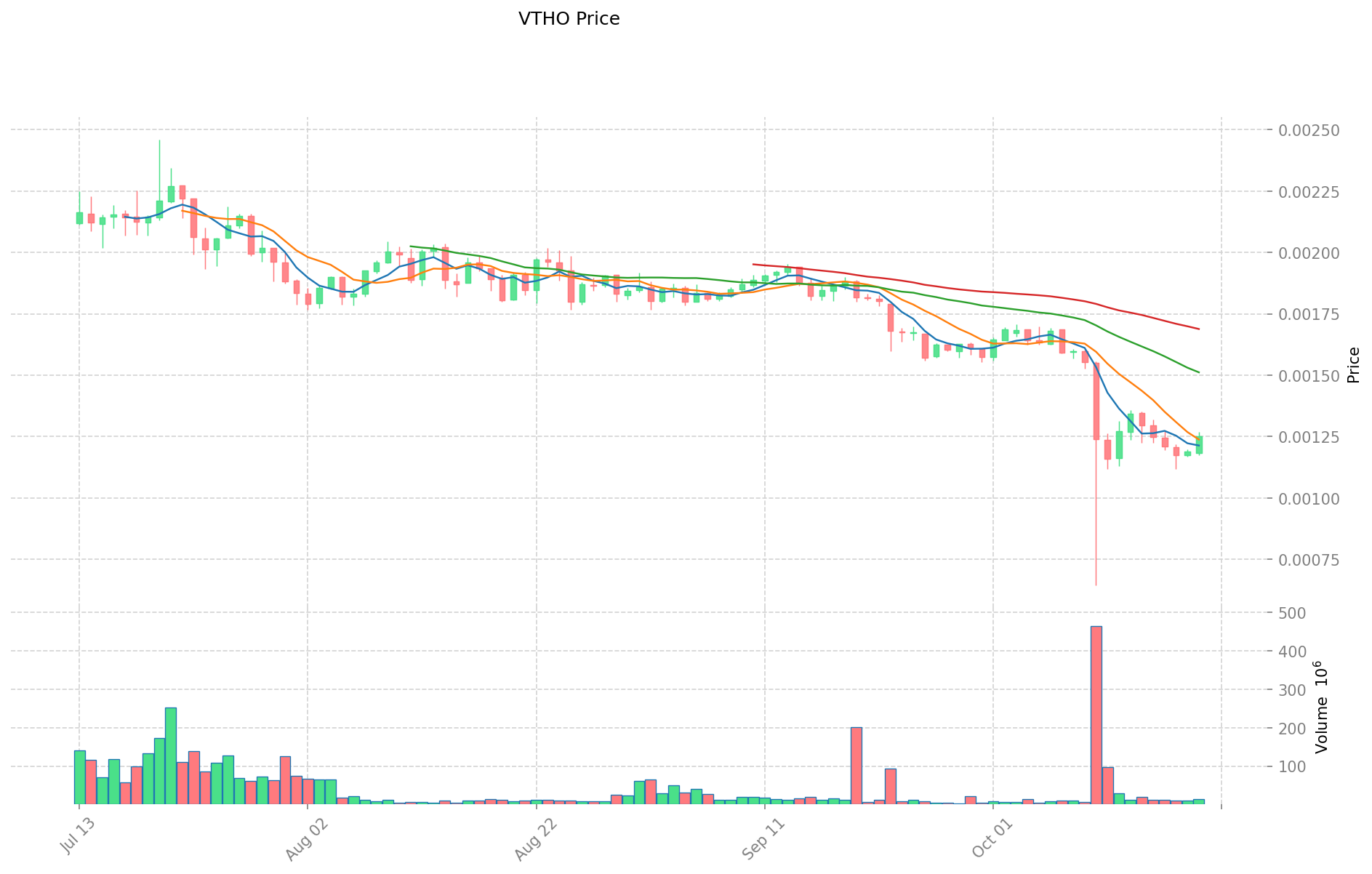
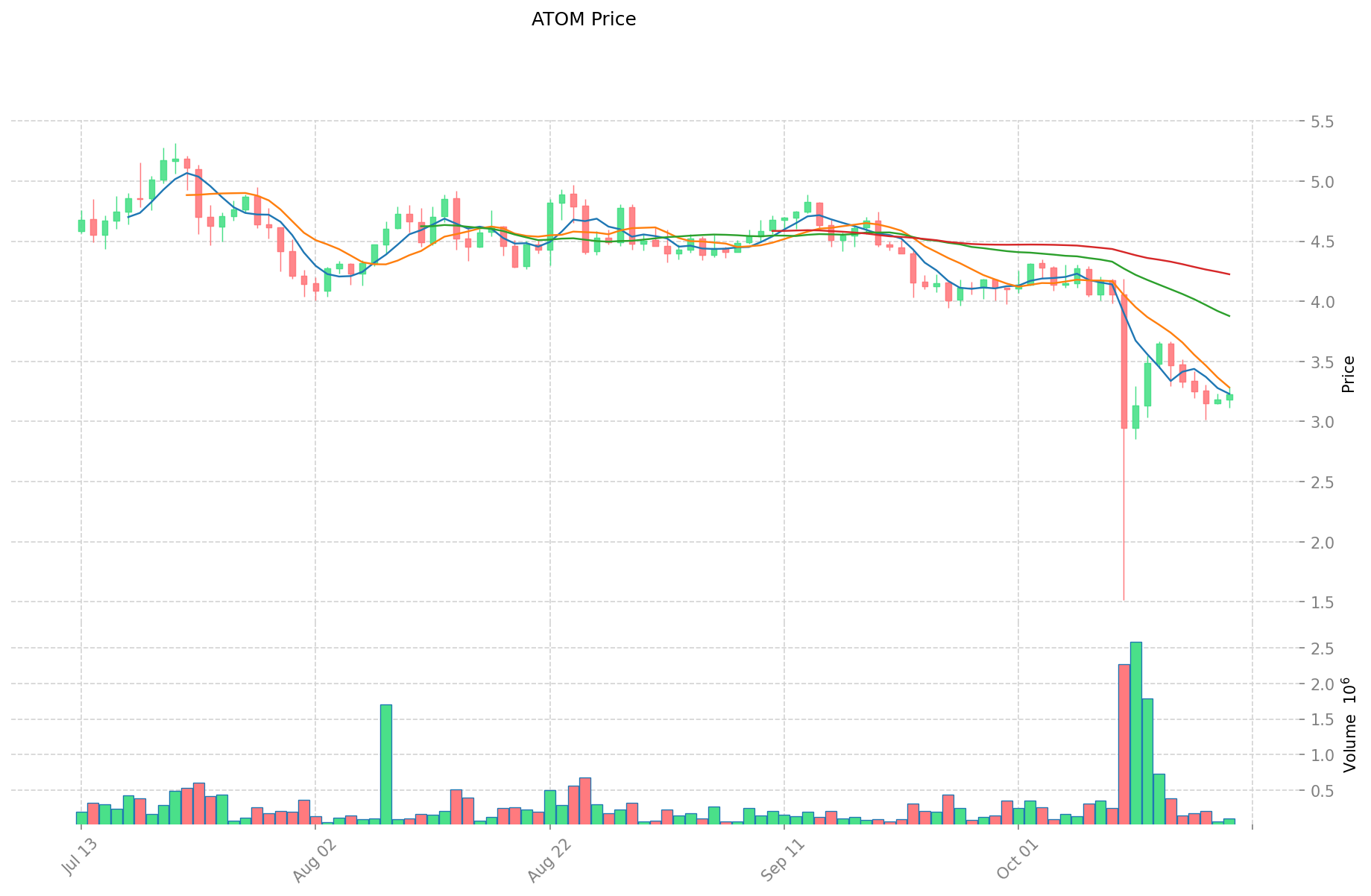
- Comparative Analysis: During the 2022 bear market, VTHO dropped from its all-time high of $0.04671227 to a low of $0.00015238, while ATOM declined from its peak of $44.45 to a low of $1.16, but managed to maintain a higher market capitalization.
Current Market Situation (2025-10-20)
- VTHO current price: $0.00125
- ATOM current price: $3.229
- 24-hour trading volume: VTHO $17,771.57 vs ATOM $305,833.96
- Market Sentiment Index (Fear & Greed Index): 29 (Fear)
Click to view real-time prices:
- View VTHO current price Market Price
- View ATOM current price Market Price
II. Core Factors Affecting the Investment Value of VTHO vs ATOM
Supply Mechanism Comparison (Tokenomics)
-
VTHO: Generated as VeChain Thor blockchain usage fee, continuously minted based on VET holdings at a rate of 0.000432 VTHO per VET per day
-
ATOM: Inflationary model with annual inflation ranging between 7-20%, adjusted based on staking participation rates
-
📌 Historical Pattern: VTHO's supply expands based on network usage, while ATOM's inflation mechanism encourages staking for network security.
Institutional Adoption and Market Applications
- Institutional Holdings: ATOM has gained more institutional interest through Cosmos ecosystem investments and validator participation
- Enterprise Adoption: VTHO is used by enterprises on VeChainThor for supply chain tracking, while ATOM powers the inter-blockchain communication in the Cosmos ecosystem
- National Policies: Both tokens face varied regulatory treatment globally, with ATOM's governance utility providing some regulatory clarity compared to VTHO's utility token status
Technical Development and Ecosystem Building
- VTHO Technical Upgrades: Fee delegation protocol allows sponsors to pay transaction fees for users, enhancing enterprise adoption
- ATOM Technical Development: IBC (Inter-Blockchain Communication) protocol enables cross-chain interoperability across the Cosmos ecosystem
- Ecosystem Comparison: ATOM has a more diverse DeFi ecosystem with applications like Osmosis, while VTHO is primarily focused on supply chain management and enterprise applications
Macroeconomic Factors and Market Cycles
- Performance in Inflationary Environments: ATOM's staking rewards offer inflation protection, while VTHO's value is tied to VeChain network activity
- Macroeconomic Monetary Policy: Interest rates impact both tokens, with ATOM's staking yield competing with traditional interest-bearing assets
- Geopolitical Factors: VeChain's strong presence in China exposes VTHO to regional regulatory risks, while ATOM's decentralized validator network provides more geopolitical diversification
III. 2025-2030 Price Prediction: VTHO vs ATOM
Short-term Prediction (2025)
- VTHO: Conservative $0.00096876 - $0.001242 | Optimistic $0.001242 - $0.00176364
- ATOM: Conservative $2.02734 - $3.218 | Optimistic $3.218 - $4.15122
Mid-term Prediction (2027)
- VTHO may enter a growth phase, with expected prices ranging from $0.00091521738 to $0.00165685905
- ATOM may enter a bullish market, with expected prices ranging from $3.7548018205 to $5.484541985
- Key drivers: Institutional capital inflow, ETF, ecosystem development
Long-term Prediction (2030)
- VTHO: Base scenario $0.001339797768309 - $0.002232996280515 | Optimistic scenario $0.002232996280515 - $0.002791245350643
- ATOM: Base scenario $6.199001034638445 - $7.044319357543687 | Optimistic scenario $7.044319357543687 - $7.748751293298056
Disclaimer: This analysis is based on historical data and market projections. Cryptocurrency markets are highly volatile and unpredictable. This information should not be construed as financial advice. Always conduct your own research before making investment decisions.
VTHO:
| 年份 | 预测最高价 | 预测平均价格 | 预测最低价 | 涨跌幅 |
|---|---|---|---|---|
| 2025 | 0.00176364 | 0.001242 | 0.00096876 | 0 |
| 2026 | 0.001653102 | 0.00150282 | 0.0007814664 | 20 |
| 2027 | 0.00165685905 | 0.001577961 | 0.00091521738 | 26 |
| 2028 | 0.0021673294335 | 0.001617410025 | 0.00129392802 | 29 |
| 2029 | 0.00257362283178 | 0.00189236972925 | 0.00113542183755 | 51 |
| 2030 | 0.002791245350643 | 0.002232996280515 | 0.001339797768309 | 78 |
ATOM:
| 年份 | 预测最高价 | 预测平均价格 | 预测最低价 | 涨跌幅 |
|---|---|---|---|---|
| 2025 | 4.15122 | 3.218 | 2.02734 | 0 |
| 2026 | 4.7531469 | 3.68461 | 2.1370738 | 14 |
| 2027 | 5.484541985 | 4.21887845 | 3.7548018205 | 31 |
| 2028 | 6.937945611025 | 4.8517102175 | 3.39619715225 | 50 |
| 2029 | 8.193810800824875 | 5.8948279142625 | 4.185327819126375 | 83 |
| 2030 | 7.748751293298056 | 7.044319357543687 | 6.199001034638445 | 118 |
IV. Investment Strategy Comparison: VTHO vs ATOM
Long-term vs Short-term Investment Strategy
- VTHO: Suitable for investors focused on enterprise adoption and supply chain applications
- ATOM: Suitable for investors looking for ecosystem growth and interoperability potential
Risk Management and Asset Allocation
- Conservative investors: VTHO: 30% vs ATOM: 70%
- Aggressive investors: VTHO: 40% vs ATOM: 60%
- Hedging tools: Stablecoin allocation, options, cross-token combinations
V. Potential Risk Comparison
Market Risk
- VTHO: Highly dependent on VeChain ecosystem adoption and enterprise usage
- ATOM: Exposed to competition from other interoperability solutions and layer-1 protocols
Technical Risk
- VTHO: Scalability, network stability
- ATOM: Validator concentration, potential security vulnerabilities in IBC
Regulatory Risk
- Global regulatory policies may impact both tokens differently, with ATOM potentially facing less scrutiny due to its governance utility
VI. Conclusion: Which Is the Better Buy?
📌 Investment Value Summary:
- VTHO advantages: Strong enterprise adoption, tied to real-world supply chain use cases
- ATOM advantages: Diverse ecosystem, interoperability focus, staking incentives
✅ Investment Advice:
- New investors: Consider a higher allocation to ATOM due to its broader ecosystem and potential for growth
- Experienced investors: Balanced approach, with slightly higher weight on ATOM while monitoring VTHO's enterprise adoption progress
- Institutional investors: Focus on ATOM for its institutional-grade staking and ecosystem development opportunities
⚠️ Risk Warning: Cryptocurrency markets are highly volatile. This article does not constitute investment advice. None
VII. FAQ
Q1: What are the main differences between VTHO and ATOM? A: VTHO is a utility token for the VeChain ecosystem, primarily used for transaction fees and supply chain applications. ATOM is the native token of the Cosmos network, focused on interoperability between blockchains and has a more diverse DeFi ecosystem.
Q2: Which token has shown better price performance historically? A: ATOM has generally shown better price performance and resilience compared to VTHO. During the 2022 bear market, ATOM maintained a higher market capitalization despite significant price declines for both tokens.
Q3: How do the supply mechanisms of VTHO and ATOM differ? A: VTHO is generated based on VET holdings at a rate of 0.000432 VTHO per VET per day. ATOM has an inflationary model with annual inflation ranging between 7-20%, adjusted based on staking participation rates.
Q4: Which token has gained more institutional adoption? A: ATOM has gained more institutional interest through investments in the Cosmos ecosystem and validator participation, while VTHO's adoption is primarily focused on enterprise use in supply chain management.
Q5: What are the key technical developments for each token? A: VTHO has implemented a fee delegation protocol to enhance enterprise adoption. ATOM has developed the Inter-Blockchain Communication (IBC) protocol, enabling cross-chain interoperability across the Cosmos ecosystem.
Q6: How do the long-term price predictions compare for VTHO and ATOM? A: By 2030, VTHO is predicted to reach $0.001339797768309 - $0.002791245350643, while ATOM is expected to reach $6.199001034638445 - $7.748751293298056 in the base to optimistic scenarios.
Q7: Which token is considered a better buy for different types of investors? A: New investors may consider a higher allocation to ATOM due to its broader ecosystem and growth potential. Experienced investors might take a balanced approach with a slight preference for ATOM. Institutional investors may focus on ATOM for its institutional-grade staking and ecosystem development opportunities.
Q8: What are the main risks associated with investing in VTHO and ATOM? A: VTHO faces risks related to VeChain ecosystem adoption and enterprise usage. ATOM is exposed to competition from other interoperability solutions and layer-1 protocols. Both tokens are subject to market volatility, technical risks, and evolving regulatory landscapes.
Share
Content
Introduction: Investment Comparison of VTHO vs ATOM
I. Price History Comparison and Current Market Status
II. Core Factors Affecting the Investment Value of VTHO vs ATOM
III. 2025-2030 Price Prediction: VTHO vs ATOM
IV. Investment Strategy Comparison: VTHO vs ATOM
V. Potential Risk Comparison
VI. Conclusion: Which Is the Better Buy?
VII. FAQ
How to Buy Cryptocurrency


Trending Cryptocurrencies



AERO vs ATOM: Comparing Two Cutting-Edge Processor Architectures for Mobile Devices

How Does Cryptocurrency Fund Flow Impact Exchange Holdings and On-Chain Metrics?
2025 NTRN Price Prediction: Future Market Trends and Investment Potential Analysis
YB vs ATOM: The Battle of Digital Asset Platforms Shaping the Future of Finance

NAVX vs ATOM: Comparing Two Leading Navigation Systems for Autonomous Vehicles
SLN vs ATOM: Comparing Two Popular XML-based Chemical File Formats for Molecular Modeling

DEEPSEEK vs QNT: A Comprehensive Comparison of Two Leading AI and Quantum Computing Platforms

CGPU vs TRX: A Comprehensive Comparison of Two Leading Blockchain Assets and Their Market Performance

What is a keylogger? How can you detect one?

Understanding Bitcoin: Native SegWit vs. Taproot

The $9 Trillion XRP Claim: Fact or Fiction?