


merge mining
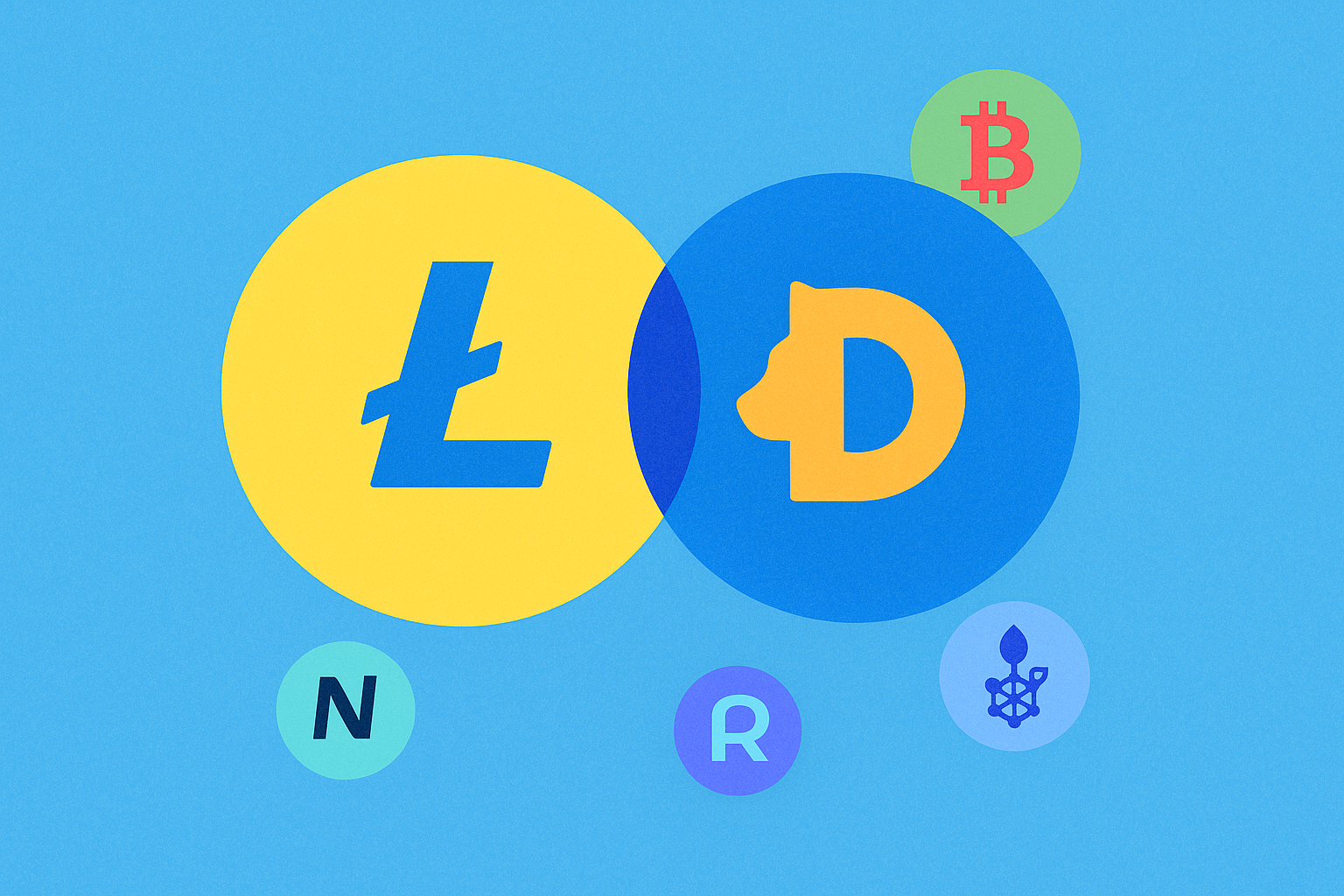
What Is Merged Mining?
Merged mining refers to the process of using a single computational effort to mine blocks for two blockchains that share the same mining algorithm. In essence, it means “recording the results of one mining job on two different ledgers.” Miners do not need to increase their hash rate to receive rewards from both chains.
Here, “work” refers to Proof of Work (PoW)—using computational power to repeatedly try random numbers in order to solve a cryptographic puzzle and find a hash that meets the required difficulty. If a solution meets the criteria, it can be accepted by both the main chain and an auxiliary chain, provided both support the same algorithm and compatible validation rules.
Why Did Merged Mining Emerge?
Merged mining was introduced to address two main issues: the lack of security on smaller chains and inefficiencies in miners’ earnings. Smaller blockchains with weak hash rates are more vulnerable to attacks, while miners who focus only on these chains face higher opportunity costs.
By allowing smaller chains to "borrow" the hash rate of larger chains through merged mining, the cost for attackers increases, enhancing the security of the smaller chain. For miners, the same power and equipment yield higher overall output, increasing mining efficiency—especially when electricity costs or token prices fluctuate.
How Does Merged Mining Work?
The core mechanism behind merged mining is Auxiliary Proof of Work (AuxPoW). The auxiliary chain includes a proof within its block that references a valid computation performed for the main chain, demonstrating that the work was genuinely completed.
Practically, a mining pool constructs two block templates, enabling miners to work under the same algorithm. When a miner finds a hash meeting the main chain’s difficulty, the pool submits this result as a block on the main chain; simultaneously, it packages related proof data into the auxiliary chain’s block (including evidence pointing to the main chain’s block header), enabling the auxiliary chain to verify the legitimacy of the work. Both chains then independently confirm their respective blocks.
How Does Merged Mining Operate in Mining Pools?
In mining pools, merged mining is managed by the pool, which merges tasks from both chains. Miners simply follow the pool’s parameters to mine. The pool uses submitted “shares” (low-difficulty solutions) to track contributions and submits valid results meeting each chain’s difficulty to their respective networks.
Typically, pools distribute rewards from both chains according to pre-set ratios. Miners just need to bind their payout addresses for both chains in their dashboard. For miners, additional overhead is mainly limited to network bandwidth and data packaging—computational load scarcely increases. However, pools must handle greater complexity, maintaining separate nodes and packaging logic for each chain.
Real-World Examples of Merged Mining
One of the earliest examples is merged mining between Namecoin and Bitcoin. In 2011, Namecoin introduced AuxPoW, enabling it to share Bitcoin’s hash rate (timeline: 2011).
Another well-known case is Dogecoin and Litecoin. In 2014, the Dogecoin community adopted merged mining with Litecoin—both using the Scrypt algorithm—and most Litecoin pools began supporting simultaneous DOGE mining (trend established from 2014 onward and still prevalent as of 2024).
Additionally, Bitcoin and RSK participate in merged mining. RSK is a smart contract platform positioned as a Bitcoin sidechain; it launched its mainnet with merged mining in 2018 (timeline: 2018). Public reports indicate that between 2019-2023, RSK repeatedly cited significant coverage of Bitcoin’s hash rate via merged mining (data from 2019-2023).
What Are the Benefits of Merged Mining for Miners and Projects?
For miners, merged mining enables dual-chain rewards without increasing electricity costs, improving returns per unit of energy consumed. For projects—especially smaller chains—merged mining significantly raises security thresholds and resistance to attacks.
Take Litecoin and Dogecoin as an example: miners use the Scrypt algorithm to mine Litecoin while simultaneously earning DOGE rewards; for Dogecoin’s network, hash power from Litecoin’s ecosystem boosts its security. Early-stage Namecoin and RSK similarly leveraged Bitcoin’s ecosystem hash power and node infrastructure, making network reorganizations far more difficult for attackers.
What Risks Are Associated With Merged Mining?
First, there are risks related to technical complexity and dependency. Since auxiliary chains anchor their validation on work performed for the main chain, poor protocol design can create vulnerabilities; excessive reliance on the main chain’s timing or block production may also cause unexpected delays or synchronization issues.
Second, there is a risk of mining pool centralization. Merged mining increases operational demands on pools, potentially leading to further concentration of hash power among a few large pools—introducing governance risks and single points of failure.
Third, there is risk from earnings volatility and settlement errors. Token prices, difficulty levels, and transaction fees fluctuate across both chains; pool allocation rules, payout delays, and orphan block rates all impact final returns. Newcomers unfamiliar with fee rates, minimum withdrawal thresholds, or settlement cycles may experience unexpected outcomes.
Fourth, there are compliance and investment risks. Regulations on mining and token trading vary by region; always research local policies before participating. For those primarily interested in asset prices, trading on exchanges exposes you to price volatility and liquidity risks.
How Can Beginners Start Merged Mining and Choose Wisely?
Step 1: Confirm Algorithm Compatibility. Merged mining requires both chains to use the same mining algorithm—for example, Litecoin and Dogecoin with Scrypt, or SHA-256 for Bitcoin with Namecoin/RSK.
Step 2: Choose a Pool That Supports Merged Mining. Check whether your pool explicitly supports your desired pairings and review their fees, payout methods, and minimum withdrawal amounts.
Step 3: Prepare Node or Wallet Addresses. Bind payout addresses for both chains in your mining pool dashboard; ensure addresses match each blockchain to avoid misdirected payments.
Step 4: Configure Mining Software. Set up your miner using the connection URL, username, and password parameters provided by your pool; test stability on backup or test pools first.
Step 5: Monitor Earnings and Risks. Watch each chain’s difficulty level, reward adjustments, and token price fluctuations. If you focus mainly on market trends, you can use Gate to track assets like DOGE or LTC and stay updated via announcements—using hashrate trends as learning reference. Always assess your risk tolerance before trading.
How Does Merged Mining Affect Token Prices and Chain Security?
Merged mining generally increases the security of auxiliary chains by raising the cost for attackers—they must compete against the main chain’s hash rate. Regarding prices, merged mining may influence miners’ sell/hold decisions and thus indirectly affect markets; however, prices are ultimately driven by supply-demand dynamics and expectations.
To analyze this in practice, observe block rewards, difficulty adjustments, and fee trends for both chains. For instance, if auxiliary chain fees rise during periods of high activity, merged mining rewards may increase; if main chain halving events reduce total issuance, miners’ income structures shift. Users can monitor DOGE and LTC market data and announcements on Gate to better understand how production changes affect market sentiment (as of 2024 this remains relevant).
Key Takeaways on Merged Mining
Merged mining enables a single PoW computation to serve two chains simultaneously—boosting miners’ energy efficiency while letting smaller chains leverage major network hash power for enhanced security. The approach relies on mechanisms like AuxPoW and robust mining pool infrastructure; popular pairs include BTC-Namecoin, LTC-DOGE, and BTC-RSK. Before participating, understand algorithm compatibility, pool settlement processes, address binding procedures, and fully evaluate risks around technical complexity, pool centralization, and earnings volatility. If you care only about asset prices or ecosystem developments, follow relevant coins and announcements on platforms like Gate—and always prioritize fund security and regulatory compliance.
FAQ
How much capital do you need to start merged mining?
The initial capital for merged mining depends on your choice of pool and hardware configuration. GPU mining usually requires purchasing graphics cards costing around 3,000–10,000 CNY each; ASIC miners require even higher investment. Joining large pools like Gate can lower entry barriers by allowing small-scale participation with regular payouts. Beginners are advised to start with small amounts for trial-and-error before scaling up.
Is there a significant difference in profitability between merged mining and traditional single-coin mining?
Merged mining typically offers more stable returns but may provide lower single payouts. Traditional mining returns depend entirely on one coin’s price volatility; merged mining allows you to earn rewards from multiple chains simultaneously—diversifying risk. During bear markets this advantage is more pronounced since multi-chain rewards can offset losses from a single coin’s decline; however, it does require additional maintenance costs for your rigs.
How should you choose a mining pool for merged mining?
When selecting a pool, focus on three key metrics: fees, withdrawal speed, and operational stability. Leading pools like Gate generally charge 1–3% in fees with instant withdrawals and comprehensive technical support. Beginners are encouraged to prioritize top-tier pools because they typically offer lower effective difficulty, more frequent payouts, and better risk control. Compare supported coins across pools as well to ensure compatibility with your hardware.
Does merged mining cause greater wear on GPUs or miners?
Merged mining increases hardware load since miners must compute hashes for multiple chains at once. This can lead to higher GPU temperatures and may shorten hardware lifespan by 3–6 months. It is recommended to set up proper cooling solutions, clean dust from rigs regularly, and keep chip temperatures within safe limits (usually 60–75°C). Regular maintenance helps extend miner lifespan—and when amortized over total earnings, costs are usually manageable.
If one chain’s difficulty suddenly spikes, will merged mining profits drop sharply?
Yes—a sudden spike in one chain’s difficulty will directly reduce rewards from that chain. However, one key benefit of merged mining is that earnings from other chains remain stable—helping offset losses. That’s why merged mining is considered a “risk diversification” strategy: you are less likely to be severely impacted by fluctuations in a single network’s performance. Over time, participating in merged mining across 2–3 stable chains yields smoother earning curves than single-coin mining.
Related Articles

The Future of Cross-Chain Bridges: Full-Chain Interoperability Becomes Inevitable, Liquidity Bridges Will Decline

Solana Need L2s And Appchains?
