On July 21, Hong Kong stocks opened slightly higher. The Hang Seng Index was at 25,150.54 points, while the Hang Seng Tech Index opened at 4,755.66 points. Big model concept stocks, which had tumbled sharply earlier, collectively stabilized and rebounded in the morning. Zhipu AI (02513.HK), dubbed the “first big model stock in Hong Kong,” quickly surged after the open; at one point during the session it jumped by more than 19%, and the share price briefly regained the HK$1,000 level. Subsequently, the gains kept expanding. As of the time of writing, it was at HK$1,116, up more than 25% from the open that day.
Behind this rally are multiple favorable factors converging at once. On the news front, Zhipu AI has completed the rollout of a 1GW-scale domestic AI compute data center construction, and all of it uses domestic AI chips. Meanwhile, Zhipu AI today officially completed its acquisition of Zhongke Jiahe, a domestic AI heterogeneous computing software company. Analysts believe these two moves each fill two key capabilities: compute supply and compute release. In addition, AI concept stocks in Hong Kong broadly strengthened, with MINIMAX-W rising by more than 5%. The sector’s sentiment warmed up, providing a good market environment for Zhipu AI’s rebound.
However, after the company went through a violent adjustment following three consecutive trading days of cumulative losses of nearly 50%, with the price retreating by more than 70% from its all-time high of HK$2,980, is a daily rebound of over 25% merely a technical repair after overselling, or does it represent a genuine bottoming and stabilization?
What are the core driving forces behind this rebound?
The rise on July 21 was not an isolated event, but the result of multiple factors stacking together.
From an industry perspective, the rollout of a 1GW-scale domestic AI compute data center marks a key step for Zhipu AI toward independent development of compute infrastructure. Using domestic AI chips throughout not only reduces reliance on external supply chains, but also aligns with the current policy direction of domestic substitution. The acquisition of Zhongke Jiahe further improves Zhipu AI’s layout at the AI infrastructure layer—Zhongke Jiahe originates from the compiling and experimental lab of the Institute of Computing Technology, Chinese Academy of Sciences, and has long focused on heterogeneous computing software stacks and compilation optimization. The synchronized strengthening of compute supply (data centers) and compute release (software optimization) provides the logical foundation for the market to reprice Zhipu AI’s long-term competitiveness.
From a market perspective, the consecutive selloff over the prior three trading days has already priced in a large amount of pessimistic expectations. On July 17, Zhipu AI plunged 28.49%, and again on July 20 it fell 19.56%, with the three-day cumulative decline approaching 50%. In such extreme short-term oversold conditions, any marginal positive development could trigger a technical rebound. With the broader Hong Kong market also moving up that day— the Hang Seng Index closed up 580 points, or 2.36%, and the Hang Seng Tech Index also rose 2.79%—sector rotation and fund inflows jointly amplified Zhipu AI’s rebound magnitude.
What deeper issues did the earlier consecutive plunge expose?
To assess the sustainability of the rebound, it’s necessary to first clarify the root causes of the prior plunge.
Zhipu AI listed on the Hong Kong Stock Exchange on January 8, 2026 at an Issue Price of HK$116.2 per share, becoming the “world’s first big model stock.” Since then, its share price surged to an intraday high of HK$2,980 on June 22, the all-time high, up more than 24 times versus the issue price, and its market cap once exceeded HK$1.33 trillion. However, most of that run-up was built on an extremely low free float. Before the unlock, Zhipu AI’s freely tradable shares in the market were only 11.74 million shares. This scarcity amplified price elasticity to a certain extent, but it also planted the risk of severe volatility.
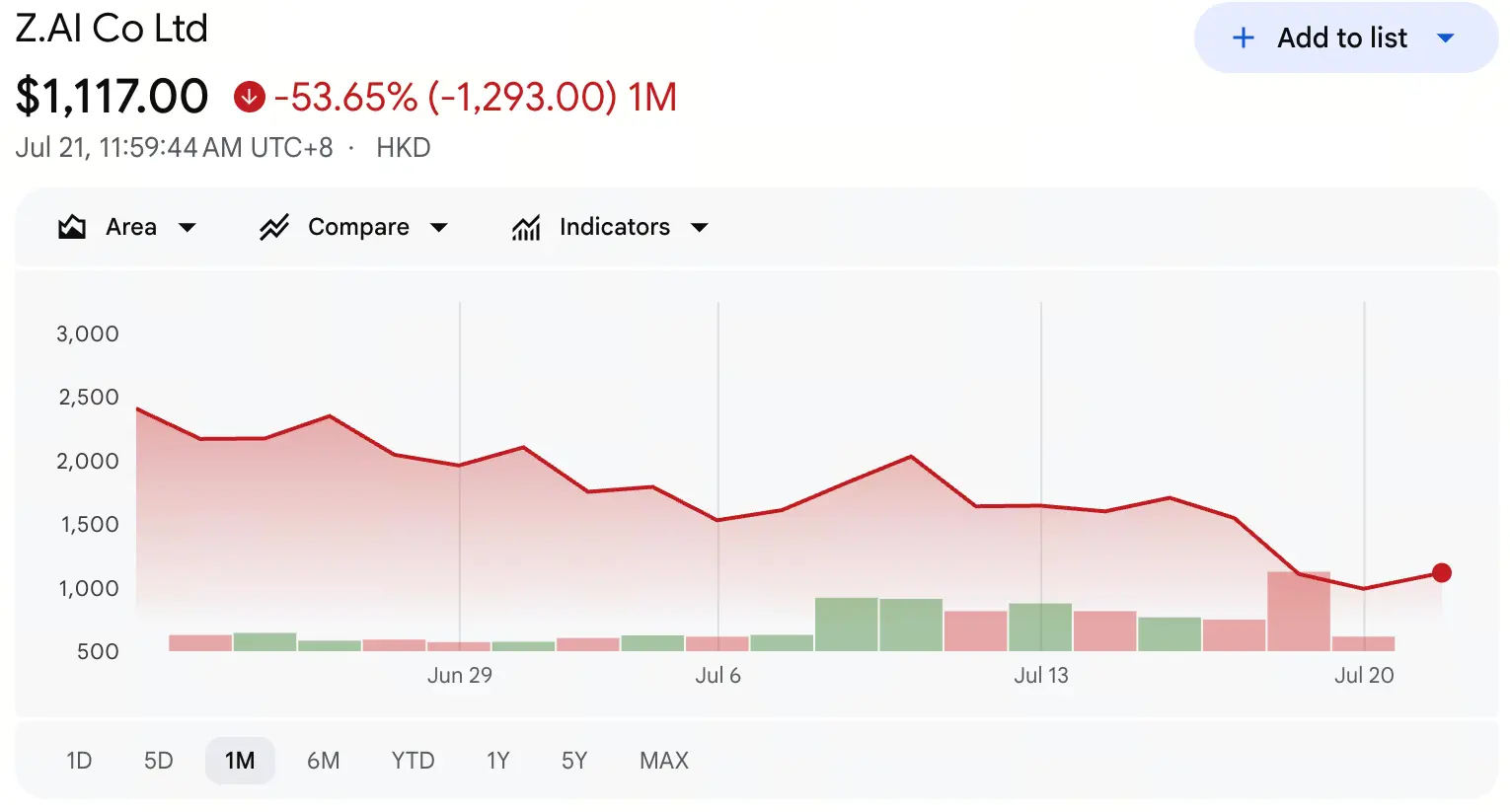
The turning point came in July. On July 8, Zhipu AI saw its first large-scale release of restricted shares after listing: approximately 25.68 million shares held by 11 cornerstone investors were released from lockup, accounting for about 5.76% of the company’s total share capital. Although nearly 70% of cornerstone investors said they intended to hold long term before the unlock, the balance of supply and demand in the market had already been broken. More importantly, just one week after the unlock, on July 13 Zhipu AI completed the placement of 19.78 million new H shares at HK$1,588 per share, raising about HK$31.4 billion. The placement price was about 12.99% discount to the closing price of HK$1,825 on July 8. Within just a few days, the share price had fallen to HK$890.5, and institutions participating in the placement were down more than 43% in floating losses.
In addition, competitor dynamics further heightened market concerns. On July 17, Moonshot (Manta) officially released its next-generation open-source model Kimi K3, featuring a parameter scale of 2.8 trillion and a 1 million Token ultra-long context window. This release directly raised the technical threshold for open-source models to a new level, prompting the market to reassess Zhipu AI’s competitive landscape.
Is the valuation logic undergoing a fundamental shift?
The essence of Zhipu AI’s extreme share-price volatility in this round is that the market is repricing AI big model companies.
From a fundamentals perspective, there is a significant gap between Zhipu AI’s revenue growth and market cap expansion. Financial reports show that in 2025, Zhipu AI’s revenue was only RMB 724 million, up 131.9% year over year, but its adjusted net loss was RMB 3.182 billion, with the loss amount equal to 4.39 times its total revenue in the same period. Supported by annual revenue of RMB 724 million, a market cap approaching trillions implied a static price-to-sales ratio that once exceeded 1,000x. Tian Lihui, professor of finance at Nankai University, said the plunge’s core was a switch in the AI industry valuation logic—from “scarcity premium” to “fundamentals-based pricing.”
Still, there are also positive signals. As of July 2026, Zhipu AI’s annual recurring revenue (ARR) has reached $1 billion. Growing from $100 million ARR to $1 billion, Zhipu AI took only 5 months, while U.S. AI lab Anthropic took 15 months to cross the same phase. Insiders said Zhipu AI’s ARR grew 15x year over year so far this year. Financials show that in this year’s first quarter, the cumulative GLM model API pricing for Zhipu AI was increased by about 83%, while usage volumes still grew by about 400% year over year.
Fast revenue growth has not yet crossed the profitability turning point—the company is still in a high-R&D-investment stage. Full-year R&D investment in 2025 was RMB 3.18 billion. The mainstream view in the market is that the sharp early surge in the share price had already priced in expectations for high growth performance; with the placement plan landing, funds choosing to lock in gains became a key reason for the rapid pullback this time.
How do institutions assess Zhipu AI’s current value?
Despite the sharp share-price correction, multiple institutions still maintain relatively positive ratings for Zhipu AI.
Goldman Sachs gave a “Neutral” rating when it first covered Zhipu AI on July 10, with a 12-month target price of HK$1,880 based on a cash flow discount model. Goldman said that under a competitive positioning framework covering pricing power, cost advantages, and financial strength, Zhipu AI is the strongest among domestic AI companies in China. The firm believes Zhipu AI’s unique “data flywheel” will help maintain GLM’s leading position in the programming domain.
Bank of America Securities first gave Zhipu AI a “Buy” rating on July 16, with a target price of HK$1,250 based on a cash flow discount model. CMB International on the same day also initiated with a “Buy” rating, with a target price of HK$1,503.9. On July 20, Lyon reiterated an “Outperform the market” rating with a target price of HK$2,061. On the same day, Changjiang Securities maintained a “Buy” rating, expecting the company to achieve revenue of RMB 45, 120, and 250 billion in 2026 to 2028, respectively, representing year-over-year growth of 517%, 168%, and 109%.
Many institutions’ target prices are significantly above the current share price, but there are also differences: the target-price range spans from HK$1,250 to HK$2,061, reflecting that the market has not reached a consensus on Zhipu AI’s long-term value.
Has there been any substantive change in the industry’s competitive landscape?
The release of Kimi K3 undeniably intensified market concerns about competition in the big model track. But over a longer time horizon, a single product release is not enough to determine the long-term competitive landscape.
Lyon believes K3 will drive more Chinese labs to release models with larger parameter scales within the next 12 months, including Zhipu AI’s next-generation GLM model adopting a new architecture. The firm expects post-training to drive near-term improvements for Zhipu AI’s models, while an architecture upgrade will prepare for the next round of scaling up pretraining.
Zhipu AI itself is also actively planning next-generation technology. On July 11, founder Tang Jie published an internal letter announcing the start of the “Touch High plan,” fully focusing on AGI research. The plan covers four core directions: long-range tasks, autonomous agent systems, fully self-training, and extreme safety governance. Changjiang Securities believes this further strengthens the company’s long-term strategic positioning centered on foundational model R&D, showing that management judges underlying model capability to remain the core competitive moat in the future.
From a commercialization progress perspective, Zhipu AI’s ARR growth has already surpassed most international peers. But competition in the Coding track is heating up across the board—on June, MiniMax released M3; in July, Moonshot released K3; OpenAI has also shown strong momentum in Coding. The Coding battle is far from over.
Which core variables will determine Zhipu AI’s outlook?
Based on the above analysis, Zhipu AI’s future direction will depend on the evolution of the following core variables:
First, the digestion progress of tradable shares. In July, the total unlocks and placements added more than 45 million shares to the market that are now tradable. The market needs time to absorb this supply shock. In January 2027, there will be another larger-scale unlock—about 40% of the original founder old shares will be released from lockup. In the medium to long term, selling pressure will still remain.
Second, the speed and quality of commercialization execution. Reaching $1 billion ARR is a positive signal, but the market needs to see the persistence of this trend and improvements in profitability. Changjiang Securities expects the company’s revenue to reach RMB 45, 120, and 250 billion in 2026 to 2028, respectively—whether these forecasts can be realized will directly determine the room for valuation recovery.
Third, the pace and effectiveness of technological iteration. The near-term iterations of GLM-5.3 and the long-term layout for the next-generation new-architecture models will determine whether Zhipu AI can maintain a technical leadership position amid increasingly fierce competition. Sustained model capability leadership is a prerequisite for continued growth in commercialization.
Fourth, global AI sector fund flows. Recently, global tech stocks have generally adjusted, and AI sector valuations face overall downward pressure. Guosheng Securities believes that this round of adjustment is driven by both macro factors and the market’s reassessment of the return on AI capital expenditure, as well as de-leveraging after crowded trades, while the long-term logic of the AI industry has not fundamentally changed.
FAQ
Q1: What are the main reasons behind Zhipu AI’s surge on July 21?
A1: The rally was mainly driven by three positive developments: first, Zhipu AI has rolled out a 1GW-scale domestic AI compute data center, using domestic AI chips throughout; second, it completed the acquisition of Zhongke Jiahe, a domestic AI heterogeneous computing software company, filling the gap in compute release capability; third, the AI sector in Hong Kong broadly rebounded, and repaired market sentiment triggered the rebound after overselling.
Q2: Why did Zhipu AI experience consecutive plunges before?
A2: The consecutive plunges resulted from multiple factors: on July 8, around 25.68 million shares locked up from cornerstone investors were released, breaking the market’s supply-demand balance; on July 13, it completed the HK$31.4 billion placement, further expanding tradable share supply; competitor Moonshot released the 2.8 trillion-parameter open-source model Kimi K3, raising market concerns about the competitive landscape; valuation and fundamentals diverged seriously, and the market shifted from “scarcity premium” to “fundamentals-based pricing.”
Q3: What are institutions’ latest ratings for Zhipu AI?
A3: Several institutions have recently issued positive ratings—Goldman Sachs gave a “Neutral” rating with a target price of HK$1,880; Bank of America Securities initiated with a “Buy” rating with a target price of HK$1,250; CMB International initiated with a “Buy” rating with a target price of HK$1,503.9; Lyon reiterated “Outperform the market” with a target price of HK$2,061; Changjiang Securities maintained a “Buy” rating.
Q4: What does Zhipu AI’s ARR reaching $1 billion mean?
A4: ARR (annual recurring revenue) reaching $1 billion is an important milestone in accelerating commercialization. From $100 million to $1 billion, Zhipu AI took only 5 months, while U.S. AI lab Anthropic spent 15 months to cross the same stage. But the company is still in a loss-expansion phase; its adjusted net loss in 2025 reached RMB 3.182 billion.
Q5: What factors will determine Zhipu AI’s outlook going forward?
A5: It mainly depends on four core variables: the digestion progress of tradable shares (another ~40% of the founder original old shares will be unlocked in January 2027), the speed and quality of commercialization execution, the pace and effectiveness of technological iteration, and overall fund flows into the global AI sector.


