Why improving inflation data hasn’t dispelled rate-hike concerns
June U.S. inflation data showed a notable improvement. The U.S. Bureau of Labor Statistics reported that June headline CPI fell 0.4% month over month, the largest single-month drop since April 2020; the year-over-year increase dropped sharply from 4.2% in May to 3.5%; core CPI was flat month over month, while the year-over-year rate fell from 2.9% last month to 2.6%. A sharp drop in energy prices was the main contributor—June’s energy index fell 5.7% month over month, including gasoline prices down 9.7% month over month.
However, the improvement in inflation data has not fully erased the market’s concerns about a rate hike. Core CPI is still 2.6% year over year, significantly above the Fed’s long-term 2% goal. The housing index rose 0.1% month over month in June and 3.3% year over year; with a relatively large weight in the CPI basket, its stickiness implies core inflation will fall only slowly and gradually. Goldman Sachs economists noted that the breadth of price increases is widening significantly; inflation is no longer confined to a few industries and is showing a “broadening/spreading” trend. Sectors such as audio-visual equipment, financial services, healthcare, and transportation have become key drivers of the current upcycle in prices.
The direction of the data improvement is clear, but the extent of the improvement and its persistence—this is the root cause of the market split.
Can cooling in the labor market provide enough support for holding rates steady?
On the labor market front, June nonfarm payrolls added only 57k jobs, well below the market expectation of 115k. Combined April and May job additions were revised down by 74k. The unemployment rate edged down to 4.2%, but the labor force participation rate fell from 61.8% to 61.5%, with 832k people leaving the labor force during the month. The reality that total employment fell month over month by 507k is masked by the superficially better unemployment-rate figure.
Wage growth still shows strong inflation stickiness. In June, average hourly earnings rose 0.3% month over month, with the year-over-year growth rate holding at 3.5%. Companies may not yet be cutting large numbers of jobs, but their willingness to expand hiring has contracted sharply.
The weakening employment data provides the logic to support “holding steady,” but wage-growth rigidity preserves the narrative space for “inflation stickiness.” The two sets of data point to different policy conclusions—this is a true reflection of the difficulty of the Fed’s decision-making.
Why economists and the interest-rate futures market are sending opposite signals
The most striking feature of this rate-setting meeting is that economists as a group and the interest-rate futures market are giving sharply different signals.
A Bloomberg survey of 76 economists showed that all respondents expect the Fed to keep the benchmark rate unchanged at a range of 3.5% to 3.75% at the July meeting. In a Reuters mid-July survey of 104 economists, all expected rates to remain unchanged, with 78 saying this level would last through December of this year.
However, the interest-rate futures market indicates that the probability of a rate hike was only 13% a week ago and rose to 38% by last Friday. As of July 27, CME “FedWatch” data shows a 63.7% probability of holding rates steady and a 36.3% probability of a 25 bps hike.
The key difference between economists’ and traders’ judgments is what each side focuses on. The former typically bets on the single outcome most likely to occur, while the latter prices in all possible outcomes, including low-probability events. The two logics are not inherently contradictory: the former judges “what will most likely happen,” while the latter prices “all possible scenarios.”
How big are the disagreements inside the Fed?
The June dot plot from the FOMC reveals deep divides within the Fed. Of the 18 voting members, 9 expect at least one additional rate hike by the end of 2026 (including 3 who support +25 bps, 5 who support +50 bps, and 1 who supports +75 bps). Eight expect no change, and only 1 expects a rate cut. The median target rate at year-end 2026 was raised from the March forecast of 3.4% to 3.8%.
Three months ago, no officials had predicted any rate hikes within the year. This clear shift shows that the Fed’s internal policy balance has moved decisively from “waiting for rate cuts” to the possibility of rate hikes.
Fed Chair Kevin Wos intentionally avoided offering any hints about the future rate path. In a congressional hearing on July 14, he said, “Some people may say the job is done on inflation—I don’t see it that way.” Wos maintains a “zero tolerance” stance toward persistently high inflation and is unwilling to loosen policy signals until it is confirmed that inflation has returned to the 2% target in a clear, sustained manner.
Fed Vice Chair Jefferson said that if inflation cannot cool quickly, the Fed should consider hiking rates, but he also believes current monetary policy is “in a good position.” Dallas Fed President Logan was the most explicit hawk, saying that “modestly raising interest rates would help better balance the outlook and risks of the Fed’s dual mandate.”
Wos’s final leanings will directly determine the outcome. But Wos himself has given no clear signals.
What signals are the bond market and oil prices sending to the Fed
The bond market has already moved first. Ten-year U.S. Treasury yields closed last Friday at 4.69%, the highest level since January 2025. More clearly reflecting near-term policy expectations, the two-year U.S. Treasury yield closed at 4.33%, already above the Fed’s 3.75% upper end. Since mid-May, the two-year yield has stayed above 4%, indicating investors are pricing in at least one 25 bps rate hike within the year.
Oil-price trends are intensifying the market’s inflation worries. On July 23, Brent crude closed at $100.69 per barrel, with a cumulative gain of more than 30% for the month. Since mid-July, the U.S.-Iran conflict has escalated again, and the Strait of Hormuz has suffered a second blockade. The average retail price of unleaded gasoline in the United States has broken back above $4 per gallon.
The simultaneous rise of the yield curve and oil prices amounts to implicit pressure on the Fed—markets are positioning in advance for a higher-rate environment.
How to interpret the 79% “hold steady” bet in the prediction market
On the Gate prediction market, capital priced the outcome differently from traditional interest-rate futures. A 79% probability is assigned to “maintain rates,” 20% to “hike 25 bps,” and 1% to “hike 50 bps.”
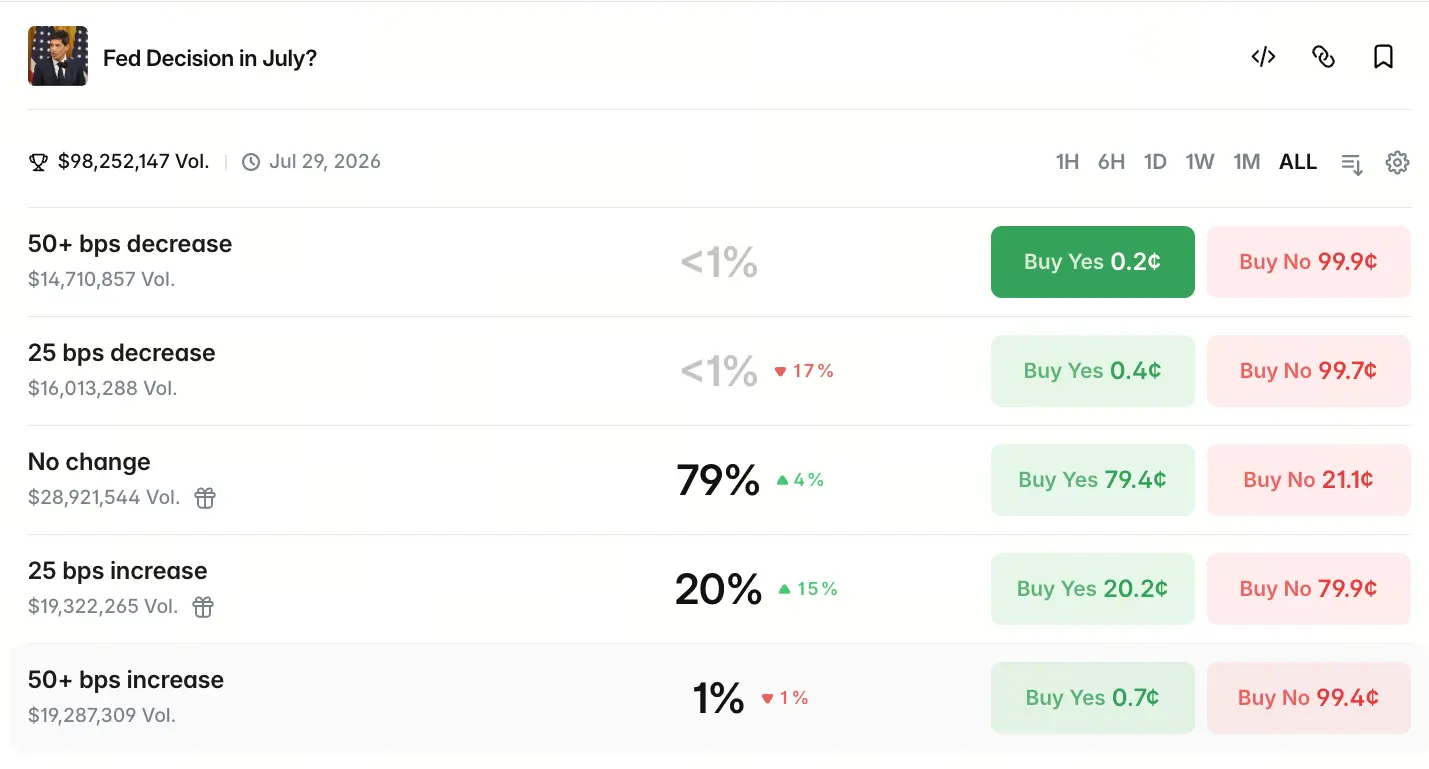
This distribution conveys several key messages.
First, the baseline scenario is highly certain. A 79% probability indicates that “holding steady” is the strongest consensus direction among market capital—this is not “possible,” but “high likelihood.” This view is built on two pillars: the June inflation data falling more than expected and cooling in the labor market.
Second, a rate hike has not been ruled out. A 20% probability of a hike means the market has not completely closed the door on the possibility of raising rates. This is higher than the 36.3% partial pricing seen in traditional interest-rate futures markets, but lower than the 38% spike in those futures once in mid-July. The differences among the three data sources themselves reflect the market’s high uncertainty about the meeting outcome.
Third, extreme scenarios are being ruled out. Only 1% for a 50 bps hike suggests the market believes the Fed will not take an aggressive policy action. Whether the final result is “hold steady” or “hike 25 bps,” the magnitude of policy adjustment is expected to be limited.
The capital structure in the prediction market reveals a core judgment: the July meeting outcome is not a simple binary between “hike or cut,” but rather a contest between “hold steady” and an “unexpected hike,” with the former overwhelmingly dominant.
How much room is there to project the intermediate-rate path?
After July, market attention will quickly shift to the September meeting. According to Lufax data, the U.S. money market has fully priced a 25 bps rate hike in September. CME data shows that the probability of holding rates steady by September has dropped sharply to around 20%.
This aligns broadly with the guidance implied by the Fed’s June dot plot—most officials lean toward delivering one rate hike by the end of 2026. Goldman Sachs maintains its forecast for the federal funds target range: 2026 would stay at 3.5%-3.75%, then gradually fall to 3%-3.25% in 2027. Morgan Stanley, however, offers the opposite view: the Fed will hold steady for the full year until it is confident inflation has sufficiently fallen going into 2027, and then it will cut twice.
The real focus of the July meeting may not be whether the rate changes itself, but whether the policy statement releases clues about a September rate hike. Since Wos has significantly reduced the forward guidance, the impact of inflation and employment data on market expectations will be amplified considerably.
Summary
As of July 27, 2026, Gate prediction market data shows the probability of market capital betting on the Fed keeping rates unchanged in July is 79%, with 20% for a 25 bps hike and 1% for a 50 bps hike. This distribution reflects strong market consensus on “holding steady,” while still pricing in the tail risk of an “unexpected hike.”
Inflation is improving but not enough, employment is cooling but wage growth remains rigid, economists and traders are calling it differently, and hawks and doves inside the Fed are locked in a tug-of-war—under the interplay of multiple forces, the July meeting is becoming one of the most suspenseful policy meetings in years. No matter what the final outcome is, the market’s real contest may not be in July, but in September.
FAQ
Why do the 79% “hold steady” probability shown on the Gate prediction market differ from other data sources?
Differences among data sources mainly come from slight divergences in the derivative pricing models and calculation methods. The Gate prediction market is based on refined event-contract wagering; participants can place direct bets on specific events, and the flow of funds often captures expectation shifts that traditional derivatives markets struggle to reflect. CME FedWatch is derived mechanically from federal funds futures. The three sources differ in methodology, but the directional consensus is highly consistent: holding rates steady in July is the strongest direction of market capital consensus.
If the Fed hikes in July, what could it mean for Crypto assets?
A rate hike implies further tightening of Dollar liquidity, which theoretically puts pressure on risk assets. But Fed Chair Wos has already sharply pared back forward guidance, so pricing of policy uncertainty in the market could matter more than the direction of rates themselves. The magnitude of the impact depends on whether the market has already priced in the rate-hike expectations—if the 20% tail risk becomes reality, near-term volatility could be fairly pronounced.
Why is the probability of a September rate hike higher than in July?
The June dot plot shows most commissioners are inclined to deliver a rate hike by the end of 2026. The market believes holding steady in July gives the Fed more time to gather observation data, while the September meeting will have more inflation and employment data to reference—at that point, the “data basis” for any policy adjustment will be more robust. Lufax data shows the U.S. money market has fully priced a 25 bps rate hike for September.
If inflation data has already improved, why is there still a possibility of a rate hike?
Core CPI is still 2.6% year over year, significantly above the Fed’s long-term 2% target. Goldman Sachs research shows the breadth of price increases is widening and inflation is taking on a “broadening/spreading” trend. Structural factors—Middle East conflict lifting oil prices, AI investment driving demand, and tariffs continuing to exert effects—make inflation stickier than what monthly data alone indicates. Fed Chair Wos has explicitly said he does not think the inflation “job is done.”
How can ordinary investors track changes in the Fed’s policy expectations?
They can watch the real-time probability data on the Gate prediction market, the pricing in CME FedWatch for federal funds futures, and the trend in two-year U.S. Treasury yields. The two-year yield is a leading indicator for the Fed’s interest-rate outlook; its movements often precede policy changes. In addition, public remarks by Fed officials ahead of the Fed’s quiet period around the rate-setting meeting provide important references.