#CLARITYActEntersFinalCriticalStage
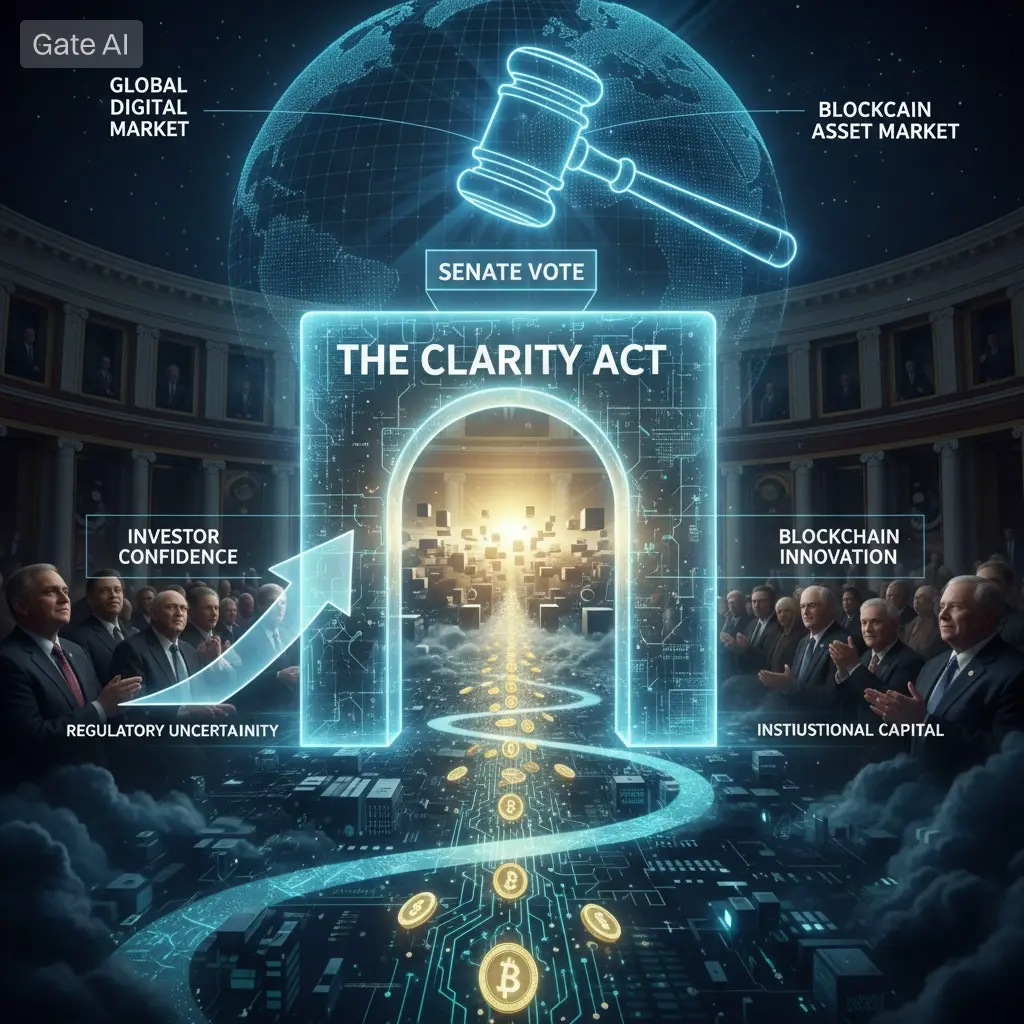
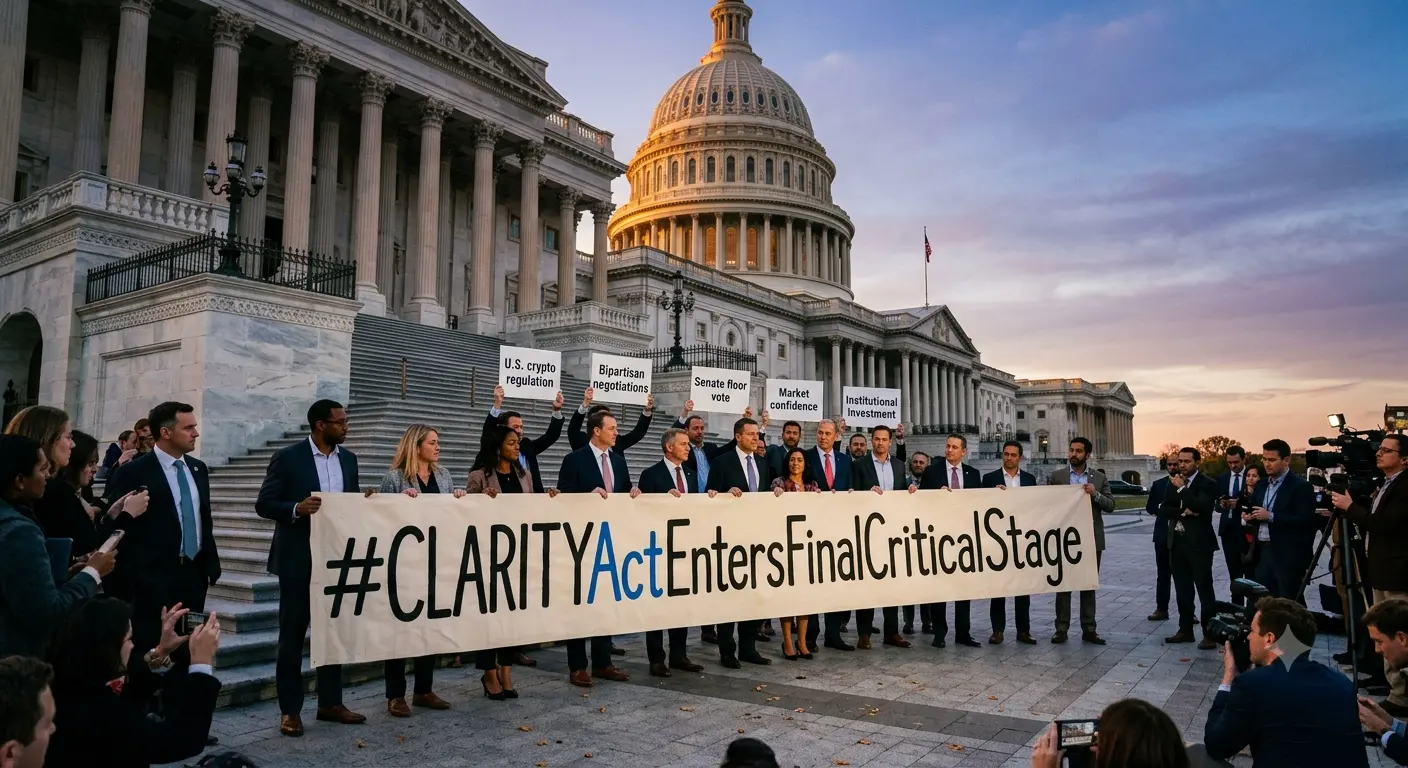
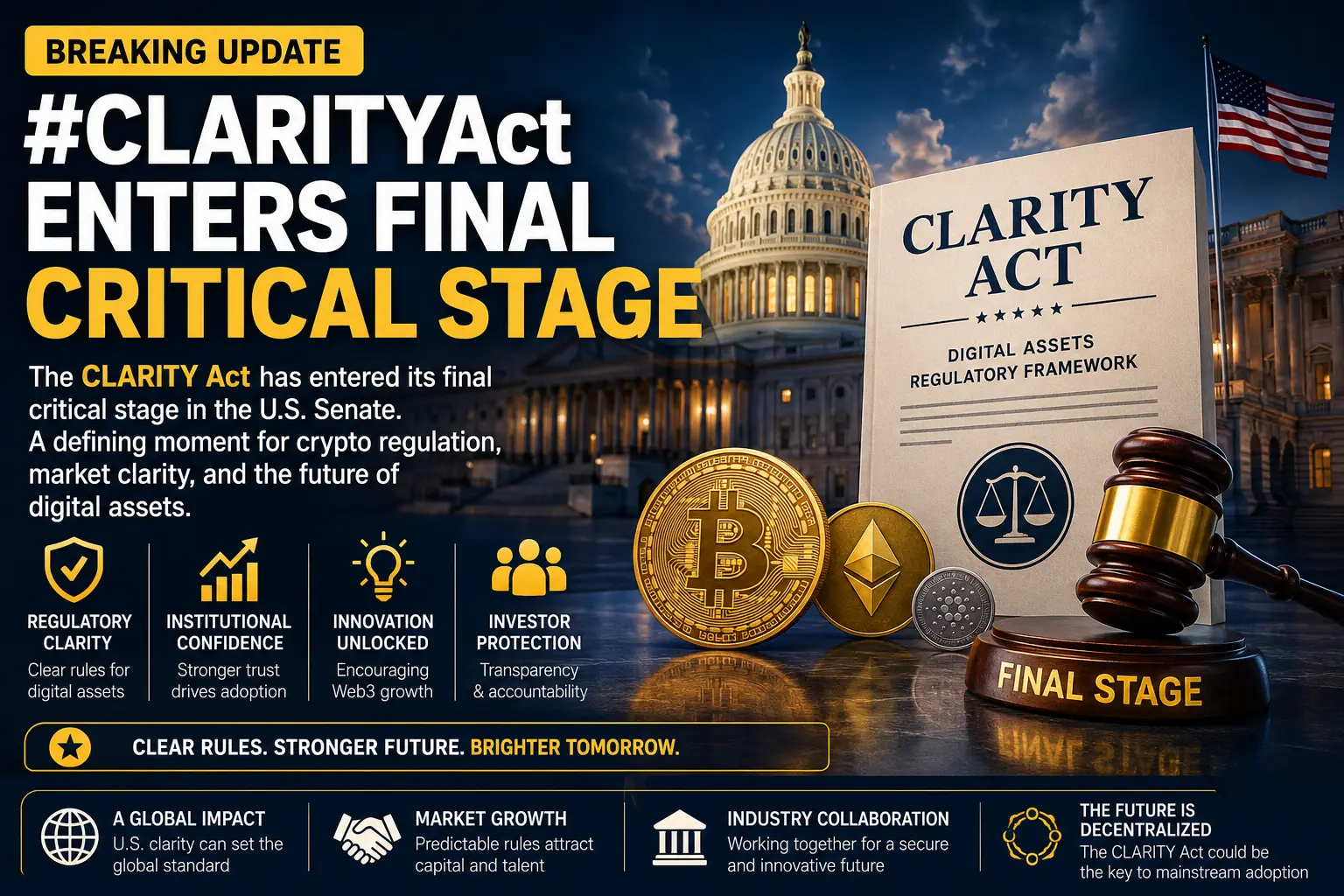
The Digital Asset Market Clarity Act of 2025 (CLARITY Act) has officially entered what could become the most historic and decisive stage in U.S. crypto legislation. After years of regulatory uncertainty, countless enforcement actions, heated political debates, and months of bipartisan negotiations, the bill is now approaching its biggest test in the United States Senate. The coming days may determine not only the future of American cryptocurrency regulation but also the direction of institutional investment, blockchain innovation, and global digital asset leadership for years to come.
For nearly a decade, the cryptocurrency industry has operated under an environment where companies often struggled to determine which regulator had authority over their business.
Different agencies frequently offered conflicting interpretations, leaving exchanges, developers, blockchain projects, and investors facing enormous legal uncertainty. The CLARITY Act seeks to finally end that confusion by creating the first comprehensive federal framework specifically designed for digital assets. If enacted, it would represent one of the most significant regulatory reforms in crypto history.
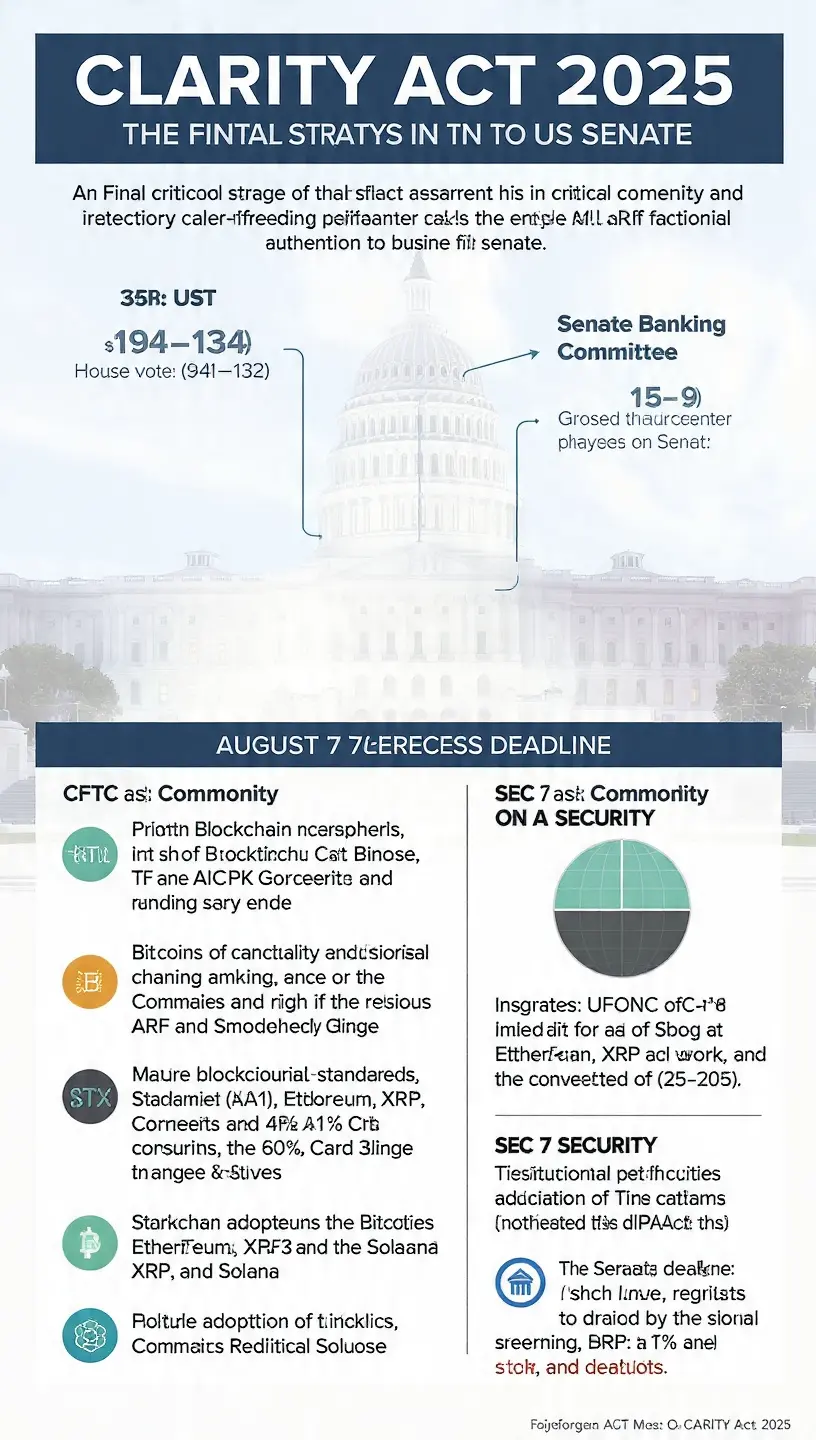
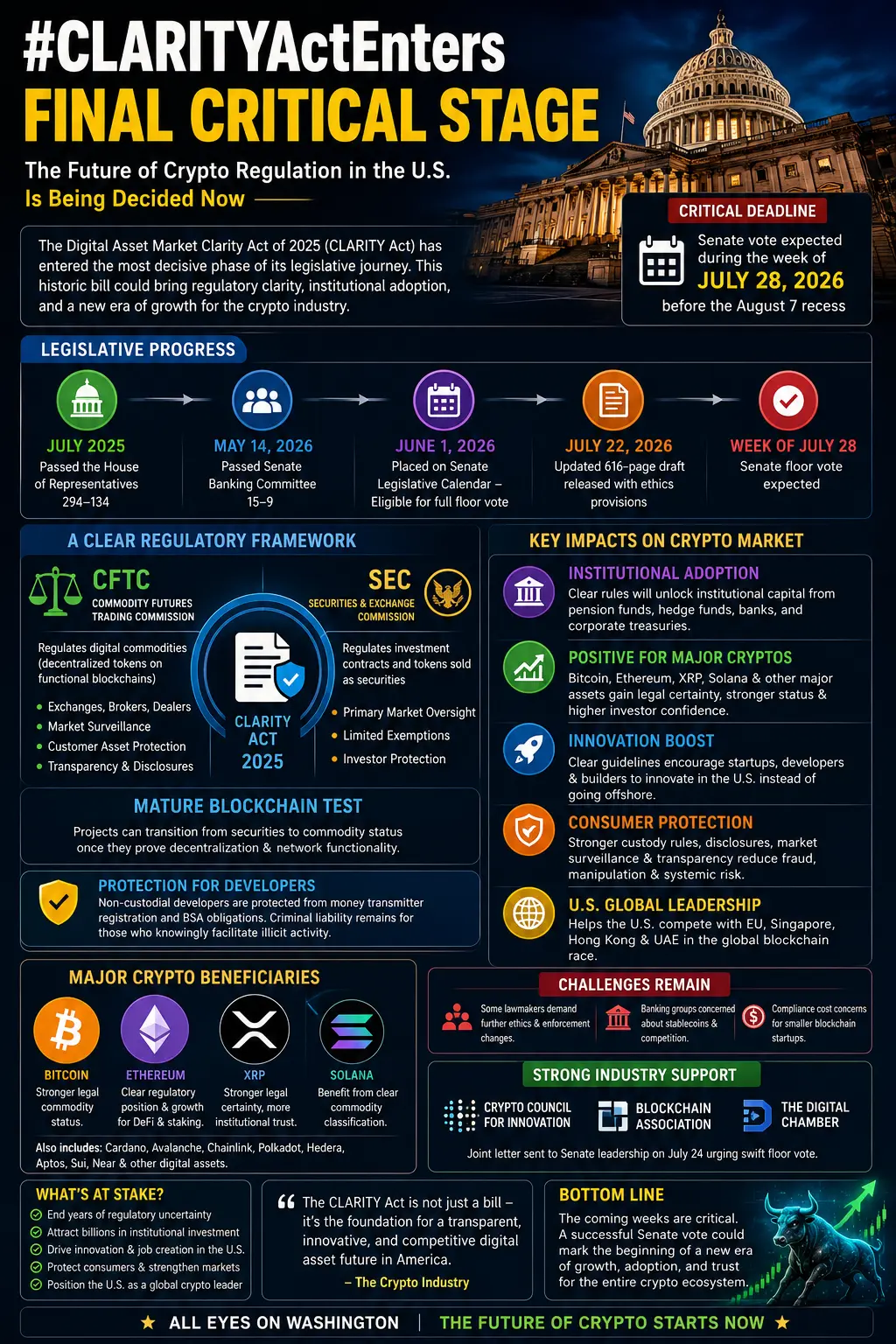
The legislation has already crossed several critical milestones. It passed the House of Representatives with an overwhelming bipartisan vote of 294-134, later advanced through the Senate Banking Committee by 15-9, and has now been placed on the Senate Legislative Calendar. An updated 616-page version was recently introduced after extensive negotiations between lawmakers, incorporating additional ethics provisions and technical revisions designed to strengthen bipartisan support. Senate Majority Leader John Thune has indicated that lawmakers intend to bring the legislation to the Senate floor before Congress begins its August 7 recess, making this one of the most closely watched legislative events of the year for global financial markets.
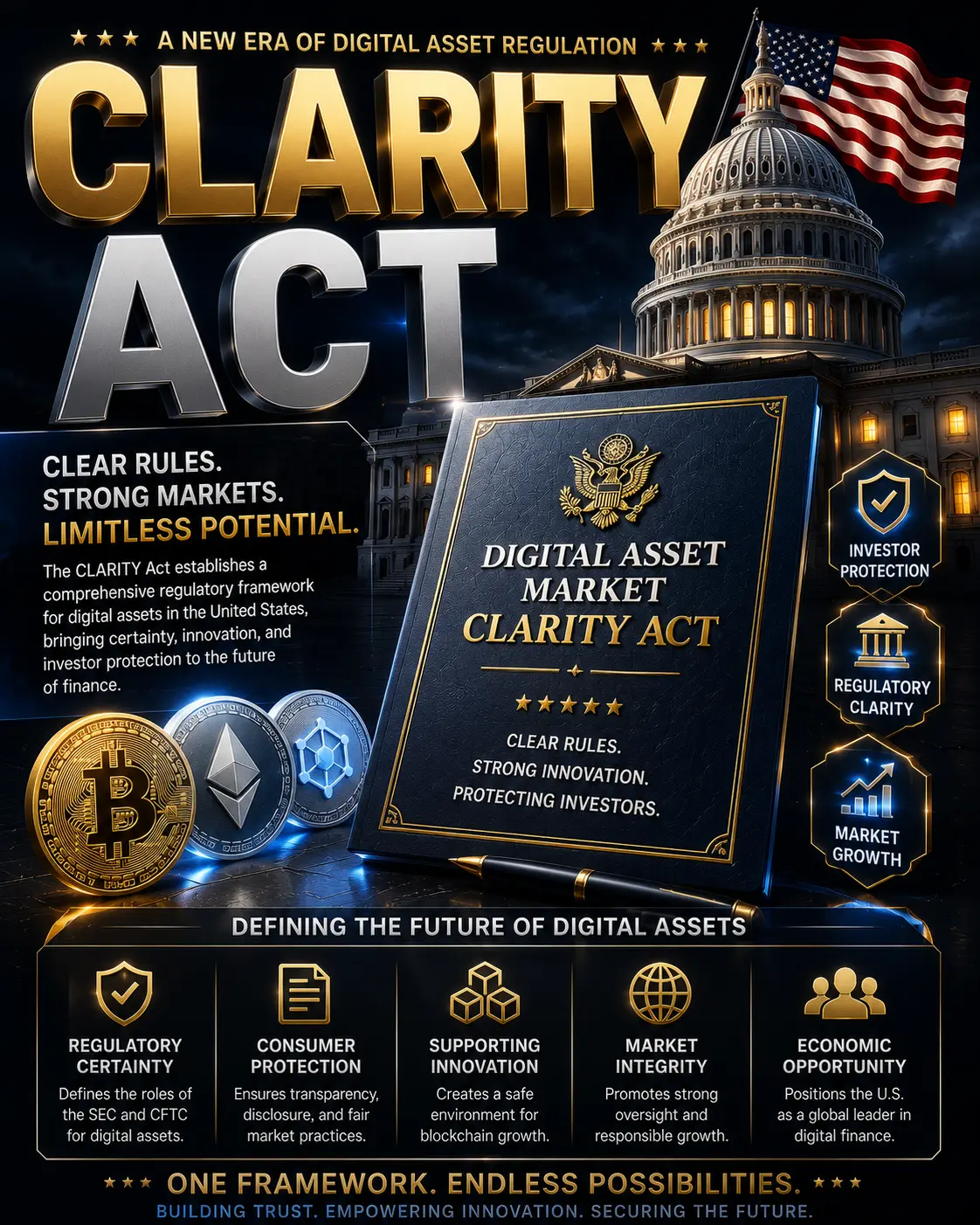
At its core, the CLARITY Act is designed to answer one simple but enormously important question: Who regulates digital assets in the United States? Today, that answer often depends on differing legal interpretations, creating years of uncertainty that have slowed innovation and discouraged institutional participation. The proposed legislation establishes a far clearer division of responsibility between the Commodity Futures Trading Commission (CFTC) and the Securities and Exchange Commission (SEC).
Under the proposed framework, decentralized blockchain networks operating as functional ecosystems would generally be regulated as digital commodities under CFTC oversight, while digital assets sold primarily as investment contracts would continue falling under SEC jurisdiction. One of the bill's most important innovations is the introduction of the "mature blockchain" standard, allowing projects to transition from securities regulation to commodity regulation once they demonstrate sufficient decentralization and network functionality. This creates a predictable legal pathway that blockchain companies have requested for years.
Beyond simply dividing regulatory responsibilities, the legislation establishes comprehensive federal standards covering cryptocurrency exchanges, brokers, custodians, dealers, customer asset protection, market surveillance, conflict-of-interest management, operational transparency, disclosures, recordkeeping, and compliance requirements. These rules are intended to replace uncertainty with consistency while improving investor confidence across the digital asset ecosystem.
Another widely praised provision protects non-custodial blockchain developers. Software engineers building decentralized protocols without controlling customer funds would receive important legal protections, allowing innovation to continue without exposing developers to inappropriate regulatory liability.
Many blockchain organizations consider this one of the bill's most valuable achievements because it recognizes the distinction between writing software and operating a financial institution.
Perhaps the greatest impact of the CLARITY Act would be ending years of "regulation through enforcement." Instead of companies constantly worrying about unexpected lawsuits, changing agency interpretations, or uncertain legal classifications, businesses would finally operate under clearly defined federal law. Predictable regulation encourages long-term planning, supports responsible innovation, reduces legal expenses, and strengthens overall market confidence.
Institutional investors are paying extremely close attention to these developments. Pension funds, asset managers, banks, hedge funds, insurance companies, family offices, and corporate treasuries have repeatedly identified regulatory uncertainty as one of the primary reasons for limiting cryptocurrency exposure. Clear federal legislation could significantly reduce those concerns by providing compliance departments with stable legal guidelines that are far more durable than temporary agency interpretations.
If institutional confidence improves, the cryptocurrency industry could experience a wave of new investment. Additional capital may flow into Bitcoin ETFs, Ethereum ETFs, tokenized securities, digital asset custody services, blockchain infrastructure, decentralized finance, stablecoin ecosystems, and regulated investment products. Greater institutional participation would also deepen market liquidity, improve price discovery, and contribute to a more mature investment environment.
The potential impact on major cryptocurrencies could be substantial. Bitcoin would receive stronger statutory confirmation of its commodity status, reinforcing its position as the flagship digital asset. Ethereum would benefit from greater legal certainty surrounding its classification while continuing to strengthen its role in decentralized finance, staking, tokenization, and smart contract infrastructure.
Other major blockchain ecosystems—including Solana, XRP, Cardano, Avalanche, Chainlink, Polkadot, Hedera, Aptos, Sui, Near Protocol, and additional digital commodities recognized under future regulatory guidance—could also benefit from a far more predictable operating environment. Instead of facing ongoing uncertainty regarding classification, projects would have clearer legal standards governing development, fundraising, exchange listings, and institutional participation.
For XRP, the legislation carries particular significance. Rather than relying primarily on regulatory interpretation or individual court decisions, federal legislation could provide much stronger legal certainty regarding its treatment within U.S. financial markets. Many analysts believe that increased legal clarity could improve institutional confidence and support broader adoption if macroeconomic conditions remain favorable.
The CLARITY Act could also transform America's competitive position within the global blockchain industry. Regions including the European Union, Singapore, Hong Kong, Japan, and the United Arab Emirates have already implemented comprehensive digital asset regulations designed to attract blockchain businesses. Without regulatory clarity, many American companies have considered relocating operations overseas. Supporters believe the CLARITY Act would help reverse that trend by encouraging innovation to remain within the United States while attracting new investment into the domestic blockchain economy.
Innovation itself may become one of the legislation's biggest beneficiaries. Entrepreneurs launching blockchain startups would finally understand the legal framework governing their businesses. Venture capital firms could invest with greater confidence. Developers would spend less time navigating uncertain regulations and more time building decentralized applications, payment systems, tokenized real-world assets, financial infrastructure, gaming ecosystems, artificial intelligence integrations, identity solutions, and enterprise blockchain platforms.
Consumer protection also stands to improve considerably. The legislation introduces stronger disclosure requirements, enhanced custody standards, greater operational transparency, improved oversight of customer assets, and more effective market surveillance mechanisms designed to reduce fraud, manipulation, insider abuse, and systemic risk.
These safeguards aim to make cryptocurrency markets more trustworthy while encouraging sustainable long-term growth.
Despite widespread industry support, challenges remain. Several lawmakers continue negotiating final amendments related to ethics provisions, enforcement authority, and regulatory implementation. Some banking organizations argue that portions of the legislation could increase competition for traditional financial institutions, particularly regarding digital payments and stablecoins.
Smaller blockchain startups have also expressed concerns about compliance costs, although supporters argue that regulatory certainty ultimately outweighs those challenges.
The political mathematics remain extremely important. The legislation is expected to require 60 Senate votes, meaning bipartisan cooperation remains essential. Every remaining negotiation could determine whether the bill successfully reaches President Trump's desk or faces additional delays beyond the August congressional recess.
For financial markets, this is far more than another legislative vote. It represents a potential turning point capable of reshaping institutional confidence, regulatory certainty, investment flows, innovation, and long-term adoption across the entire digital asset industry. While legislation alone cannot guarantee higher cryptocurrency prices, reducing one of the industry's largest sources of uncertainty has historically been viewed as a powerful catalyst for stronger market participation.
If the CLARITY Act ultimately becomes law, the United States would take one of its biggest steps toward establishing a transparent, modern, and globally competitive regulatory framework for blockchain technology and digital assets. Clear rules could encourage billions of dollars in additional institutional participation, strengthen investor confidence, accelerate innovation, improve consumer protection, and reinforce America's position within the rapidly evolving digital economy.
The countdown has begun. The Senate's decision will not simply determine the future of one bill—it could help define the next chapter of Bitcoin, Ethereum, XRP, Solana, the broader cryptocurrency market, and the future of blockchain innovation in the world's largest economy. Every investor, developer, institution, and crypto enthusiast is now watching Washington, because the outcome of the CLARITY Act may become one of the most influential moments in crypto history.
#SummerCreationCamp @Gate_Square
The Digital Asset Market Clarity Act of 2025 (CLARITY Act) has officially entered what could become the most historic and decisive stage in U.S. crypto legislation. After years of regulatory uncertainty, countless enforcement actions, heated political debates, and months of bipartisan negotiations, the bill is now approaching its biggest test in the United States Senate. The coming days may determine not only the future of American cryptocurrency regulation but also the direction of institutional investment, blockchain innovation, and global digital asset leadership for years to come.
For nearly a decade, the cryptocurrency industry has operated under an environment where companies often struggled to determine which regulator had authority over their business.
Different agencies frequently offered conflicting interpretations, leaving exchanges, developers, blockchain projects, and investors facing enormous legal uncertainty. The CLARITY Act seeks to finally end that confusion by creating the first comprehensive federal framework specifically designed for digital assets. If enacted, it would represent one of the most significant regulatory reforms in crypto history.
The legislation has already crossed several critical milestones. It passed the House of Representatives with an overwhelming bipartisan vote of 294-134, later advanced through the Senate Banking Committee by 15-9, and has now been placed on the Senate Legislative Calendar. An updated 616-page version was recently introduced after extensive negotiations between lawmakers, incorporating additional ethics provisions and technical revisions designed to strengthen bipartisan support. Senate Majority Leader John Thune has indicated that lawmakers intend to bring the legislation to the Senate floor before Congress begins its August 7 recess, making this one of the most closely watched legislative events of the year for global financial markets.
At its core, the CLARITY Act is designed to answer one simple but enormously important question: Who regulates digital assets in the United States? Today, that answer often depends on differing legal interpretations, creating years of uncertainty that have slowed innovation and discouraged institutional participation. The proposed legislation establishes a far clearer division of responsibility between the Commodity Futures Trading Commission (CFTC) and the Securities and Exchange Commission (SEC).
Under the proposed framework, decentralized blockchain networks operating as functional ecosystems would generally be regulated as digital commodities under CFTC oversight, while digital assets sold primarily as investment contracts would continue falling under SEC jurisdiction. One of the bill's most important innovations is the introduction of the "mature blockchain" standard, allowing projects to transition from securities regulation to commodity regulation once they demonstrate sufficient decentralization and network functionality. This creates a predictable legal pathway that blockchain companies have requested for years.
Beyond simply dividing regulatory responsibilities, the legislation establishes comprehensive federal standards covering cryptocurrency exchanges, brokers, custodians, dealers, customer asset protection, market surveillance, conflict-of-interest management, operational transparency, disclosures, recordkeeping, and compliance requirements. These rules are intended to replace uncertainty with consistency while improving investor confidence across the digital asset ecosystem.
Another widely praised provision protects non-custodial blockchain developers. Software engineers building decentralized protocols without controlling customer funds would receive important legal protections, allowing innovation to continue without exposing developers to inappropriate regulatory liability.
Many blockchain organizations consider this one of the bill's most valuable achievements because it recognizes the distinction between writing software and operating a financial institution.
Perhaps the greatest impact of the CLARITY Act would be ending years of "regulation through enforcement." Instead of companies constantly worrying about unexpected lawsuits, changing agency interpretations, or uncertain legal classifications, businesses would finally operate under clearly defined federal law. Predictable regulation encourages long-term planning, supports responsible innovation, reduces legal expenses, and strengthens overall market confidence.
Institutional investors are paying extremely close attention to these developments. Pension funds, asset managers, banks, hedge funds, insurance companies, family offices, and corporate treasuries have repeatedly identified regulatory uncertainty as one of the primary reasons for limiting cryptocurrency exposure. Clear federal legislation could significantly reduce those concerns by providing compliance departments with stable legal guidelines that are far more durable than temporary agency interpretations.
If institutional confidence improves, the cryptocurrency industry could experience a wave of new investment. Additional capital may flow into Bitcoin ETFs, Ethereum ETFs, tokenized securities, digital asset custody services, blockchain infrastructure, decentralized finance, stablecoin ecosystems, and regulated investment products. Greater institutional participation would also deepen market liquidity, improve price discovery, and contribute to a more mature investment environment.
The potential impact on major cryptocurrencies could be substantial. Bitcoin would receive stronger statutory confirmation of its commodity status, reinforcing its position as the flagship digital asset. Ethereum would benefit from greater legal certainty surrounding its classification while continuing to strengthen its role in decentralized finance, staking, tokenization, and smart contract infrastructure.
Other major blockchain ecosystems—including Solana, XRP, Cardano, Avalanche, Chainlink, Polkadot, Hedera, Aptos, Sui, Near Protocol, and additional digital commodities recognized under future regulatory guidance—could also benefit from a far more predictable operating environment. Instead of facing ongoing uncertainty regarding classification, projects would have clearer legal standards governing development, fundraising, exchange listings, and institutional participation.
For XRP, the legislation carries particular significance. Rather than relying primarily on regulatory interpretation or individual court decisions, federal legislation could provide much stronger legal certainty regarding its treatment within U.S. financial markets. Many analysts believe that increased legal clarity could improve institutional confidence and support broader adoption if macroeconomic conditions remain favorable.
The CLARITY Act could also transform America's competitive position within the global blockchain industry. Regions including the European Union, Singapore, Hong Kong, Japan, and the United Arab Emirates have already implemented comprehensive digital asset regulations designed to attract blockchain businesses. Without regulatory clarity, many American companies have considered relocating operations overseas. Supporters believe the CLARITY Act would help reverse that trend by encouraging innovation to remain within the United States while attracting new investment into the domestic blockchain economy.
Innovation itself may become one of the legislation's biggest beneficiaries. Entrepreneurs launching blockchain startups would finally understand the legal framework governing their businesses. Venture capital firms could invest with greater confidence. Developers would spend less time navigating uncertain regulations and more time building decentralized applications, payment systems, tokenized real-world assets, financial infrastructure, gaming ecosystems, artificial intelligence integrations, identity solutions, and enterprise blockchain platforms.
Consumer protection also stands to improve considerably. The legislation introduces stronger disclosure requirements, enhanced custody standards, greater operational transparency, improved oversight of customer assets, and more effective market surveillance mechanisms designed to reduce fraud, manipulation, insider abuse, and systemic risk.
These safeguards aim to make cryptocurrency markets more trustworthy while encouraging sustainable long-term growth.
Despite widespread industry support, challenges remain. Several lawmakers continue negotiating final amendments related to ethics provisions, enforcement authority, and regulatory implementation. Some banking organizations argue that portions of the legislation could increase competition for traditional financial institutions, particularly regarding digital payments and stablecoins.
Smaller blockchain startups have also expressed concerns about compliance costs, although supporters argue that regulatory certainty ultimately outweighs those challenges.
The political mathematics remain extremely important. The legislation is expected to require 60 Senate votes, meaning bipartisan cooperation remains essential. Every remaining negotiation could determine whether the bill successfully reaches President Trump's desk or faces additional delays beyond the August congressional recess.
For financial markets, this is far more than another legislative vote. It represents a potential turning point capable of reshaping institutional confidence, regulatory certainty, investment flows, innovation, and long-term adoption across the entire digital asset industry. While legislation alone cannot guarantee higher cryptocurrency prices, reducing one of the industry's largest sources of uncertainty has historically been viewed as a powerful catalyst for stronger market participation.
If the CLARITY Act ultimately becomes law, the United States would take one of its biggest steps toward establishing a transparent, modern, and globally competitive regulatory framework for blockchain technology and digital assets. Clear rules could encourage billions of dollars in additional institutional participation, strengthen investor confidence, accelerate innovation, improve consumer protection, and reinforce America's position within the rapidly evolving digital economy.
The countdown has begun. The Senate's decision will not simply determine the future of one bill—it could help define the next chapter of Bitcoin, Ethereum, XRP, Solana, the broader cryptocurrency market, and the future of blockchain innovation in the world's largest economy. Every investor, developer, institution, and crypto enthusiast is now watching Washington, because the outcome of the CLARITY Act may become one of the most influential moments in crypto history.
#SummerCreationCamp @Gate_Square