U.S. Stocks Near Record Highs as 2025 Enters Its Final Stretch: Key Market Watchpoints This Week
Year-End Approaches: Global Equities in a High-Level Trading Range
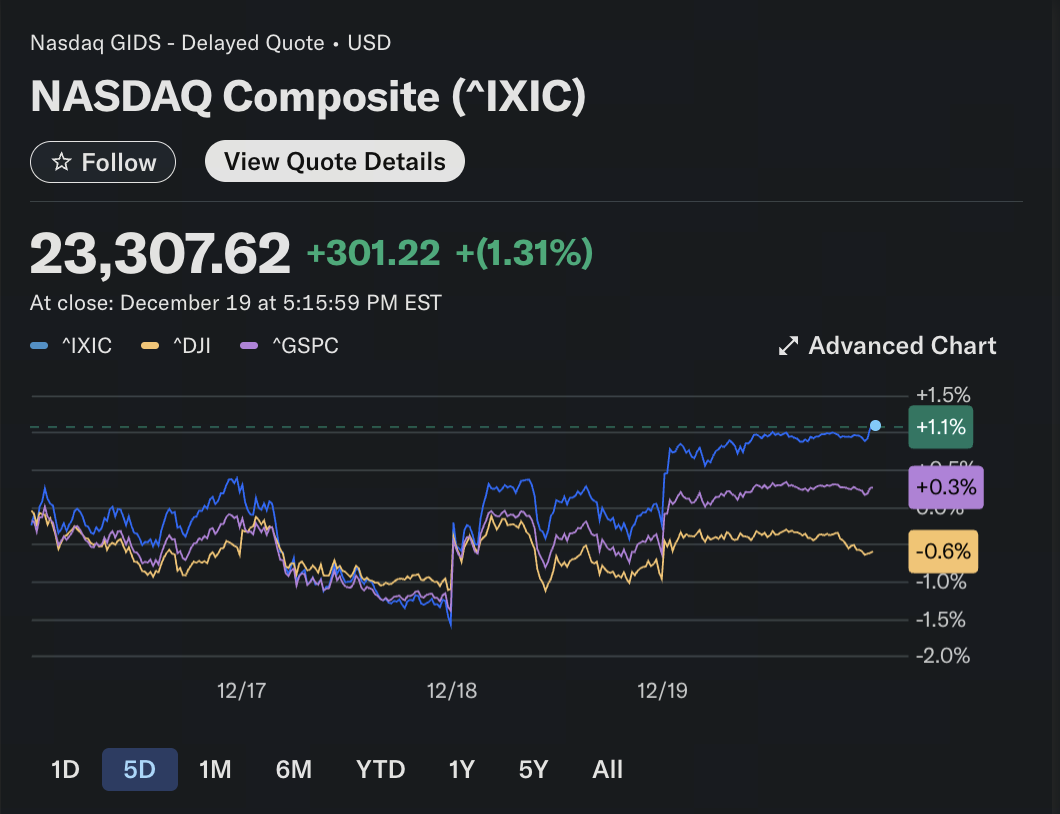
As 2025 comes to a close, global equity markets are entering a pivotal year-end phase. Major indices remain near record highs, but market momentum has slowed compared to mid-year. The current environment reflects a high-level trading range, making risk management and certainty top priorities for investors at year-end.
During this period, holidays often play a significant role in shaping market conditions. Trading volumes typically decline in phases, and volatility can occasionally spike—both are common features of year-end market activity. As a result, elevated index levels do not guarantee a one-sided market trend will continue.
Major Indices Near Record Highs, Valuation Sensitivity Rises
Most core equity indices are just shy of all-time highs. This reflects continued optimism in the market, but also signals that valuations are historically elevated.
In this environment, markets are highly sensitive to macroeconomic variables. Even marginal changes in economic data or slight shifts in policy expectations can be amplified and quickly reflected in asset price volatility.
As the year ends, capital flows are diverging: some investors are locking in annual gains and reducing risk, while others are positioning early for the next year. This divergence is adding complexity to overall market structure.
Macroeconomic Data Is This Week’s Key Short-Term Variable
Year-end brings increased importance for macroeconomic data in shaping market sentiment. This week’s releases on consumer spending, employment, and inflation will serve as critical indicators of economic resilience.
If the data is solid, it could support markets at current highs. But any significant downside surprises may trigger a short-term correction. Policy expectations remain a central focus, and market views on next year’s policy direction are often priced in ahead of time during year-end trading.
Technology and AI Sectors Remain Core Index Drivers
Throughout 2025, the technology sector—especially AI-related segments—has driven major indices higher. Market capital continues to flow into computing infrastructure, semiconductors, and data-centric industries.
However, after substantial gains in select stocks this year, market attitudes toward AI have shifted from broad pursuit to more selective allocation. This internal differentiation could persist through year-end and into 2026.
Market Sentiment Shifts and Faster Sector Rotation
At elevated index levels, sector rotation has accelerated. Some capital is moving out of high-valuation, high-volatility sectors and into more defensive industries with stable cash flows to hedge against potential volatility.
This rotation does not necessarily signal a trend reversal. Instead, it represents a market-wide risk rebalancing at high levels.
Year-End Risks and Outlook
In summary, global equities retain some support as 2025 ends. However, high valuations, shifts in liquidity, and macroeconomic uncertainty remain key risks for investors to monitor.
In an environment where opportunity and risk coexist, year-end trading puts a premium on allocation timing and portfolio structure. Staying flexible and closely tracking both data and policy changes will be critical strategies heading into 2026.
Share
Content
Year-End Approaches: Global Equities in a High-Level Trading Range
Major Indices Near Record Highs, Valuation Sensitivity Rises
Macroeconomic Data Is This Week’s Key Short-Term Variable
Technology and AI Sectors Remain Core Index Drivers
Market Sentiment Shifts and Faster Sector Rotation
Year-End Risks and Outlook


Related Articles

2025 BTC Price Prediction: BTC Trend Forecast Based on Technical and Macroeconomic Data

Flare Crypto Explained: What Is Flare Network and Why It Matters in 2025

Pi Coin Transaction Guide: How to Transfer to Gate.com

How to Use a Crypto Whale Tracker: Top Tool Recommendation for 2025 to Follow Whale Moves

What is N2: An AI-Driven Layer 2 Solution