The fuse points to the Strait of Hormuz. This narrow waterway carries about one-fifth of global oil trade and is now experiencing the most severe shipping crisis since the Iran-Iraq War. Iran claims that traffic through the strait has dropped to zero, with two oil tankers exploding as they attempted to pass; the U.S. military has carried out airstrikes against Iran for the ninth consecutive night; and a Kuwaiti oil facility was attacked over the weekend and suffered serious damage. The signals from both the supply and demand sides are highly aligned: JPMorgan data shows that, aside from China, global crude inventories have fallen to historical lows, leaving the market with “almost no room for mistakes.”
For the crypto market, this geopolitical storm is rewriting Bitcoin’s short-term pricing logic.
How rising oil prices transmit to Bitcoin: a complete chain of logic
To understand the relationship between oil prices and Bitcoin, you need to break down the full transmission chain.
The first link: energy costs push up inflation expectations. Crude oil is a foundational input for the global economy. When Brent crude jumps from $71 to above $90, upward pressure on energy costs will transmit step-by-step along the industry chain. Data from the U.S. Bureau of Labor Statistics shows that in June, U.S. prices fell 0.4% month-over-month because energy prices dropped 5.7%—but with oil prices rising above $90, the direction is completely the opposite. The sustained blockade of the Strait of Hormuz means this rise is not a short-lived spike, but a structural supply-side shock.
The second link: the market reprices the Fed rate path. The reversal in inflation expectations maps directly to rates pricing. Changes recorded by the CME FedWatch tool clearly document the process: in early July, the market priced the probability of a rate hike at just 18%; by mid-July, that probability had risen to 46.5%; and as of July 20, traders’ bets on a September rate hike are close to 61.4%. The market is shifting from a “rate-cut cycle” narrative to “higher rates for longer.”
The third link: higher real rates weigh on risk-asset valuations. Rate-hike expectations lift the U.S. dollar’s real interest rate, and real rates act as an anchor for risk-asset pricing. Higher rates mean a higher discount rate for future cash flows, which compresses valuation multiples. This logic applies just as well to Nasdaq, AI stocks, and crypto assets. On July 20, Bitcoin was trading around $64,000, with almost no change on the day; the week-over-week rise is about 3%. Against the backdrop of oil jumping 3% in a single day, this kind of “standing still” is itself a signal: the market is digesting the new rate expectations.
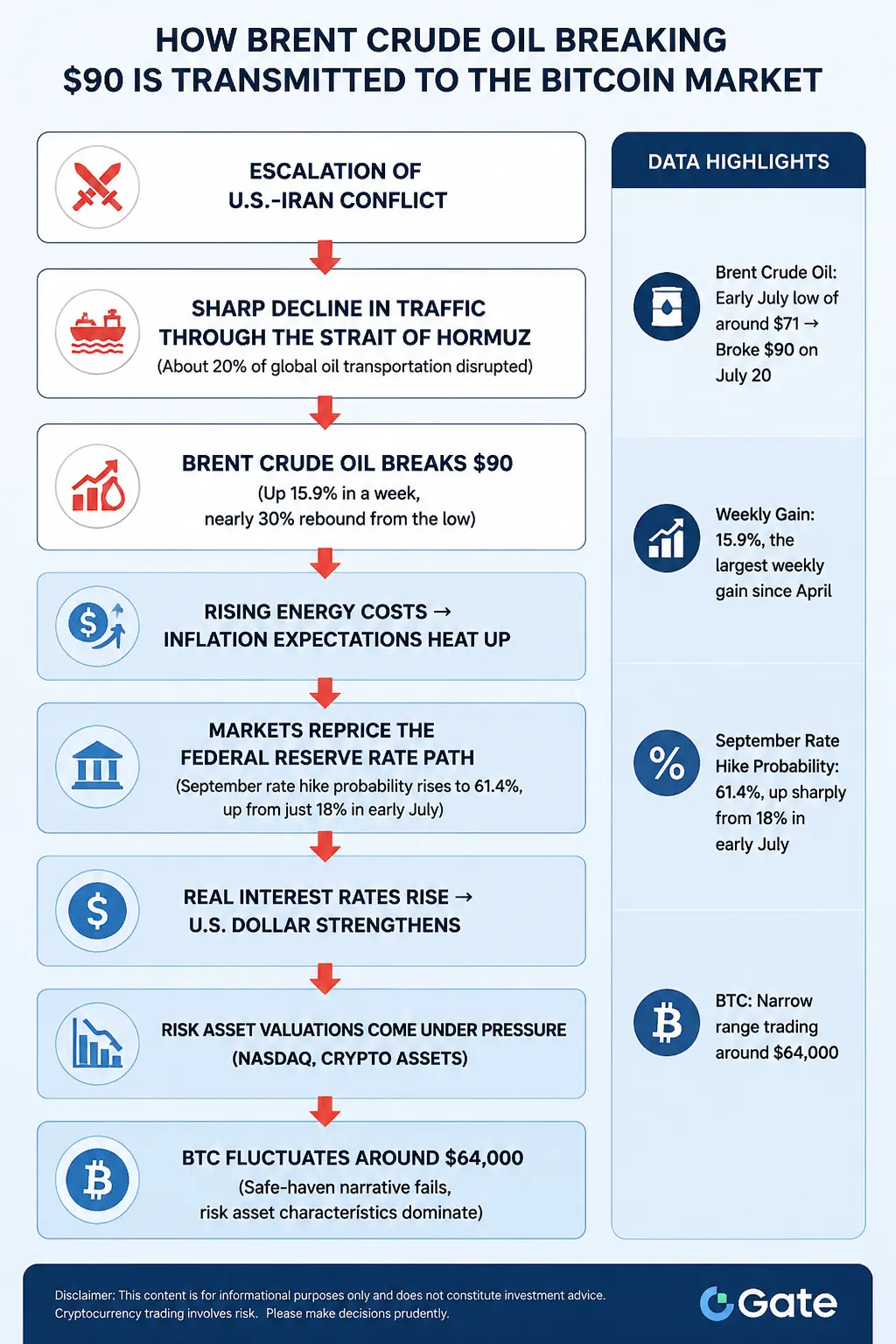
A full chain of logic for how rising oil prices transmit to the Bitcoin market
Why Bitcoin’s “safe-haven narrative” failed in this conflict
This is the most worth digging into question in the current market move. The traditional asset-pricing logic in geopolitical conflicts is usually: war escalates → safe-haven demand → gold and Bitcoin rise. But the market performance in July 2026 provides contrary evidence.
Gold didn’t benefit. Spot gold slid toward the $4,000 level in Asian early trade on July 20. Gold prices in the second quarter fell 14%, the worst quarterly performance since 2013. Inflation-driven rate-hike expectations weakened gold’s appeal as a non-yielding asset.
Bitcoin also failed to play “digital gold.” Despite war escalation and surging geopolitical risk, Bitcoin’s price didn’t get a boost from safe-haven buy orders; instead, it traded in a narrow range around $64,000. CoinDesk’s analysis says the crypto market is weighing two forces pulling against each other: inflation and rate-hike pressure caused by a surge in oil prices (bearish for risk assets), and AI selling triggered by Moonshot AI’s Kimi model (the impact on crypto is more complex). The two forces roughly offset, and no directional breakout formed.
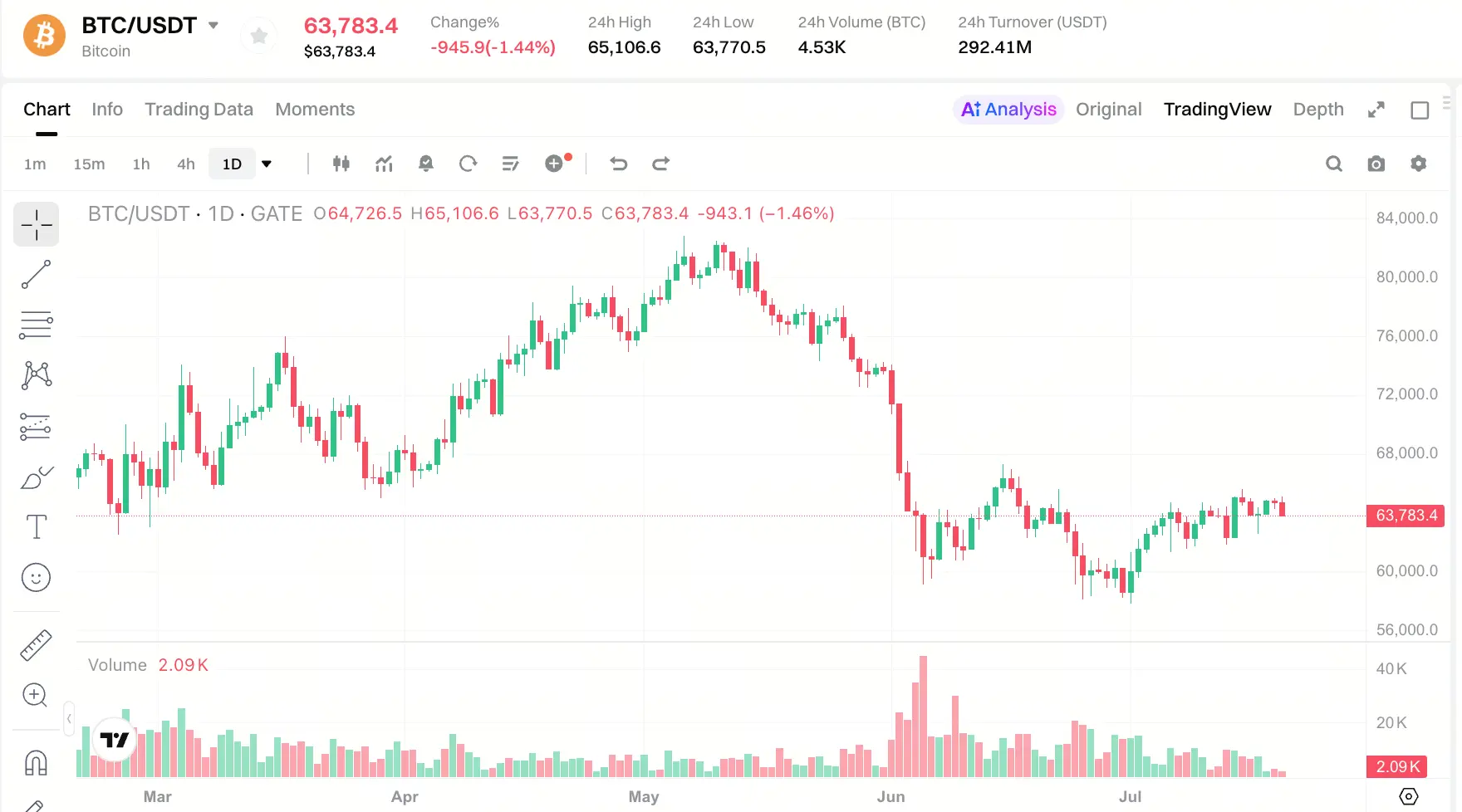
Source: Gate 行情数据
Why didn’t Bitcoin become a safe-haven asset during the war? The answer lies in Bitcoin’s current market structure. Bitcoin’s strengths—non-sovereign characteristics and scarce supply—are a long-term narrative. But in the short term, Bitcoin’s pricing depends more on: the global liquidity environment (rate expectations), ETF inflows and outflows, and overall risk appetite. When rising oil prices trigger stronger rate-hike expectations, tighter liquidity expectations directly suppress Bitcoin’s valuation. In other words, in today’s macro environment, Bitcoin is closer to a “high-volatility risk asset” than “digital gold.”
Fed policy: regaining the title of the biggest macro variable for Bitcoin
In the first half of 2026, the main narrative in crypto markets was “rate cuts → liquidity improvement → BTC higher.” This narrative was built on expectations that inflation would keep easing and that the Fed would turn more dovish. But the breakthrough in oil prices above $90 changes that premise.
The data from July 20 shows that bets on the Fed’s rate hike at its July 28–29 meeting have jumped sharply from the low levels at the start of the month. More importantly, the probability of a rate hike in September is nearing 61.4%—meaning the market not only expects a potential hike in July, but also believes the tightening cycle is far from over.
The newly appointed Fed chair, Kevin Wosch, made a very brief remark at the central bank forum on July 1: “Prices are too high.” This statement aligns with the stance of 9 of the 18 members of the Federal Open Market Committee who expect rates to rise this year. With oil prices continuing to move upward, “rate hikes” are being transformed from a tail risk into a baseline scenario.
For Bitcoin, that means the core macro logic that previously supported price gains is being shaken. If rate-hike expectations strengthen further, a stronger dollar and tighter liquidity will create sustained pressure on crypto assets.
If oil prices keep rising: three scenario forecasts
Scenario A: geopolitical risk eases, oil prices fall. If both sides of the Iran-U.S. conflict restart negotiations, or if the Strait of Hormuz partially restores shipping, oil prices could pull back quickly. Market experience from March this year shows that once signals of negotiation restart are released, the crude futures market could reverse swiftly. In this scenario, inflation pressure declines, rate-cut expectations recover, and Bitcoin is likely to regain upside momentum.
Scenario B: oil prices stay above $90. If the conflict enters a stalemate and shipping through the strait remains blocked, oil prices will trade with high-level volatility. The market will keep pricing in Fed rate hikes, the dollar will remain strong, and risk assets overall will face pressure. Bitcoin could churn within a broad range, and a directional breakout would need a new catalyst.
Scenario C: the Strait of Hormuz closes long-term. This is the most extreme scenario. The global crude supply chain would face a systemic reshuffle, and inflation could evolve into a more persistent cost-push type of inflation. Global risk assets would undergo a full repricing, and Bitcoin could face a liquidity shock in the short term. A Barclays analyst noted that the oil market’s potential impact from inventory shocks is “still too complacent”—current inventories are the tightest in five years.
Historical perspective: asset performance during wartime
Based on historical data, asset performance varies significantly across different geopolitical conflicts.
During the 2022 Russia-Ukraine conflict, both gold and crude oil recorded gains, U.S. stocks fell, and Bitcoin traded sideways, showing no clear safe-haven attribute.
During the Middle East conflicts from 2023 to 2024, gold and crude oil also rose, volatility increased in U.S. stocks, and Bitcoin performed relatively weakly, failing to rise in step with gold.
Entering the Iran-U.S. conflict in July 2026, the market reaction is starkly different: gold fell under pressure, while Brent crude surged sharply and broke above $90; both U.S. stocks and Bitcoin were under pressure. This contrast clearly shows that war does not automatically lift Bitcoin prices—Bitcoin’s performance depends heavily on how the conflict transmits to the global liquidity environment. When conflict pushes up inflation through energy prices and triggers rate-hike expectations, Bitcoin is more likely to bear downside as a risk asset than to play a safe-haven role as “digital gold.”
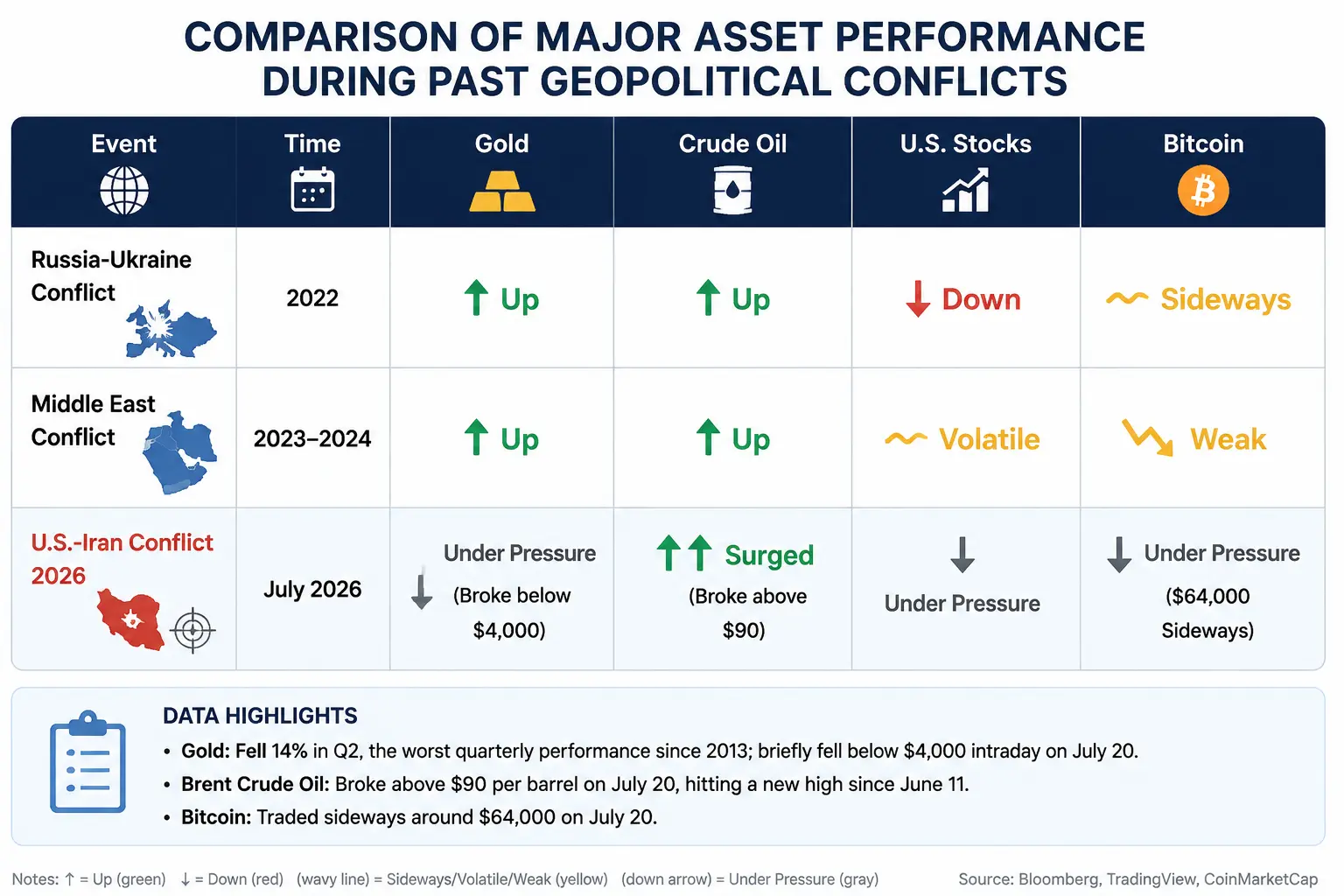
Asset performance comparison across geopolitical conflicts
Historical data reveals a key conclusion: war does not automatically drive Bitcoin higher. Bitcoin’s performance differs across conflicts, depending on how strongly the conflict impacts the global liquidity environment. When conflicts raise inflation through energy prices and trigger tightening expectations, Bitcoin often comes under pressure—this is exactly the story unfolding in July 2026.
FAQ
Q: Why does a rise in oil prices affect Bitcoin prices?
Rising oil prices push up inflation expectations, leading the market to reprice the Fed’s rate path—rate-hike probabilities rise while rate-cut expectations are delayed. Higher rates mean tighter dollar liquidity, pressuring risk-asset valuations; as a high-volatility asset, Bitcoin is hit first.
Q: Why doesn’t Bitcoin become a safe-haven asset like gold?
Gold has thousands of years of historical backing as a safe-haven asset and is also a reserve asset for global central banks. While Bitcoin has advantages of non-sovereign characteristics and scarcity, its short-term pricing depends heavily on liquidity and risk appetite. In an environment where rate-hike expectations are heating up, Bitcoin is closer to a risk asset than a safe-haven asset.
Q: Under what conditions can Bitcoin rise again?
If geopolitical tensions ease and oil prices fall, reducing inflation pressure, and the market once again bets on a rate-cut cycle, Bitcoin could get upside momentum from improved liquidity expectations. In addition, renewed ETF inflows and a rebound in risk appetite are also key variables.
Q: How much does a closure of the Strait of Hormuz affect global energy markets?
The Strait of Hormuz carries about one-fifth of global oil transport. Currently, shipping volume through the strait has dropped to near zero, and the scale of global crude floating storage has fallen sharply. If the blockade continues, the global crude supply cycle would not be able to close, and the market could face an extreme tight-supply situation.