The European Parliament voted on July 9 on the “chat surveillance” transitional rules, with the results: 314 votes against, 276 votes in favor, and 17 abstentions. The transitional rules approved this time remain in effect until April 3, 2028, covering the scope again including Instagram, Discord, Snapchat, Skype, and Xbox DMs, as well as Gmail and iCloud inboxes, which are once again added to the scanning list.
The 47-vote gap: 314 votes against versus 276 in favor—how the veto threshold let the rules pass on technical grounds
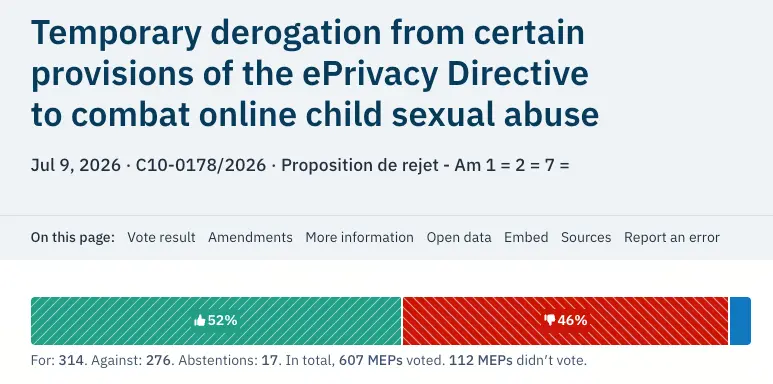 (Source: the European Union How They Vote platform)
According to reports, the European Parliament’s July 9 vote resulted in 314 votes against, 276 votes in favor, and 17 abstentions; under the rules of procedure, an absolute majority of 361 votes is required to veto a law. The opposition received only 314 votes, falling 47 votes short of the threshold.
The European People’s Party (EPP) used an emergency procedure before the vote to put the case back on the agenda, while Chat Control had already been rejected twice earlier this March by the European Parliament.
Former European Parliament member and digital rights activist Patrick Breyer said: “For Chat Control to move forward despite going against the will of the majority of voting members is a farce that harms democracy. The real losers are our children.”
Instagram, Discord, Snapchat, Gmail, and others are re-included on the scanning list
According to reports, the transitional rules approved this time include the following U.S. technology company services on a list that can be scanned “without a court order and without prior suspicion”:
Private message services: Instagram, Discord, Snapchat, Skype, Xbox
Email services: Gmail, iCloud
Expiration: until April 3, 2028, or until the permanent version of the rules is finalized
Exceptions: end-to-end encrypted services (such as WhatsApp) receive a symbolic exemption, but this is an acknowledgment of technical reality rather than a policy concession—service providers have no way to scan end-to-end encrypted content in the first place
European domestic communication and email service providers have never been required to implement Chat Control.
The EU Commission’s own data: 48% of reports lack criminal relevance—indiscriminate scanning does not increase convictions
Based on the European Commission’s own report, the following six sets of figures point to the same conclusion: large-scale scanning does not effectively protect children:
· Since 2022, the number of suspected abuse cases reported from the U.S. has decreased by 50%;
· In 2024, large-scale scanning of private messages accounted for only 36% of all abuse reports, with most leads coming from public posts and cloud storage;
· Germany’s Federal Criminal Police Office (BKA) found that 48% of reports lack criminal relevance;
· In ongoing investigations, 40% of the subjects were minors themselves;
· About 99% of the reports generated by Meta are duplicate hits of “known material,” helping only limitedly to prevent abuse that is currently happening;
· The European Commission acknowledges that there is no evidence showing that indiscriminate scanning increases the number of convictions or saves any additional children.
Chat Control 2.0 negotiations to restart in September—European Parliament demands that scan warrants target specific suspects
According to reports, the transitional rules are only extended to 2028, and negotiations on the permanent “CSAM rules” (Chat Control 2.0) will restart in September 2026. The conditions the European Parliament set for the negotiations include: scan warrants must target genuine suspects (not indiscriminate scanning of the entire population); establish an EU child protection center to take down known material; and require communication software to adopt “Security-by-Design” standards.
Privacy advocate Alexander Hanff noted: “Chat Control was not created to protect children; it’s for large tech companies like Meta and Google to get our data, and for governments to expand large-scale surveillance.”
FAQ
How did the European Parliament’s vote allow chat surveillance to pass when there were more votes against?
According to reports, the July 9 vote results were 314 votes against and 276 in favor—there were more votes against. However, under the rules of procedure, vetoing a law requires an absolute majority of 361 votes. The opposition fell only 47 votes short of the threshold, so the rules passed on procedural and technical grounds.
Which platforms and services are included in the chat surveillance scanning list?
According to reports, the services included are: Instagram, Discord, Snapchat, Skype, and Xbox direct messages, as well as Gmail and iCloud email inboxes. Scanning does not require a court order or prior suspicion; end-to-end encrypted services like WhatsApp receive a symbolic exemption. The rules remain in effect until April 3, 2028.
How does the European Commission’s data assess the effectiveness of indiscriminate scanning?
According to the European Commission’s own report, the data show: 48% of reports lack criminal relevance, 40% of investigation subjects were minors themselves, and about 99% of reports from Meta are duplicate matches of known material; the Commission admits there is no evidence that indiscriminate scanning increases convictions or saves additional children.


